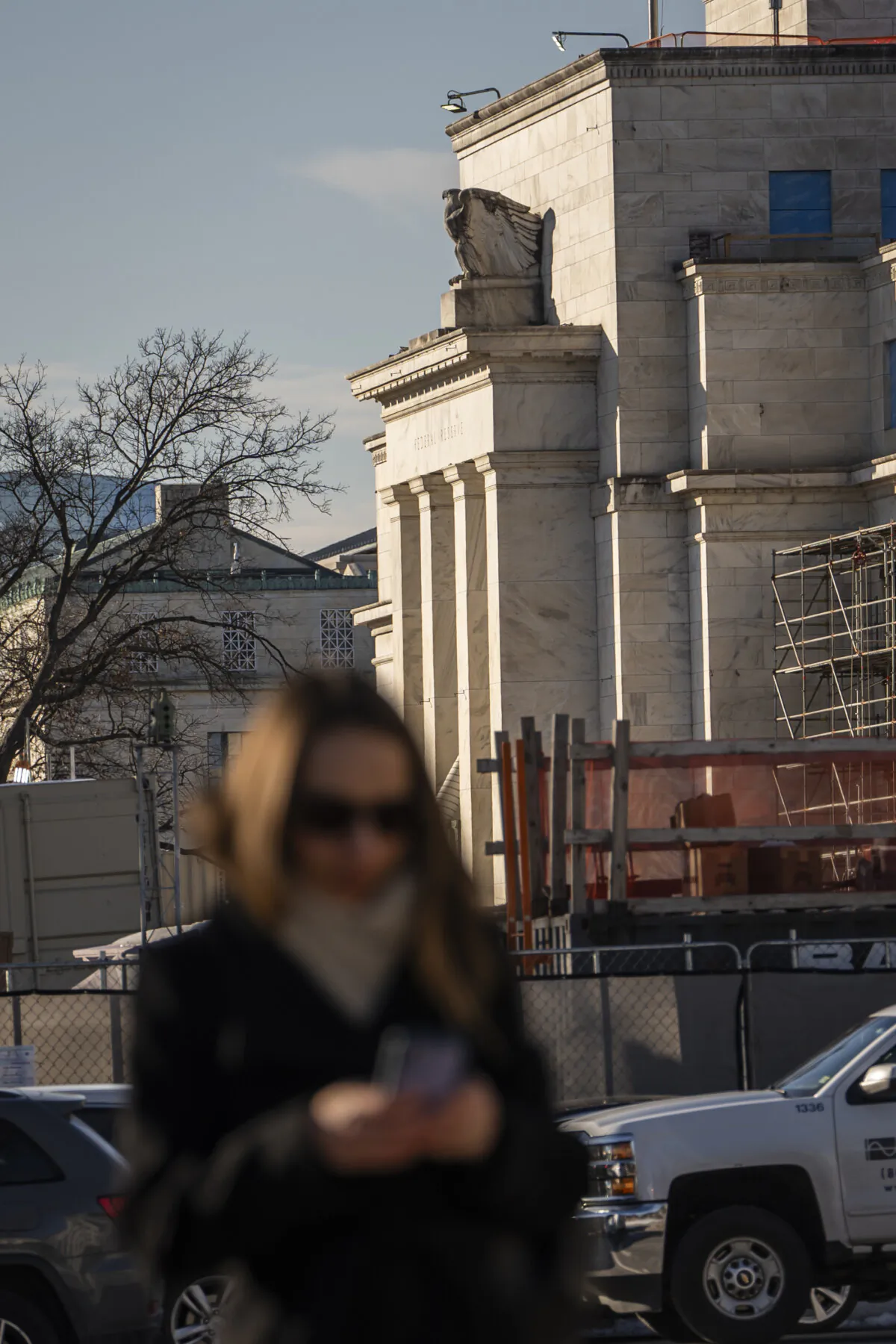

Odds of a July interest rate cut ticked up on June 23, as key Federal Reserve officials signaled support for a reduction next month.
New CME FedWatch Tool data from June 23 suggest that the futures market projects a 21 percent chance of a quarter-point rate cut in July, up from 14 percent a week ago.
Investors overwhelmingly expect the rate-setting Federal Open Market Committee (FOMC) to leave the benchmark federal funds rate—a key policy rate that influences consumer borrowing costs and the federal government’s debt servicing payments—in a range of 4.25 to 4.5 percent.
The slight increase comes as two Fed officials signaled support for a rate cut next month, the first since December.
Speaking at a central bank conference in the Czech Republic, Federal Reserve Vice Chair for Supervision Michelle Bowman said she would vote for a rate cut if inflationary pressures from the Trump administration’s tariffs “remain contained.”
“I would support lowering the policy rate as soon as our next meeting in order to bring it closer to its neutral setting and to sustain a healthy labor market,” Bowman said in a June 23 speech.
Bowman noted that it might take longer for the effects of President Donald Trump’s levies to appear in the hard data. They might also be delayed or have a more minor impact than initially expected, she said.
These remarks mirror those of her colleague, Federal Reserve Gov. Christopher Waller, who thinks the institution can follow through on an interest rate cut “as early as July.”
In an interview with CNBC’s “Squawk Box” on June 20, Waller stated that monetary policymakers may soon conclude that tariff-related inflation is not posing a severe economic threat.
“I think we’re in the position that we could do this as early as July,” he said. “That would be my view, whether the committee would go along with it or not.”
Neither Waller nor Bowman mentioned how much the Fed should cut interest rates next month.
In May, consumer prices rose at a smaller-than-expected pace of 0.1 percent, and the headline annual inflation rate inched higher to a lower-than-expected 2.4 percent.
Price inflation is also not being reflected at the wholesale level or at the nation’s ports.
The producer price index—a measure of prices paid for goods and services by businesses and can serve as a precursor to consumer inflation—jumped 0.1 percent in May, less than expected. Import prices remained flat, while export prices declined by 0.9 percent.
Economists have worried that the president’s changes to immigration and trade policies would open the door to a revival of inflation. However, since the April 2 announcement of sweeping global tariffs, Trump has softened his stance, and his team has engaged in various trade negotiations aimed at lowering tariffs and non-monetary trade barriers.
At the same time, Waller says, the central bank may want to start lowering the policy rate to avoid possible downside risks to the labor market, though there is no need for a dramatic pace of cuts.
“Why do we want to wait until we actually see a crash before we start cutting rates?” he said.
“So I’m all in favor of saying maybe we should start thinking about cutting the policy rate at the next meeting, because we don’t want to wait till the job market tanks before we start cutting the policy rate.”
So far, employment conditions have remained in balance, with the economy adding a stronger-than-expected 139,000 new jobs in May and the unemployment rate holding steady at 4.2 percent.
However, San Francisco Federal Reserve President Mary Daly would prefer to continue waiting for more data, potentially until the fall.
“I think we want to be thoughtful enough to collect the information, and we do have these three scenarios that could unfold,” Daly said in a June 20 interview with CNBC’s “Closing Bell.”
“So I’m for me, I look more to the fall, and by then we’ll have quite a bit more information.”
Trump Wants Rate Cut
These remarks, meanwhile, align with Trump’s view that the Fed should begin cutting rates immediately.
Over the past several weeks, the president has intensified his pressure campaign to urge the Fed to restart its easing cycle.
In a lengthy June 20 post on Truth Social, Trump wrote that Federal Reserve Chair Jerome Powell would help the United States by lowering interest rates by 1 or 2 percent.
“I fully understand that my strong criticism of him makes it more difficult for him to do what he should be doing, lowering Rates, but I’ve tried it all different ways,” the president said. “I’ve been nice, I’ve been neutral, and I’ve been nasty, and nice and neutral didn’t work!”
Despite rhetoric from the White House, market analysts say the Fed is clearly in a wait-and-see mode and will not cut rates until there is more clarity on inflation related to tariffs.
“Effectively they are sitting on their hands, waiting to see if tariffs increase inflation or the jobs market starts to falter, and whichever part of their dual mandate is impacted first will likely guide whichever direction they take, although the bias is still toward cutting rates (or at least keeping rates unchanged; not raising rates),” Chris Zaccarelli, chief investment officer at Northlight Asset Management, wrote in a note emailed to The Epoch Times.
Powell, speaking to reporters at last week’s post-meeting press conference, reiterated that monetary policy is well-positioned to respond to any economic developments. Since conditions remain solid, according to the central bank chief, the monetary authorities can afford to be patient.
The Fed does anticipate lowering rates by the year’s end.
In the updated Summary of Economic Projections—a quarterly survey of policymakers’ expectations for policy and data—officials still expect two quarter-point rate cuts in 2025. However, seven of the 19 Fed policymakers do not expect any rate cuts this year, up from four in the March update.
The next FOMC meeting will take place from July 29 to July 30.
 Friends Read Free
Copy
Facebook
Tweet
Friends Read Free
Copy
Facebook
Tweet