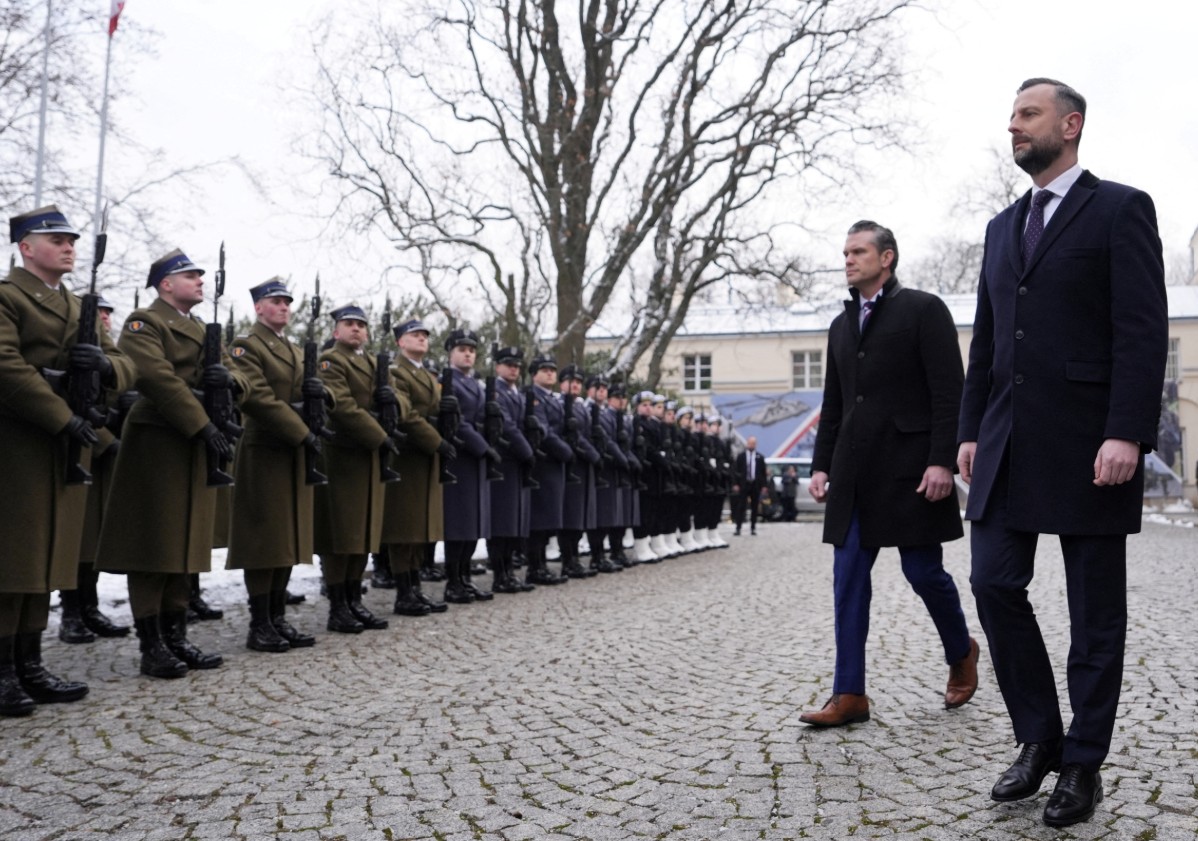

The Pentagon and the Polish defense minister have confirmed that the United States has decided not to go ahead with the temporary deployment of 4,000 extra U.S. troops to Poland, which was linked to the withdrawal of personnel from Germany.
The decision follows the Pentagon’s announcement on May 1 that it would be reducing its military presence in Germany by 5,000 soldiers.
The Army Times originally published an article on May 13, based on anonymous sources, regarding the canceled deployment to Poland, and Politico later claimed U.S. Secretary of War Pete Hegseth made a last-minute decision that caught Pentagon officials by surprise.
But, responding to the Politico article, Chief Pentagon spokesman Sean Parnell posted on X a comment by acting Pentagon press secretary Joel Valdez, who said, “The decision to withdraw troops follows a comprehensive, multilayered process that incorporates perspectives from key leaders in EUCOM [United States Europe Command] and across the chain of command.”
Not ‘Last-Minute Decision’
“This was not an unexpected, last-minute decision, and it would be false to report it as such,” said Valdez.
Polish Defense Minister Władysław Kosiniak-Kamysz said the news did not trouble Warsaw.
“This issue does not concern Poland—it relates to the previously announced change in the presence of some U.S. armed forces in Europe,” Kosiniak-Kamysz posted on X on May 13, referencing the Army Times article. “The rapidly developing capabilities of the Polish armed forces and the presence of U.S. forces in Poland strengthen NATO’s eastern flank.”
German Chancellor Friedrich Merz later said the decision was unconnected to comments he had made about the United States and the Iran conflict.
In a post on X on May 15, the Polish Defense Ministry sought to clarify the situation.
“Trump’s decision was as follows: a reduction of the U.S. contingent in Germany by five thousand soldiers,” Kosiniak-Kamysz said, according to the post.
“Now the implementation of that decision is underway. It does not concern Poland, but it may indirectly influence decisions regarding rotations.
“However, the Polish-American relationship is not rotational; it is enduring. Both the presence and the alliance itself are enduring.
“Everything that stems from our political and military relations indicates that we are dealing with the execution of President Trump’s decision regarding the reduction of the contingent in Germany. Therefore, other brigades may be designated and deployed in Poland.”
The Epoch Times reached out to the Pentagon, which said it had nothing to add to the comments by Valdez.
Sen. Jeanne Shaheen (D-N.H), who sits on the Senate Armed Services Committee, told reporters the decision was a surprise to her.
“As far as I know, we weren’t notified about it,” Shaheen said.
As of late 2025, there were 85,000 U.S. troops in Europe, more than 35,000 of whom were stationed in Germany.
The military presence in Germany dates back to the end of World War II. After the defeat of the Nazis, U.S. troops were occupiers, but later they became guests of the Federal Republic (West Germany), defending it against the Soviet Union and their communist allies in East Germany and the rest of the so-called Warsaw Pact.
In the 1990s, following the collapse of the Soviet Union, NATO expanded into Eastern Europe, which has been viewed with growing suspicion by successive Russian administrations and Russian nationalists.
Poland joined NATO in 1999, followed by the Baltic states—Estonia, Lithuania, and Latvia—in 2004.
In 2008, at a summit in Bucharest, NATO agreed to admit Ukraine, but this was delayed, and in 2014, Russian forces took over Crimea, leading to a disputed referendum and a decision by Russia to annex the territory.
Russia Invaded Non-NATO Member Ukraine
In February 2022, Russia invaded Ukraine, and it now occupies a fifth of the country.
Article 5 of the treaty, which set up NATO, calls for all nations to defend any member nation that comes under attack.
The invasion of Ukraine encouraged Finland and Sweden to join NATO, and spurred most European members of the alliance to increase their defense spending.
In June 2022, at a NATO summit in Madrid, President Joe Biden promised to bolster U.S. forces in Poland.
“In Poland, we’re going to establish a permanent headquarters of the U.S. 5th Army Corps and strengthen NATO interoperability across the entire eastern flank,” he said.
All members of the alliance—with the exception of Spain—agreed in June 2025 to spend 5 percent of gross domestic product on defense and security-related investments by 2035.
Poland is among the biggest spenders on defense in Europe, and earlier this month, Kosiniak-Kamysz said NATO members should bring the 5 percent target forward by five years to 2030.
Reuters contributed to this report.
 Friends Read Free
Copy
Facebook
Tweet
Friends Read Free
Copy
Facebook
Tweet