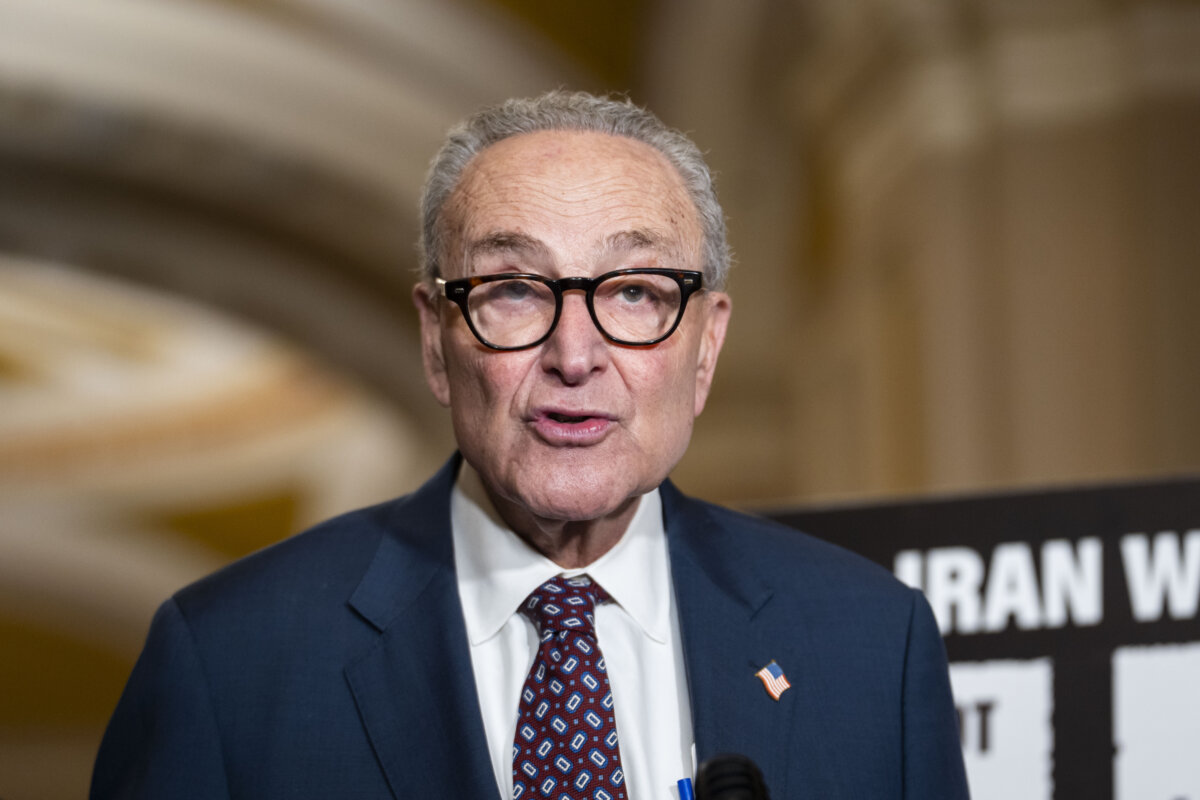

Senate Democrats on June 25 announced a program to train Senate staff as official election observers for the 2026 midterm elections, an effort that Senate Democratic Leader Chuck Schumer (D-N.Y.) and Sen. Alex Padilla (D-Calif.) described as the first of its kind in the chamber.
The Election Observer Program will recruit and train Senate staff to document attempted voter interference, threats against election workers, and what the senators called misinformation and disinformation, both on Election Day and during the postelection canvass and certification process, according to a statement from Schumer’s office. Schumer and Padilla announced the program on a press call on June 25.
The senators framed the program as a response to what they described as efforts by President Donald Trump to undermine confidence in the 2026 elections. Schumer said the observers would serve as “the Senate’s eyes and ears in closely contested races.”
Padilla, the ranking member of the Senate Rules and Administration Committee, said in a statement that he was “committed to using every tool to protect free and fair elections, and the new Senate Election Observer Program will do just that.”
Democrats have pointed in particular to the Safeguard American Voter Eligibility Act, a Republican-backed bill that would require voters to provide documentary proof of citizenship, such as a passport or birth certificate, to register for federal elections, and to an executive order Trump signed in March directing changes to how mail-in and absentee ballots are handled. The bill passed the House but has not passed the Senate, as Majority Leader John Thune (R-S.D.) has repeatedly said he lacks the votes to pass it.
Supporters, including Trump and House Republicans, say the measures are needed to ensure that only U.S. citizens vote and to protect elections against fraud. Democrats and voting rights groups say noncitizen voting is already illegal and rare, and they argue that the proof of citizenship requirement would block eligible citizens who lack ready access to documents, while contending that the mail-voting order exceeds presidential authority.
Federal courts have blocked parts of Trump’s 2025 elections order, and earlier in the day on June 25, Judge Indira Talwani of the U.S. District Court for the District of Massachusetts blocked his March order on mail-in voting, ruling that it exceeded presidential authority over elections. The White House said the order is lawful and that it expects to prevail on appeal.
The Senate program will be nonpartisan and noninterfering, according to Schumer’s statement. Designated observers will not advocate for candidates, count votes, interfere with election officials, handle ballots or election equipment, or seek to influence results, and their role will be to observe, document, and report, it states. Staff may be sent to any state with a Senate race and will receive mandatory training on election administration procedures and election law before Election Day, the statement reads.
The program is modeled on a long-running observer program in the House of Representatives and follows the 2024 passage of the Confirmation of Congressional Observer Access Act. That law, which passed both chambers and was signed by President Joe Biden on Oct. 4, 2024, confirmed the authority of the chairs and ranking members of the House Administration Committee and the Senate Rules and Administration Committee to designate congressional observers.
The House program, overseen by the Administration Committee, deploys congressional staff trained as observers to congressional races, according to the committee. In an October 2024 letter to the National Association of Counties, committee Chairman Rep. Bryan Steil (R-Wis.) and ranking member Rep. Joseph Morelle (D-N.Y.) wrote that observers are typically deployed in bipartisan pairs and that the chamber’s constitutional and statutory authority in the area supersedes state law.
The observer program is part of the Senate Democrats’ Election Protection Task Force, which Schumer and other Democrats launched in April.
Thune’s office did not respond to a request for comment by publication time on whether Senate Republicans plan to establish a similar program.
Jackson Richman contributed to this report.
 Friends Read Free
Copy
Facebook
Tweet
Friends Read Free
Copy
Facebook
Tweet