
Half a dozen senior Senate Democrats urged President Donald Trump to reverse a decision allowing U.S. chipmakers Nvidia and AMD to sell advanced artificial intelligence (AI) chips to China in exchange for a 15 percent government fee, warning the arrangement could undermine U.S. national security and violate export control laws.
In an open letter dated Aug. 15, Senate Minority Leader Chuck Schumer (D‑N.Y.), and Sens. Mark Warner (D‑Va.), Elizabeth Warren (D‑Mass.), Jack Reed (D‑R.I.), Jeanne Shaheen (D‑N.H.), and Chris Coons (D‑Del.) said the decision trades away U.S. technological leadership for what amounts to a “commission” on sensitive technology sales to a strategic competitor.
They also questioned the legality of the deal, citing federal export control laws that prohibit charging fees for licensing or authorization.
“This ‘negotiated deal,’ allowing American semiconductor manufacturers to pay a 15 percent fee for the ability to sell critically sensitive technology to our adversary, blatantly violates the purpose of export control laws,” the senators wrote, requesting detailed information by Aug. 22 about how the deal was made, how fees will be collected and used, and whether similar arrangements are planned for other exports.
The Biden administration imposed strict export controls to limit the sale of advanced AI chips—such as Nvidia’s H100 and H200 and AMD’s highest-end GPUs—to China due to national security concerns.
However, it also established technical performance thresholds that allowed the export of specially designed, lower-performing chips like Nvidia’s H20 and AMD’s MI308. During the Biden era, Nvidia and AMD intentionally downgraded the chips to remain within permitted limits so that they could be exported without individual licenses.
In April 2025, the Trump administration further tightened the Biden administration’s controls by halting exports of the H20 and MI308 to China, citing concerns that the technology could be used to advance China’s military capabilities, including hypersonic weapons, surveillance systems, and battlefield AI.
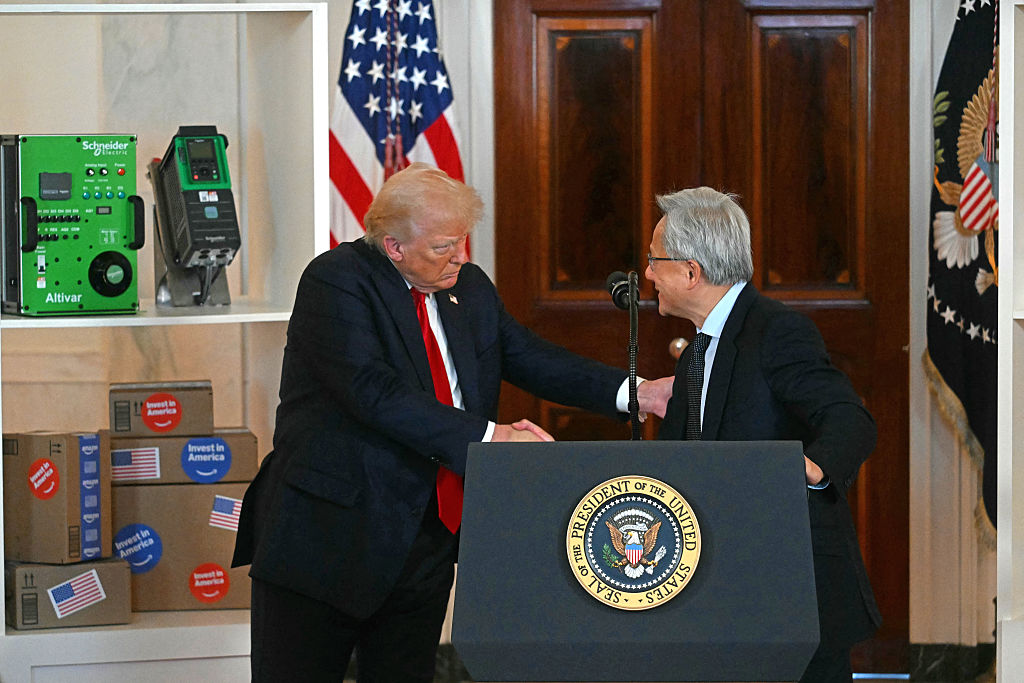
However, on Aug. 11, Trump announced that the companies could resume exporting to China if they agreed to pay a 15 percent fee to the U.S. government. He said this figure was negotiated down from an initial demand of 20 percent following industry lobbying.
Nvidia had argued that the H20 chip was specifically designed for the Chinese market and lacks the performance needed for military use. The company said the chip is not intended for defense or government infrastructure and does not pose a national security risk. Nvidia also warned that stringent export restrictions could harm U.S. interests by accelerating the growth of Chinese rivals, such as Huawei, and preventing U.S. firms from participating in the world’s largest semiconductor market.
Despite the Trump administration’s decision to permit chip sales to resume, Chinese authorities have not fully welcomed Nvidia’s return. Chinese regulators have expressed concerns that the H20 chips could contain location-tracking or remote shutdown functions controlled by the United States, which could pose national security risks.
Chinese regulators have issued formal notices to state-owned and private firms asking why they are purchasing Nvidia’s H20 chips instead of domestic alternatives. The notices also ask whether such purchases are necessary and whether any security vulnerabilities have been identified in the Nvidia hardware.
 Friends Read Free
Copy
Facebook
Tweet
Friends Read Free
Copy
Facebook
Tweet