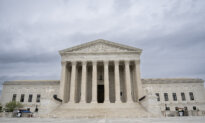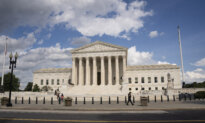

The Supreme Court has allowed the Department of Homeland Security’s (DHS’s) attempt to remove deportation protections for nationals of Haiti and Syria.
In a 6–3 decision on June 25, a majority of the court said federal law barred judicial review of certain legal arguments against the department’s determinations for temporary protected status.
Their decision focused on a portion of the Immigration and Nationality Act that states, “There is no judicial review of any determination of the [DHS Secretary] with respect to the designation, or termination or extension of a designation, of a foreign state under this subsection.”
Lower courts had blocked the department’s decisions, holding that the administration didn’t follow the proper procedures for revoking protected status. One judge in Washington also said the department’s revocation of Haitians’ protected status was motivated by racial discrimination and likely violated the Constitution.
The Supreme Court held on June 25 that judges could review constitutional arguments like those, but that the one leveled in this case would likely fail.
Justice Samuel Alito wrote the majority opinion while Justice Elena Kagan penned a dissent that was joined by Justices Ketanji Brown Jackson and Sonia Sotomayor.
“Citing statements made by President Trump and former Secretary of Homeland Security Kristi Noem, one set of respondents advances an equal protection claim that Haiti’s TPS [Temporary Protected Status] designation was terminated because of the racial makeup of that country’s population,” Alito wrote.
“But, ironically, one of respondents’ other arguments undermines the equal protection claim by offering a strong, race-neutral explanation for Haiti’s termination: namely, that the current administration, which has terminated every TPS designation that has come up for renewal, simply opposes the TPS program, at least as it has been implemented in the past.”
The decision is expected to affect thousands of Haitians and Syrians who received temporary protected status.
Kagan’s dissent argued that the majority misinterpreted how far Congress had gone in blocking judicial review of the department’s decisions.
“[The law’s] judicial-review bar applies not to everything the Secretary does under the law,” she said.
She said the department failed to follow a requirement that it consult with other agencies before revoking protections.
“The law prevents the program from ending as it likely did here—without the required consultations about country conditions and, as to Haiti, with impermissible race-based considerations tainting the decision,” she said, saying that the plaintiffs were entitled to stay in the country while litigation proceeded.
“For all the reasons given, they are entitled to that relief, and should not instead be consigned to devastating, and indeed life-threatening, injury.”
The decision came in response to two cases—Mullin v. Doe and Trump v. Miot—that were consolidated for oral argument. The first focused on protected status for Syrians, while the latter focused on Haitians.
 Friends Read Free
Copy
Facebook
Tweet
Friends Read Free
Copy
Facebook
Tweet