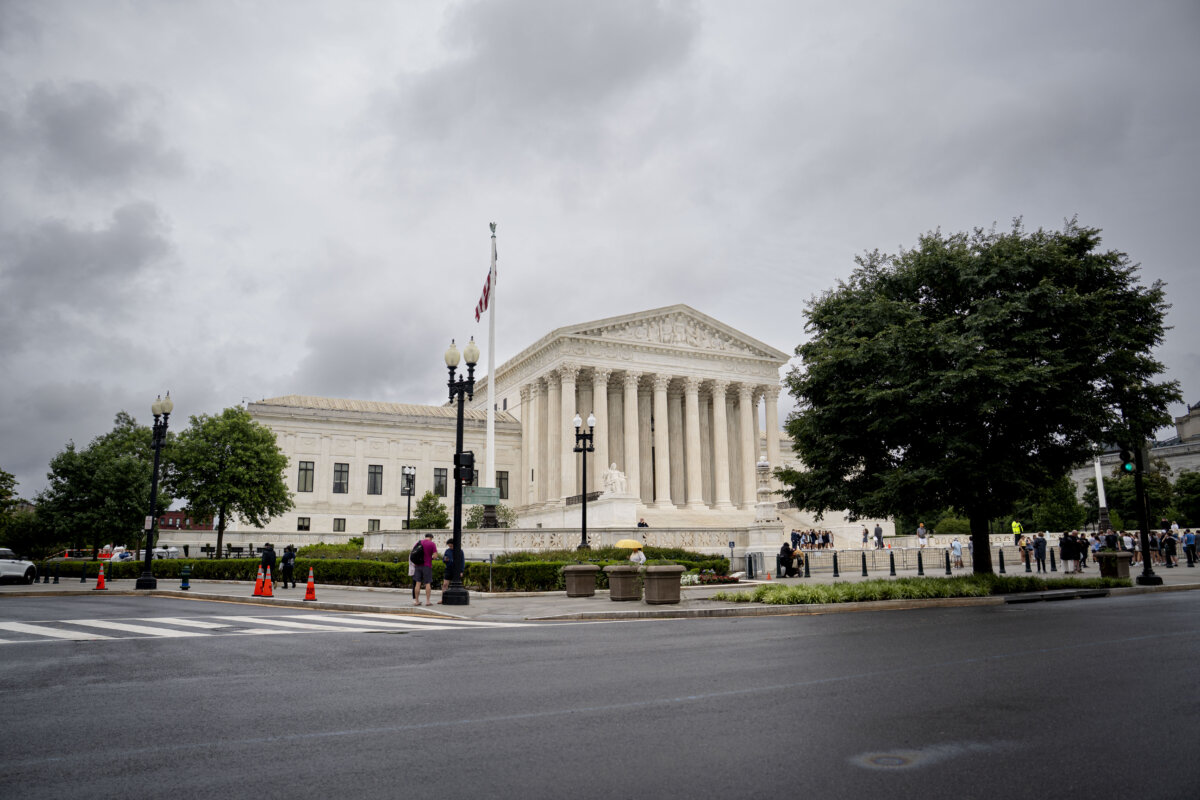


The U.S. Supreme Court voted 6–3 on June 25 to strike down a Hawaii gun law that banned residents from carrying concealed weapons in privately owned public places, such as gas stations and shopping malls, without permission from the owners.
The majority opinion in Wolford v. Lopez was authored by Justice Samuel Alito.
Justices Elena Kagan, Ketanji Brown Jackson, and Sonia Sotomayor dissented in the case, which was closely watched by gun rights advocates.
Alito said the Second Amendment “has the same meaning in all parts of the United States.”
“It cannot give way to ‘the spirit of Aloha’ in Hawaii … any more than it can yield to the spirit of the Big Apple … or the Windy City,” he said.
“It applies in the same way to our 50th State (where about 8 [percent] of adults possess guns) and our 49th State (where the figure is roughly 59 [percent]).
“Merely local attitudes can neither shrink nor inflate the meaning of fundamental Bill of Rights guarantees that apply to the States through the Fourteenth Amendment.”
Over the years, the court has invoked the so-called doctrine of incorporation to apply the constitutional protections of the Bill of Rights—the first 10 amendments to the Constitution—to the states. Initially, the Bill of Rights was understood to apply only to the federal government.
Alito said the state law “departs sharply from the standard common-law rule on access to private property held open to the public,” under which everyone, including lawful carriers of firearms, may enter unless specifically forbidden to do so.
The Hawaii law “hobbles what the Second Amendment protects,” preventing everyone from carrying a gun without express consent by the property owner, while it imposes “severe restrictions on the daily activities of residents who have satisfied the State’s rigorous requirements for the issuance of a carry permit.”
“When these permit holders leave home in the morning, not only must they take care to avoid all the territory where the possession of a gun is prohibited outright, but they may also be barred from entering many places that people routinely visit,” Alito said.
Justice Amy Coney Barrett filed a concurring opinion, saying that according to Hawaii’s logic, if a state made it a crime to wear religious head garb, such as a hijab, on private property open to the public, that law could “evade constitutional scrutiny” because the state “has merely adjusted the default to require permission to be clear.”
That is “plainly wrong,” she said.
“Property laws, no less than other laws, are subject to constitutional limits. So when a property law ‘restrict[s]’ the bearing of arms, the State must prove that the law abides by the limits of the Second Amendment,” Barrett said.
In her dissenting opinion, which Sotomayor joined, Jackson said the majority holds that the Hawaii law “is a blatant attempt to end-run our Second Amendment precedents.
“But the statute at issue does no such thing. Instead, it fairly applies a first principle of property law—the right to exclude—and does no harm to the Second Amendment.”
With this new decision, the Supreme Court “has now manipulated Bruen into a free-for-all that lets the Judiciary thwart the will of legislatures by privileging access to firearms above all else. Today’s decision makes one thing clear: The Court’s objective is protecting guns, not consistently preserving any principle of law.”
Jackson was referencing New York State Rifle and Pistol Association v. Bruen (2022), which held that the Second Amendment protects the right to carry firearms in public for self-defense.
Hawaii’s Act 52 banned handguns on private property unless the permit holder had received “express authorization to carry a firearm on the property by the owner, lessee, operator, or manager of the property.”
It also banned firearms in bars, beaches, parks, and “sensitive places” such as hospitals, schools, and government buildings.
The law placed the onus on private property owners who wish to allow concealed carry on their property to communicate their policy to the public.
The state calls the rule requiring express authorization to carry the “default rule,” but critics call it the “vampire rule,” naming it after the mythical creatures that need permission to enter a property, Second Amendment expert Cam Edwards previously told The Epoch Times.
When the U.S. Court of Appeals for the Ninth Circuit reviewed the Hawaii law, it said the restrictions fell “well within the historical tradition,” a reference to the history-based legal test the Supreme Court adopted in Bruen.
The appeals court had upheld the state law, pointing to a New Jersey anti-poaching law from 1771 and a Louisiana law from 1865 that it said were “dead ringers” for Hawaii’s restrictions.
Earlier in the litigation, a federal district judge blocked the law, but the Ninth Circuit largely reversed that decision. In a 2–1 vote, the appeals court allowed Hawaii to enforce much of the law because, in its view, Act 52 was consistent with Bruen, which recognized a “sensitive places” exception to the right to bear arms in public.
At the oral argument on Jan. 20, Hawaii argued that the state statute protects private property rights and the public, while those challenging the law contended that it violates their constitutionally protected right to carry guns in public to defend themselves.
The case was brought by three Hawaii gun permit holders and the Hawaii Firearms Coalition, a gun rights organization, alleging that the state violated the right to bear arms.
John Commerford, executive director of the National Rifle Association Institute for Legislative Action (NRA-ILA), hailed the new ruling as “a major victory for the Second Amendment.”
“Law-abiding gun owners will no longer be forced to beg for special permission simply to exercise their constitutional right to bear arms in public places,” he told The Epoch Times.
Global Action on Gun Violence president Jonathan Lowy praised Jackson’s dissent, saying the justice “is fast establishing herself as the voice of sanity, reason, and principle in Second Amendment cases.”
“The Court’s history test is unworkable, unwise, and not actually about history,” he told The Epoch Times.
“The Court is picking and choosing from the historical record to elevate gun rights over property rights, over state rights, and ultimately, over our paramount right to live,” Lowy added.
The Supreme Court reversed the judgment of the Ninth Circuit, sending the case back to that court for “further proceedings consistent with this opinion.”
 Friends Read Free
Copy
Facebook
Tweet
Friends Read Free
Copy
Facebook
Tweet