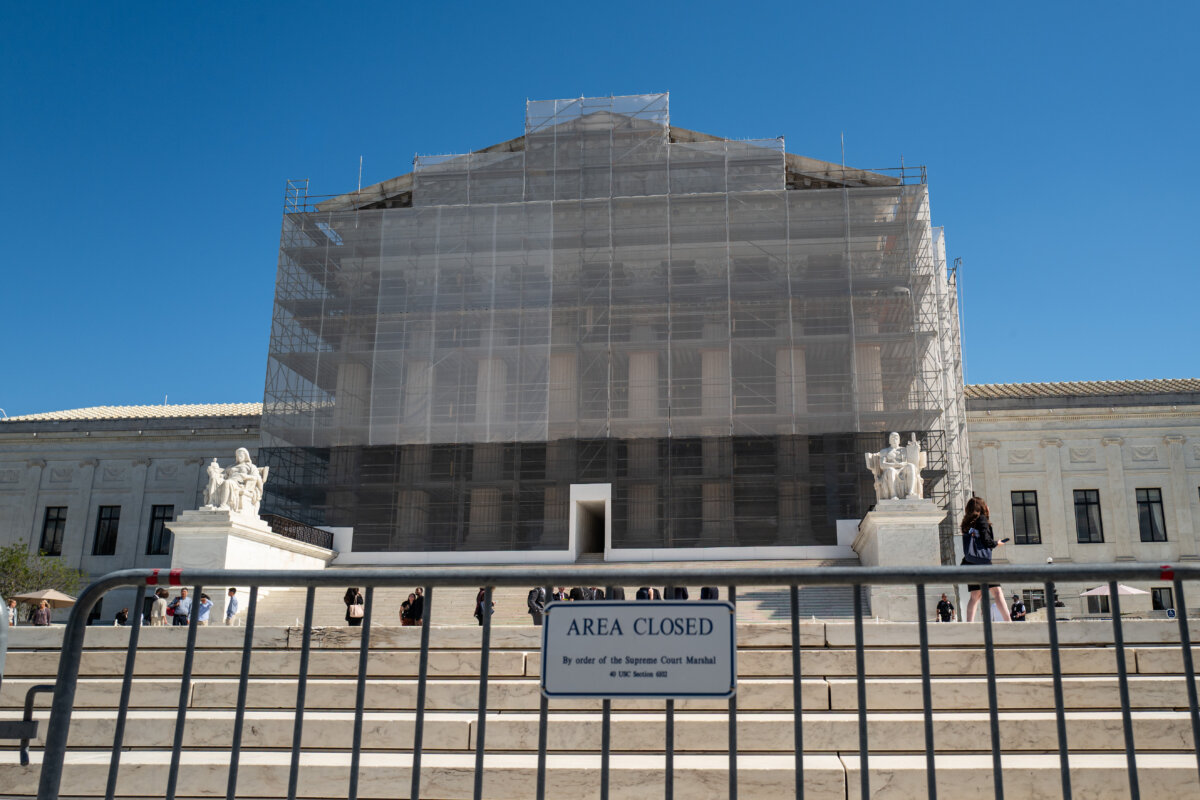
WASHINGTON—The U.S. Supreme Court seems poised to rule against Colorado’s law banning so-called conversion therapy for LGBT youth.
During a hearing on Oct. 7, several justices appeared sympathetic to a therapist’s challenge to the ban on the grounds that it violates her First Amendment rights to free speech. Lower courts had ruled that the law regulates a therapist’s conduct, finding that any infringement on her speech was incidental.
Colorado’s Prohibit Conversion Therapy for a Minor Law was enacted in 2019, and bans licensed therapists from trying to “change an individual’s sexual orientation, including efforts to change behaviors or gender expressions, or to eliminate or reduce sexual or romantic attraction or feelings toward individuals of the same sex.”
Violators of the law face fines up to $5,000.
Colorado therapist Kaley Chiles sued to overturn that law in 2022, on the grounds that it violated her First Amendment free speech rights.
Colorado Solicitor General Shannon Stevenson, arguing on behalf of the state, said on Oct. 7 that such therapy is harmful and that states have a right to ban it.
“People have been trying to do conversion therapy for a hundred years, with no record of success,” she said.
“There is no study—despite the fact that people tried to advance this practice—that has ever shown that it has any chance of being efficacious.”
Justice Clarence Thomas asked: If Chiles were not a therapist, would her speech be protected by the First Amendment?
Stevenson said yes, noting that the law contains an exemption for religious ministers engaging in such practices. The difference, she said, comes from Chiles being a licensed therapist, which means the state has a duty to regulate her conduct.
Justice Neil Gorsuch also presented Stevenson with a hypothetical: Noting that homosexuality was considered a mental illness until the 1970s, he asked whether a state back then could have legally barred therapists from affirming a patient in their same-sex attraction.
Stevenson said yes.
James Campbell, chief legal counsel of Alliance Defending Freedom, which is representing Chiles, said the state law was an example of “viewpoint discrimination.”
Campbell said the law should be subjected to what is known as “heightened scrutiny,” which requires the state to show the law serves a compelling governmental interest, and uses the least restrictive means.
“Here, Colorado can’t satisfy any level of heightened scrutiny,” Campbell told the justices.
“It didn’t seriously consider any less restrictive alternatives. And Colorado can’t prove harm because it hasn’t cited a study focusing on what’s at issue here: voluntary speech between a licensed professional and a minor.”
Lower courts had used a less strict standard when examining the law.
Justices Ketanji Brown Jackson and Sonya Sotomayor suggested that perhaps the case should be remanded back to lower courts for reconsideration—under heightened scrutiny.
Campbell rejected that idea, saying that Chiles and her clients were suffering “irreparable harm.”
Colorado’s law would allow a 12-year-old to receive therapy affirming a transgender identity, he said, but would not allow a therapist to try to help change that identity to match the person’s biological sex, even if the client wanted to do so.
In the petition to the court, Campbell also cited studies that found 98 percent of youth experiencing gender dysphoria before puberty eventually realign themselves to match their biology—but said that Colorado’s law would not allow them to seek help from a licensed therapist to do so.
Sotomayor questioned, at first, whether Chiles had “standing,” or the right to sue. She said the case was “unusual,” because Colorado had not tried to enforce the law since it was enacted, while she said “the entity charged with administering the law”—the state—had asserted that the legislation did not apply to Chiles’s work.
However, Gorsuch later asked Stevenson whether a therapist working to change a youth’s “identity” would run afoul of Colorado’s law, and she agreed it would.
“Okay, so that settles the standing question,” Sotomayor said.
More than 20 states, including Colorado, have laws prohibiting conversion therapy for minors. Five states have laws or rulings that bar local officials from making the therapy illegal.
 Friends Read Free
Copy
Facebook
Tweet
Friends Read Free
Copy
Facebook
Tweet