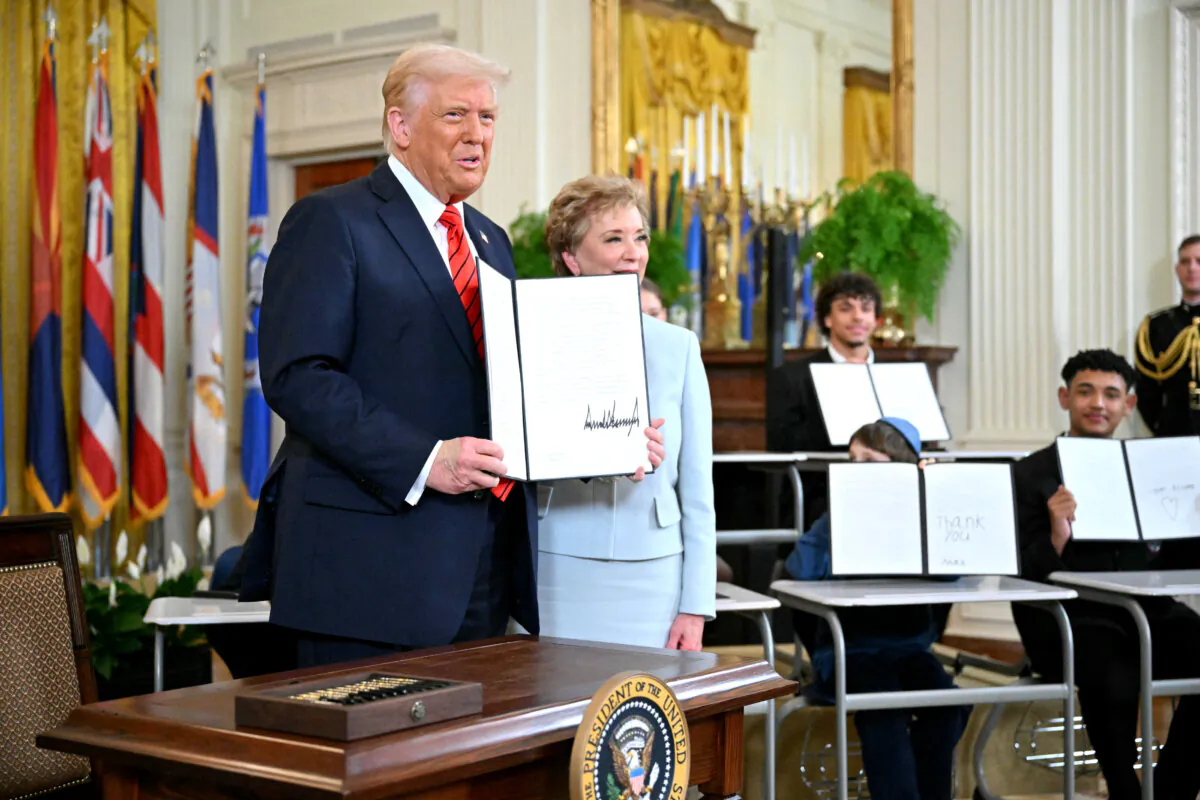

It has been nine months since President Donald Trump signed his executive order to dismantle the Education Department, something other U.S. leaders have called for but never attempted.
Trump has acknowledged that only Congress can completely eliminate the department. Instead, his plan is to press ahead and dismantle it by moving its functions to other agencies and leaving just a Cabinet secretary in place as the sole employee, along with a physical location, before any legislative vote.
The plans for dismantling the department were revealed in more detail on Nov. 18 by Education Secretary Linda McMahon.
Although critics argue that local schools will be shortchanged because of the federal cuts, McMahon maintains that funding from the department is not being eliminated; rather, according to her, it is just being streamlined so money otherwise spent on the bureaucracy makes it directly to classrooms.
Here is a closer look at what is happening with the dismantling of the department.
Transferring Responsibility
Under the plan announced on Nov. 18, federal grant administration for K–12 schools and universities, including workforce development initiatives but not student loans, will be moved to the Labor Department.
In addition to money for low-income and special needs students, this function also earmarks grants for rural school programs, homeless youth, neglected and at-risk children, charter schools, and arts education, according to a Nov. 18 fact sheet issued by the Education Department.
McMahon, during a Nov. 20 White House news briefing, said the Labor Department’s system for grant administration is far more efficient and technologically advanced than what her agency has used, so she expects that the move will only make the federal grant process more efficient.
The Interior Department will take over education programs that serve tribal schools serving Native American students.
The Health and Human Services Department will head the accreditation process for foreign medical schools and federally funded child programs serving parents enrolled in colleges. The agency already oversees Head Start, the largest federal child care program, which makes the agency “better positioned to ensure efficient delivery of childcare services to low-income students enrolled in postsecondary education,” the fact sheet states.
The State Department will now oversee international education and foreign language programs, including the Fulbright-Hays scholarships for research in other countries.
There will be more scrutiny in order to preserve the core mission of these programs. Grants awarded under President Joe Biden’s administration included a $70,000 award for a doctoral student to create an interactive map identifying “queer” and transgender communities in Czechia and Slovakia, as well as $34,000 for a study on how queer and transgender artists in other nations are reshaping contemporary Thai Buddhism, the fact sheet reads.
Under this consolidated program management, data collection measures will be more efficient and national security interests will be advanced, Sarah Rogers, State Department undersecretary, said in the Nov. 18 release.
“With its unmatched global reach and deep public diplomacy expertise, the State Department will strengthen and streamline these programs while equipping American students and professionals with skills that are critical to our national interests,” she said.
What Remains
McMahon previously said that special education functions could be absorbed by Health and Human Services, student loans by the Small Business Administration, and civil rights by the Justice Department, but those moves have yet to happen.
During a Nov. 18 media call, a senior Education Department official said moving the Office for Civil Rights has been discussed lately, with options still being explored.
It has also been suggested that higher education financial aid functions could be moved to the Treasury Department and that the Census Bureau within the Commerce Department could take over data and information services currently provided by the National Center for Education Statistics and the Institute of Education Sciences.
Opposition
The National Education Association teachers union issued a statement calling the moves “illegal, cruel, and shameful.”
“Not only do they want to starve and steal from our students—they want to rob them of their futures,” Becky Pringle, the organization’s president, said in the Nov. 18 statement.
“Nothing is more important than the success of our students, and America’s educators and parents will not be silent as Trump and Linda McMahon turn their backs on our students, families, and communities to pay for billionaire tax cuts.”
Democrats echoed those sentiments during a Nov. 19 House subcommittee meeting on career and technical education, calling these functions transfers dangerous and unprecedented.
Rep. Suzanne Bonamici (D-Ore.) said moving career and technical education functions to the Labor Department forces schools to deal with a state agency and a federal agency that have two different purposes instead of one. She called it a “hyper-partisan move that threatens to stifle innovation.”
Rep. Summer Lee (D-Pa.) said that without the oversight of a federal education department, many school districts and states will track black and Hispanic students into “devalued professions” such as hospitality and tourism.
“One of the reasons the Department of Education exists is to help states and schools address their educational inequities,” she said.
What Is Next
Education Department officials have yet to disclose how much money these moves will save taxpayers, when the moves will be in effect, and whether there will be additional layoffs. They indicated that more interagency transfer agreements may be forthcoming.
Lawsuits against this administration by the teachers unions or Democratic state leaders have been commonplace, including cases in which federal funding was halted or denied because of diversity, equity, and inclusion issues prohibited by Trump’s executive orders and existing civil rights laws.
As for the layoffs, federal courts have ruled in favor of the Trump administration.
Whether opponents challenge Trump’s authority to move money and staff between federal agencies remains to be seen.
Although Democrats argue that the dismantling of the Education Department is unprecedented, the Economy Act that allows the executive branch to move functions from one federal agency to another is not. The senior official said it has been applied at least 200 times in the past, including by Biden.
In 2022, for example, the Federal Bureau of Prisons within the Justice Department signed an interagency agreement permitting the Labor Department to administer grants for the First Step Act criminal justice reform program, according to the fact sheet.
McMahon, meanwhile, plans to visit all types of schools, public and private, in every state. She has visited 14 states so far and said a “best practices tool” based on notable improvements championed by states and local school districts will be produced and made available to the public when the tour concludes.
“These are innovations that are done at the state level,” she said during a Nov. 20 White House news briefing. “It’s nothing [the federal government is] dictating.”
 Friends Read Free
Copy
Facebook
Tweet
Friends Read Free
Copy
Facebook
Tweet