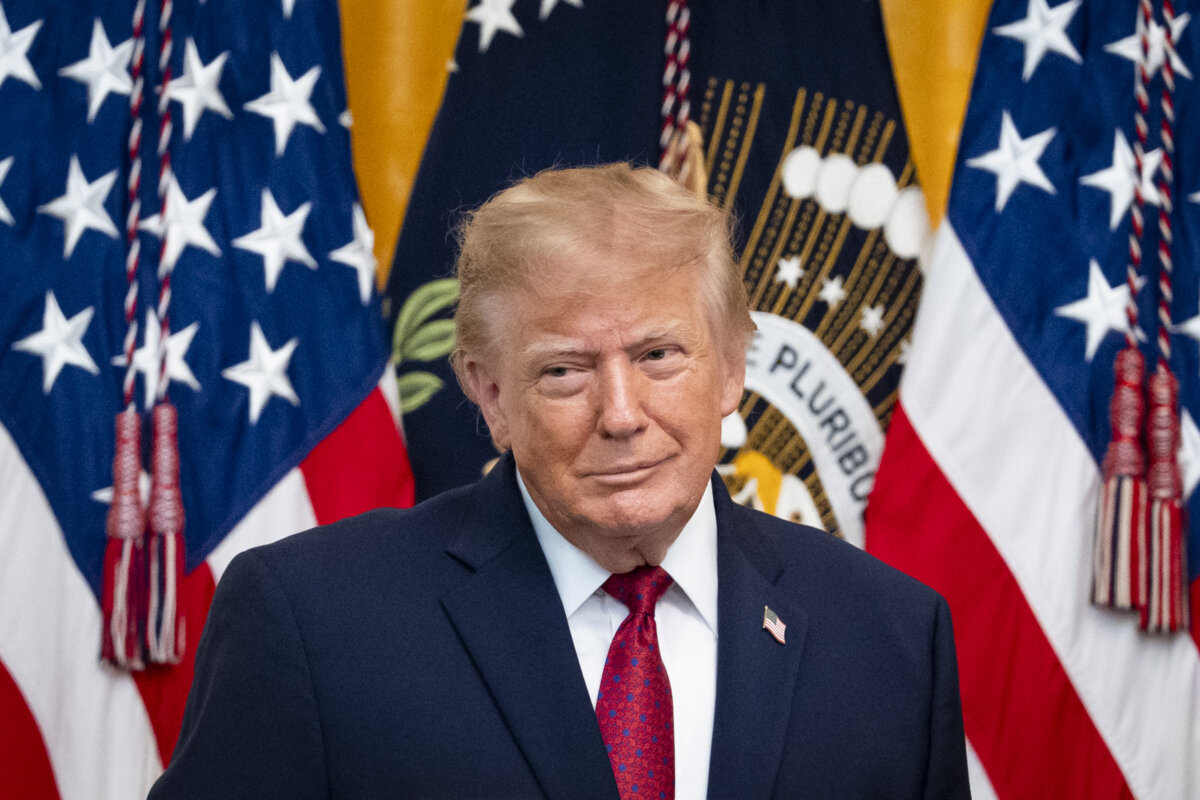

President Donald Trump on Oct. 4 announced the creation of the Super Intelligence Force to coordinate federal efforts to maintain U.S. leadership in artificial intelligence.
The group will engage with the public, various organizations, critical infrastructure providers, and technology companies, and more, Trump said in a Truth Social post.
Director of National Intelligence Jay Clayton, Chairman of the Federal Trade Commission Andrew Ferguson, Pentagon Chief Technology Officer Emil Michael, and Director of the Office of Personnel Management Scott Kupor will lead it, reporting to Trump and White House chief of staff Susie Wiles, Trump said in his post.
Trump has officially changed the U.S. government’s branding of artificial intelligence so that it is referred to as “super intelligence.”
“The Super Intelligence Force is tasked with coordinating the effort of the Federal Government to ensure that America continues to lead the World in Super Intelligence, which many say is bigger than the Industrial Revolution, and the Internet, and will protect the interests, and improve the lives, of all Americans,” Trump wrote in his post.
Trump and technology industry leaders signed a voluntary agreement on artificial intelligence safety standards after a Sept. 29 meeting at the White House.
The policy calls for companies to develop their technology safely and establish internal controls while using external auditors and evaluators. The tech leaders also agreed to have their boards independently review audit reports. The tech giants agreed to meet regularly to establish safety standards and share best practices.
Trump has favored industry self-regulation over government oversight, saying federal law enforcement agencies could address “bad actors” while companies monitor their own systems.
Meta CEO Mark Zuckerberg described the agreement as a starting point for industry cooperation on safety. Anthropic CEO Dario Amodei said the technology poses risks and that how to address them is being considered.
Amodei, Zuckerberg, OpenAI President Greg Brockman, SpaceX CEO Elon Musk, and Nvidia President and CEO Jensen Huang were among the tech leaders who attended the Sept. 29 meeting.
House Speaker Mike Johnson (R-La.) opposed a moratorium on AI development, warning that halting American progress would only allow China to overtake the United States in developing AI.
Trump signed a Sept. 29 executive order directing federal agencies to replace “artificial intelligence” and “AI” with “super intelligence” and “SI” in official correspondence.
The order does not require changes to previously issued regulations or previously published documents.
The order also gives the president’s science and technology adviser 60 days to propose legislative language establishing a federal definition of “super intelligence,” assess potential changes to existing law, and recommend further executive action.
OpenAI decided against an initial public offering this year as it focuses on addressing potentially catastrophic AI risks, CEO Sam Altman said Sept. 13.
Altman questioned how estimates that AI would cause human extinction could be calculated but said the potential danger requires companies and governments to act responsibly. He also suggested leading AI companies could be nearing an agreement to slow development and cooperate on safety.
Anthropic CEO Dario Amodei urged companies to slow improvements in AI capabilities, while Sen. Bernie Sanders (I-Vt.) said he would bring AI safety experts to Capitol Hill to brief lawmakers from both parties.
Rep. Greg Casar (D-Texas) posted on X on Oct. 3 about his concerns with the AI accord.
“This week, the most powerful AI companies on Earth signed a pledge with Trump to regulate themselves,” Casar said on X. “It’s one page. It’s voluntary. It has no penalties. @SenSanders and I have a bill that is binding, to put a real watchdog on AI. Not a pinky promise.”
Jacob Burg contributed to this article.
 Friends Read Free
Copy
Facebook
Tweet
Friends Read Free
Copy
Facebook
Tweet