
President Donald Trump on Jan. 22 said that a new bruise on his hand was partly due to his high aspirin intake, saying the medication has made him prone to bruising.
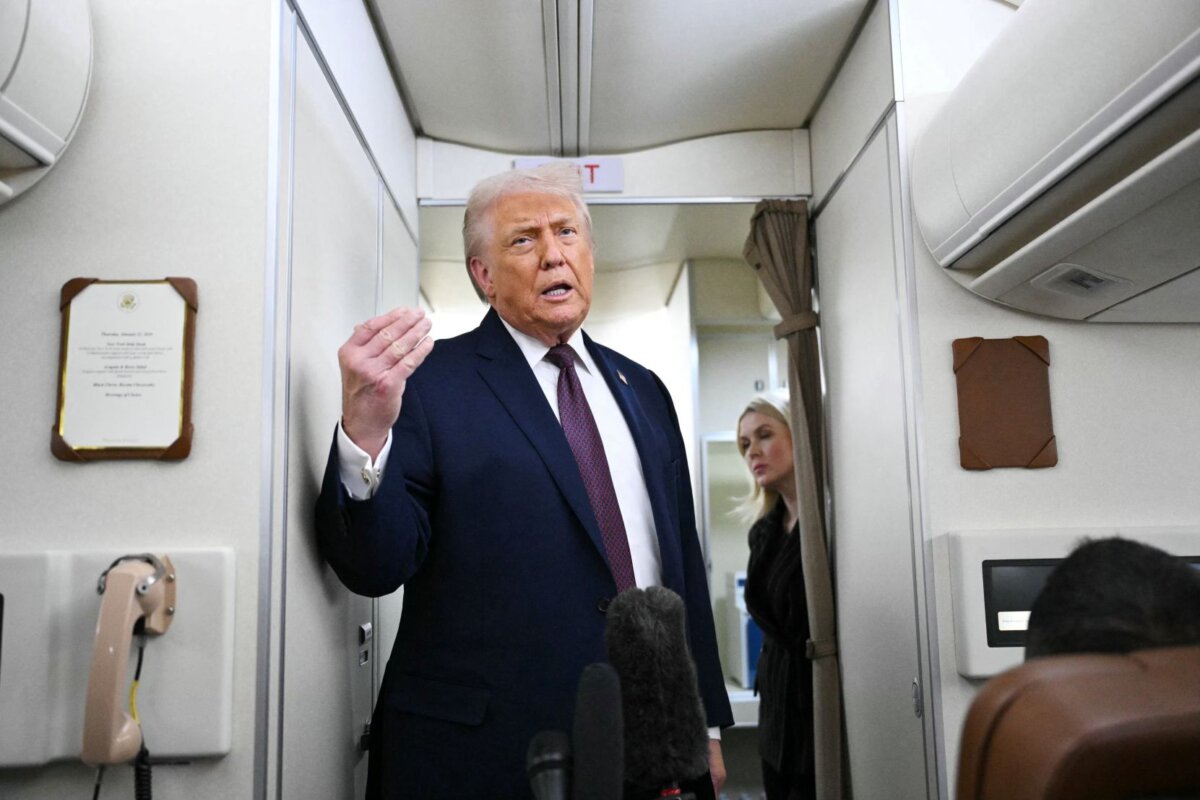
Trump was responding to a reporter’s question about the bruise on his left hand, which was noticeable during his Jan. 22 address at the World Economic Forum in Davos, Switzerland.
“I clipped it on the table. So, I put a little, what do they call it? Cream on it. But I clipped it,” the president told reporters aboard Air Force One.
White House press secretary Karoline Leavitt said in a statement provided to multiple news outlets that Trump hit his hand on the signing table while announcing his Board of Peace in Davos.
During the press gaggle, Trump said the bruising was one of the side effects of his high intake of aspirin.
“I would say, take aspirin if you like your heart, but don’t take aspirin if you don’t want to have a little bruising,” the president said.
“I take the big aspirin, and when you take the big aspirin, they tell you, you bruise. The doctor said, ‘You don’t have to take that, sir, you’re very healthy.’ I said, ‘I’m not taking any chances.’ So anyway, that’s one of the side effects of taking aspirin.”
Trump told The Wall Street Journal last month that he had been taking 325 milligrams of aspirin per day, well above the 81 milligrams recommended by his doctors, for years due to the drug’s blood-thinning effect.
“They say aspirin is good for thinning out the blood, and I don’t want thick blood pouring through my heart. I want nice, thin blood pouring through my heart,” he told the news outlet.
Health officials have said that aspirin can irritate the lining of the stomach, triggering internal bleeding, ulcers, or gastrointestinal problems. Aspirin, a blood thinner, can be dangerous for people who are at a high risk of bleeding, guidelines say.
Under recent medical guidelines, people who have a personal history of heart attack or stroke are advised to take a low-dose daily aspirin, typically around 81 milligrams.
White House physician Dr. Sean Barbabella told the Journal last month that Trump takes a high dose of aspirin daily to prevent cardiac issues.
Trump completed his routine medical evaluation at the Walter Reed National Military Medical Center in October.
In an Oct. 10, 2025, memo, his doctor wrote that Trump remains in “exceptional health, exhibiting strong cardiovascular, pulmonary, neurological, and physical performance.”
Barbabella said the 79-year-old president’s cardiac age is “approximately 14 years younger than his chronological age” and that he could continue to carry out his demanding daily schedule without restriction.
Jack Phillips and Reuters contributed to this report.
 Friends Read Free
Copy
Facebook
Tweet
Friends Read Free
Copy
Facebook
Tweet