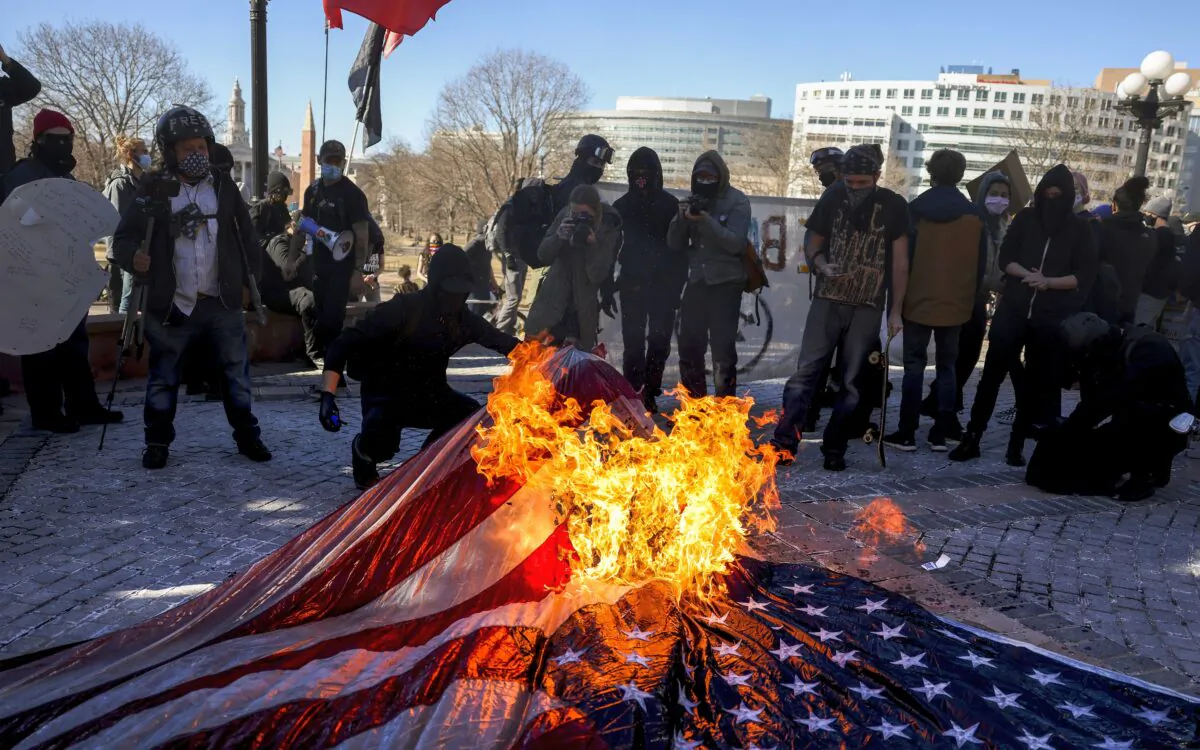


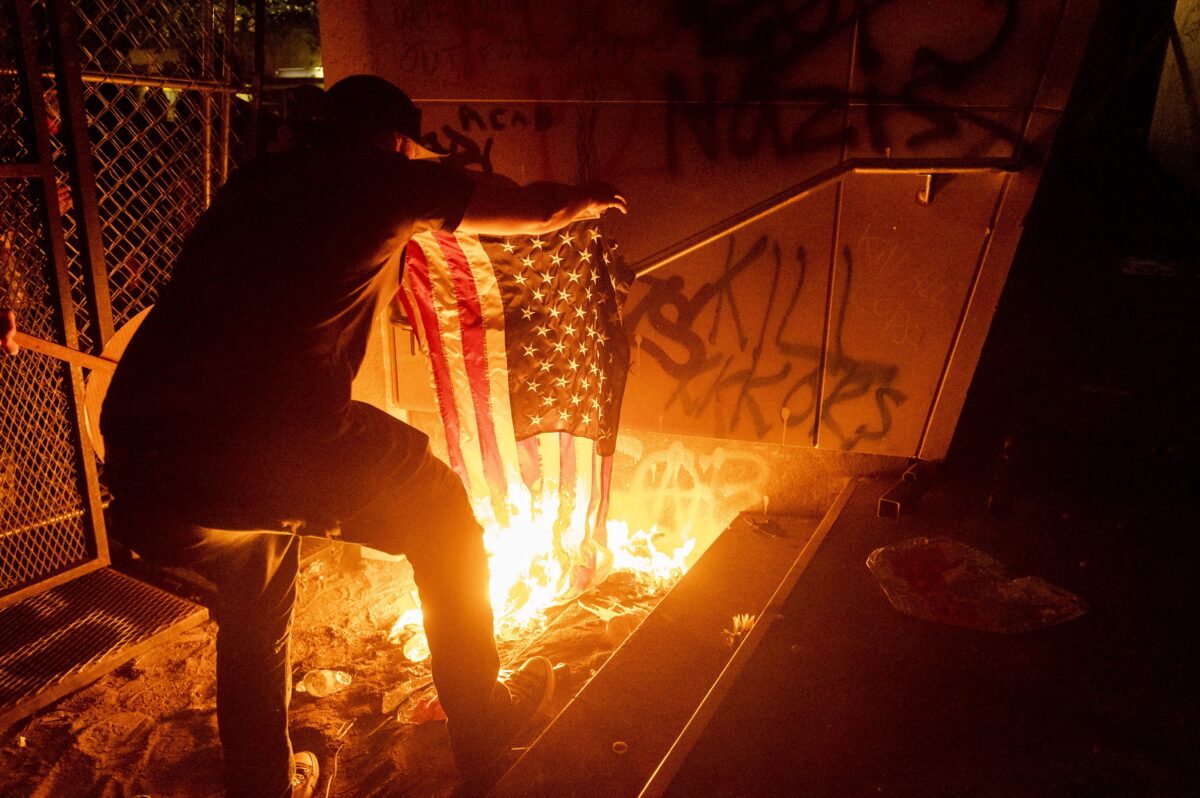
President Donald Trump on Aug. 25 signed an executive order directing Attorney General Pam Bondi to “vigorously prosecute” those who violate the law in ways that “involve desecrating the American Flag,” a bid that could face legal challenges in both lower federal courts and the U.S. Supreme Court.
“Our great American Flag is the most sacred and cherished symbol of the United States of America, and of American freedom, identity, and strength,” Trump wrote in the order. “Desecrating it is uniquely offensive and provocative.”
Critics of the administration and civil liberties activists describe the move as a violation of the freedom of expression permitted by the First Amendment to the U.S. Constitution. Supporters of the move note the unique nature of the flag as a symbol of the country and say the ban is justified.
Here’s what to know.
Executive Order
The order directs Bondi to prioritize enforcing laws to punish flag-burning incidents while preserving First Amendment protections. It directs federal prosecutors to enforce laws that “violate applicable, content-neutral laws, while causing harm unrelated to expression, consistent with the First Amendment” in cases of flag burning.
While the order would authorize officials to pursue criminal prosecution, the penalty would be based on violations of other local, state, or federal laws in order to head off First Amendment challenges.
The executive order directs Bondi to “prioritize the enforcement to the fullest extent possible of [the] Nation’s criminal and civil laws” in instances of flag burning, including through enforcing laws unrelated to free expression.
These include violent crimes, hate crimes, illegal discrimination against American citizens, other violations of Americans’ civil rights, and crimes against property and the peace, as well as efforts to aid and abet the violation of such laws.
It also encourages Bondi to make referrals to relevant state and local authorities for violations of applicable laws, such as those against open burning, disorderly conduct, or destruction of property.
‘Fighting Words’
The order suggests that flag burning can be prosecuted under the “fighting words” doctrine, one of a handful of limited carve-outs to the right to free expression granted by the First Amendment.
Established in 1942 in Chaplinsky v. New Hampshire, the doctrine allows for criminal punishment of words that are likely to provoke an immediate, violent response.
Trump wrote that burning the flag “may incite violence and riot.”
The order states, “Notwithstanding the Supreme Court’s rulings on First Amendment protections, the Court has never held that American Flag desecration conducted in a manner that is likely to incite imminent lawless action or that is an action amounting to ‘fighting words’ is constitutionally protected.”
The executive order calls for Bondi to prosecute such instances “to the maximum extent permitted by the Constitution.”
Neama Rahmani, a California attorney who comments on national politics, told The Epoch Times that it’s difficult to successfully prosecute such cases.
“They’re rarely prosecuted, and when they are, they’re often challenged on First Amendment grounds,” Rahmani said.
Rahmani also noted that existing precedent, established in the 1989 case Texas v. Johnson and the 1990 case United States v. Eichman, treats burning the American flag as protected speech that even Congress is not permitted to ban.
“Supreme Court precedent … says this is protected First Amendment activity that can’t be prosecuted,” Rahmani added.
Debate
Civil liberty organizations—including some with a right-of-center lean—have said the order transgresses on free speech.
These include the Foundation for Individual Rights and Expression (FIRE), which criticized the order in an Aug. 25 statement.
“Flag burning as a form of political protest is protected by the First Amendment,” the organization wrote.
“While people can be prosecuted for burning anything in a place they aren’t allowed to set fires, the government can’t prosecute protected expressive activity—even if many Americans, including the president, find it ‘uniquely offensive and provocative.’”
Bryan Leib, CEO of Henry Public Relations and a senior fellow with the Hungary-based Center for Fundamental Rights, expressed support for the executive order.
”The American flag represents far more than just fabric and stitching. It’s a symbol of our nation, the greatest nation on Earth,” he told The Epoch Times. “I mean, a beacon of freedom that so many men and women have given their lives for, fought for, died to defend.”
Leib rejected arguments that burning Old Glory is a form of freedom of speech.
“Freedom of speech, of course, is constitutionally protected, but freedom of speech has limits,” he said. “Just, as you know, we don’t allow people to threaten violence or to shout that they’re about to kill someone, I don’t think that we should be allowing for the desecration of the very symbol that unites us as a nation.”
The order instructs Bondi to prepare litigation to challenge the current precedent on the issue.
Rahmani predicted that the bid would be shot down by the Supreme Court.
 Friends Read Free
Copy
Facebook
Tweet
Friends Read Free
Copy
Facebook
Tweet