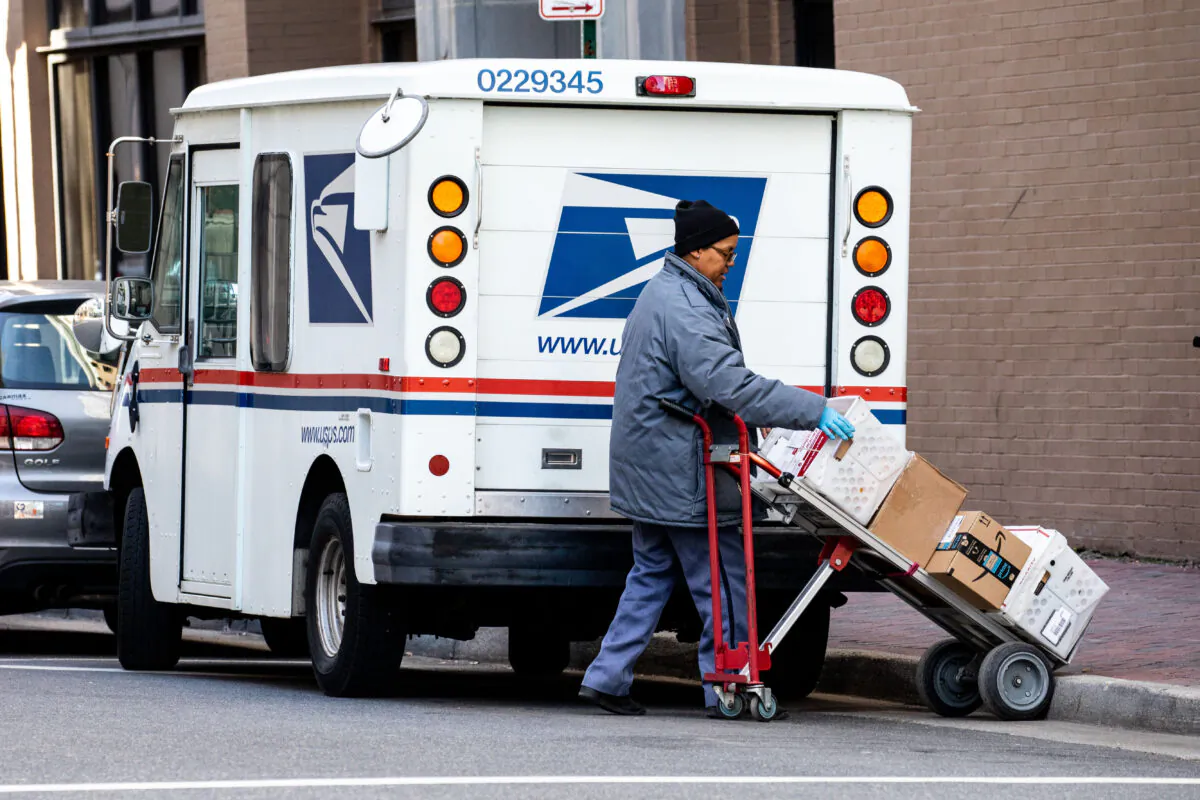

The United States Postal Service (USPS) saw its net loss for the first quarter of fiscal year 2026 widen by almost $1.4 billion from the same quarter last year, the agency said in a Feb. 5 statement.
USPS suffered a net loss of around $1.26 billion for the quarter of Oct. 1–Dec. 31, 2025, compared to a gain of $144 million during the same period in the previous fiscal year.
“This change to net loss is attributed to an increase in workers’ compensation expense of $634 million, operating revenue decrease of $264 million, an increase in retiree health benefits expense of $175 million, higher other operating expenses of $169 million, and higher transportation expenses of $43 million,” the statement said.
Total operating revenues came in at $22.2 billion for the first quarter of 2026, down $264 million, or 1.2 percent, from the first quarter of 2025, according to USPS.
The postal service attributed the decline in revenues largely to falling volumes in its First-Class Mail, Shipping and Packages, and Marketing Mail categories.
The USPS handled 28.35 billion pieces of mail and packages in the recent quarter, down from 31.28 billion a year earlier.
The roughly $1.26 billion loss continues the trend of large losses suffered by USPS over recent years.
In fiscal year 2023, the agency incurred a net loss of $6.5 billion, which jumped to $9.5 billion in 2024 and then to $9 billion in 2025.
A December 2025 Government Accountability Office (GAO) report warned that action was needed to address the USPS’s “unsustainable” business model.
The postal service has taken several actions to boost revenue and reduce expenses since a 10-year strategy was introduced in 2021, GAO said. This includes raising prices and redesigning the service’s transportation network. Congress also chipped in through the Postal Service Reform Act of 2022, which canceled $57 billion in USPS’s outstanding debt.
Despite all these measures, “USPS’s financial condition remains poor,” GAO said. “While USPS has increased revenue, its total expenses continue to outpace total revenue leading to further losses.”
In addition, the postal agency’s unfunded liabilities and debts have “steadily increased” since fiscal year 2022. If USPS were to make all required payments towards its unfunded liabilities in full, the agency estimates it would run out of cash in fiscal year 2026.
Commenting on recent results, Postmaster General David Steiner said USPS was facing difficult systemic financial and business headwinds.
“To right our financial ship, we are aggressively pursuing growth strategies—which include creating new opportunities for businesses to leverage our vast last-mile delivery network—and driving greater efficiencies throughout our operations,” Steiner said.
“We are convinced that these efforts, if combined with needed regulatory, administrative, and legislative changes, can meet the needs of the American public and return the Postal Service to long-term financial stability and strength.”
In a Feb. 5 statement, advocacy group Keep US Posted called for abandoning the “Delivering for America” plan introduced by former Postmaster General Louis DeJoy in 2021, noting that the postal service has lost more than $25 billion since then.
The plan implemented several changes at USPS to improve operational and financial efficiency.
Kevin Yoder, executive director of the advocacy, said the Delivering for America plan should be marked “return to sender.”
“We had hoped that Postmaster General Steiner would take a fresh approach and shift away from DeJoy’s tax-and-spend strategy, but so far, he appears to be doubling-down on his predecessor’s failed strategy,” Yoder said.
Last year, President Donald Trump suggested privatizing the USPS, saying it was “not the worst idea” he had heard. However, the White House quickly clarified that the president has no intention of taking control of the USPS, which is an independent agency.
During a House Subcommittee on Government Operations hearing in June, Mark Dimondstein, president of the American Postal Workers Union, warned against privatizing USPS, according to a June 30 statement from the union.
While privatization would benefit corporate interests, it would ultimately harm most businesses and customers by raising costs, Dimondstein said.
 Friends Read Free
Copy
Facebook
Tweet
Friends Read Free
Copy
Facebook
Tweet