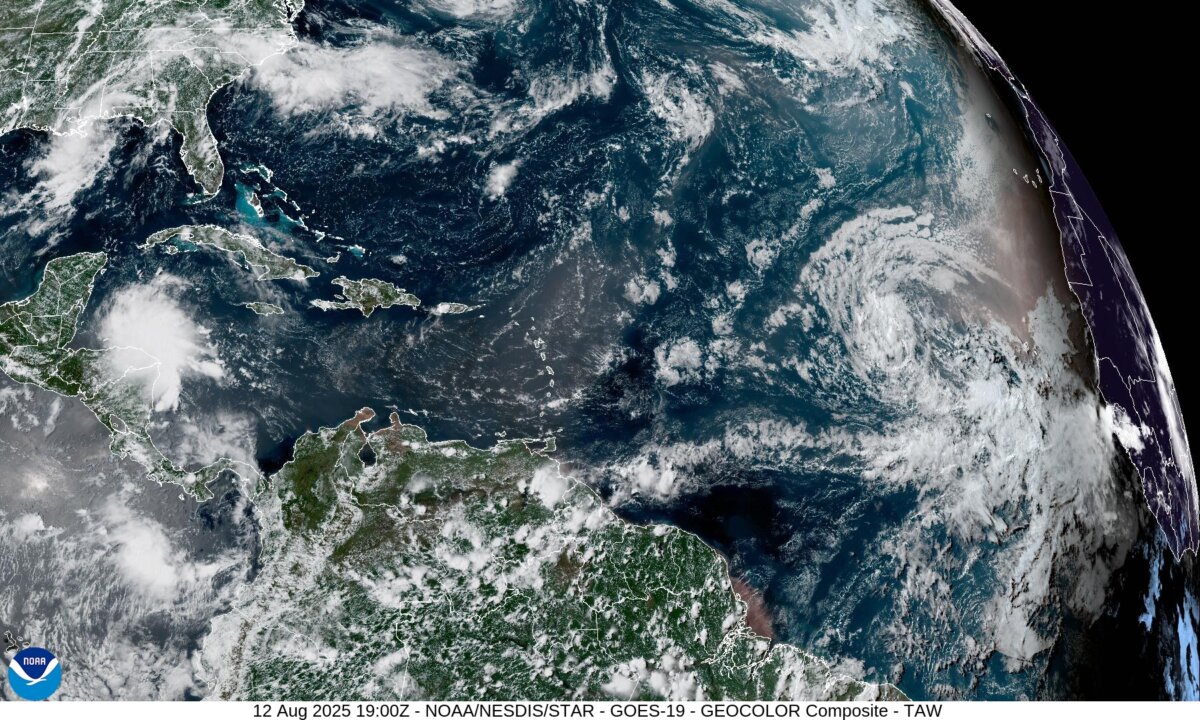

Tropical Storm Erin formed in the Atlantic Ocean on Aug. 11 and long-range forecast models predict it will become a major hurricane that could impact Puerto Rico and the Eastern Caribbean, as well as the U.S. East Coast and Bermuda.
As of the evening of Aug. 12, Erin was still more than 1,600 miles away from the Northern Leeward Islands and the edge of the Caribbean, but as eyes look eastward for what is expected to be the first hurricane of the 2025 season to form, here are some things to know about this storm.
Erin Expected to Become Major Hurricane
As of 5 p.m. on Aug. 12, the National Hurricane Center (NHC) reported that Tropical Storm Erin was moving fast across the Atlantic Ocean. The storm is expected to become a hurricane in the next couple of days, and to grow into a major hurricane by Sunday, Aug. 17. A major hurricane is one that is a Category 3 or higher with sustained wind speeds greater than 111 mph.
Erin was last tagged nearly 1,000 miles west of the Cabo Verde Islands, moving westward at 22 mph. Its sustained wind speeds were recorded at 45 mph, with tropical-storm-force winds (39 mph to 73 mph) extending out 35 miles from the storm’s center.
“Sea surface temperatures and instability begin to increase after about 24 hours, which should allow Erin to produce more organized convection,” the NHC stated in its discussion, alluding to the fact that warm sea temperatures fuel tropical cyclones. “Given that the cyclone already has a well-defined low-level structure, this could result in significant intensification.”
“In this scenario, Erin would still become a major hurricane in about four or five days,” it added.
Erin Could Affect Puerto Rico, Stay Offshore
Forecast models appear to project that Erin could turn north and stay well off shore of the United States mainland, but eastern Caribbean islands like Puerto Rico could face some impacts.
“Erin could move close enough to the northern Leeward Islands, Virgin Islands, and Puerto Rico over the weekend to produce some impact on those islands,” the NHC said in its forecast discussion. “However, the magnitude of those impacts is still not known, and interests there should continue to monitor the progress of this storm.”
Supporting graphics published with the advisory and discussion show Erin beginning a turn northward just before reaching Puerto Rico, with the islands just on the edge of the cone of uncertainty.
The NHC added that there is significant uncertainty about how would-be Hurricane Erin could affect portions of the east coast of the United States, Bermuda, the Bahamas, and the Greater Antilles next week, and urged people in those areas to make sure their preparedness plans are in place.
Long-range forecast models provided by TropicalTidbits predict that Erin will remain off the coast of the United States. However, at least one week remains before it is supposed to enter the vicinity of Florida’s east coast.
That being said, at least one forecast model predicted on the evening of Aug. 12 that another big storm will enter the Caribbean Sea and Gulf of America shortly after Erin, developing into a tropical storm as it crosses over Cuba, the Florida Keys, and Miami and curves north, skirting Florida’s Gulf Coast by Aug. 27.
At Least a Week to Prepare
With the would-be hurricane still several days out, the NHC urged those who could be impacted by this storm to prepare.
The NHC’s parent agency, the National Oceanic and Atmospheric Administration (NOAA), outlined necessary actions one should take to prepare for a hurricane and provided online resources for how to prepare.
Those actions include developing personal evacuation plans, assembling disaster supplies such as non-perishable foods, having enough water to last each member of one’s family up to at least three days, extra batteries, extra cash, flashlights, an emergency radio and portable chargers.
NOAA also advises homeowners to know how to strengthen their homes against hurricanes and communicate with insurance agencies. Renters should communicate with landlords. Families are advised to communicate their own hurricane action plans.
“Take the time now to write down your hurricane plan, and share it with your family,” NOAA stated on its website. “Determine family meeting places, and make sure to include an out-of-town location in case of evacuation. Write down on paper a list of emergency contacts, and make sure to include utilities and other critical services—remember, the internet may not be accessible during or after a storm.”
Erin is only the fifth named storm so far this hurricane season. The previous four were tropical storms that failed to reach hurricane strength.
Hurricane season continues until Nov. 30.
 Friends Read Free
Copy
Facebook
Tweet
Friends Read Free
Copy
Facebook
Tweet