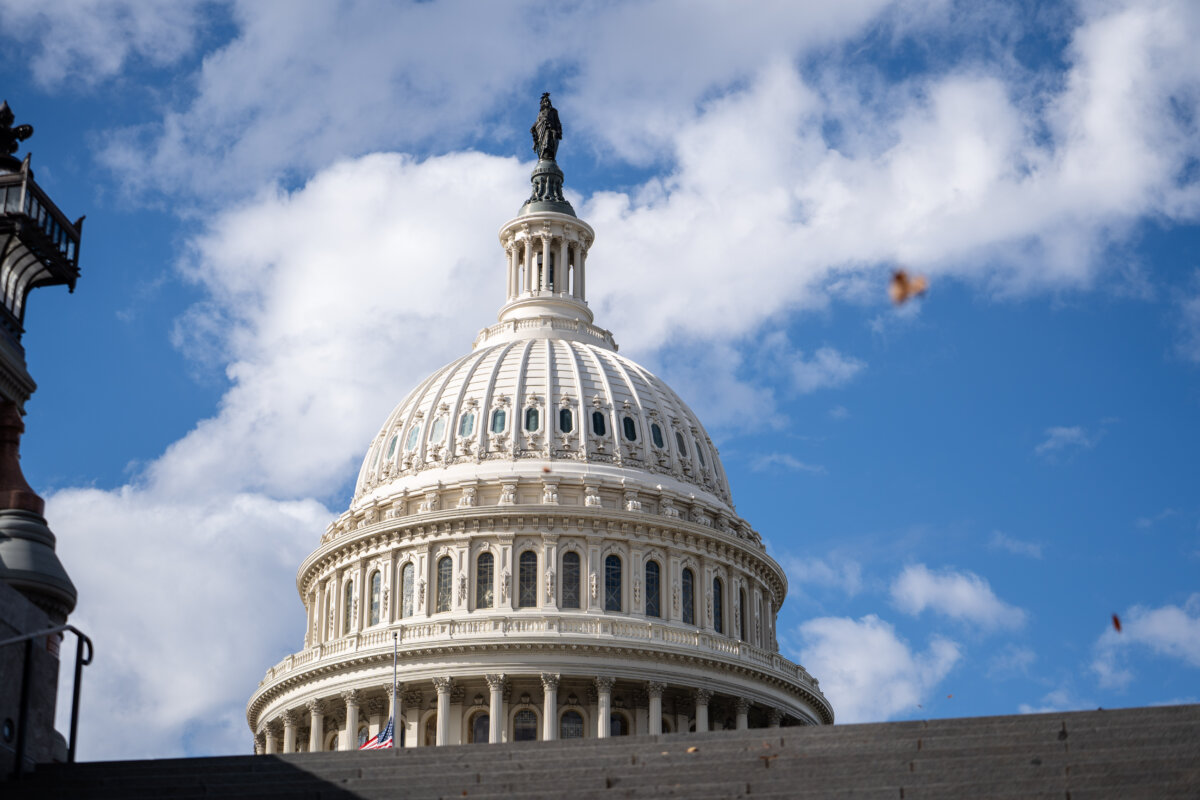

WASHINGTON—After more than 40 days, Congress has passed legislation to end the government shutdown.
The bill funds the government through Jan. 30, 2026.
It also includes three full-year appropriations bills to fund the Department of Veterans Affairs, the Food and Drug Administration, and the Department of Agriculture through Sept. 30, 2026.
The Agriculture Department funding ensures services to the Supplemental Nutrition Assistance Program and the Special Supplemental Nutrition Program for Women, Infants, and Children through Sept. 30, 2026.
The legislation also reverses cuts made to the federal workforce during the government shutdown. Those employees will get back pay.
Here is what is next for Congress after reopening the government.
Spending Bills
Congress has only until the end of January to fund the government long term. Appropriators will have to come up with legislation to fund the agencies that did not get full-year appropriations.
House Speaker Mike Johnson (R-La.) said the point of the short-term spending bill, also known as a continuing resolution, is to give appropriators time to put forth bills to fund the government through the last day of the fiscal year, which is Sept. 30.
“We have been trying to force the government appropriations process back to what we call regular order, you know, the way it’s supposed to work,” Johnson previously told CNBC.
“We’re moving forward productively, but the concern is that we’ve run out of clock to finish that process. We need a short-term, very clean continuing resolution to keep the government open so our appropriators can continue to do their work.”
Congress passed three of the 12 appropriations bills in the Senate deal ending the shutdown.
Since Republicans took over Congress in January, Congress has been operating on continuing resolutions to fund the government at Biden-era levels. The GOP is looking to change that and decrease spending.
Senate Vote on Extending Affordable Care Act Subsidies
The deal guarantees a vote in the second week of December on extending subsidies under the Affordable Care Act, a demand made by Democrats that was the point of contention that kept the government unfunded. The subsidies expire on Dec. 31.
This vote is likely to fail, as Republicans are unlikely to help Democrats reach the 60-vote threshold to overcome the filibuster.
Johnson has not guaranteed a vote in the House on the subsidies if such legislation passes the Senate.
Appearing on MSNBC, Sen. Tim Kaine (D-Va.) said Republicans were not going to cave on the subsidies.
“Now, we get to have the fight in the full view of the American public, just this issue, Dems versus [Republicans],” he said. “We’re going to put a proposal on the table that we’ll write that will be maximally designed to help Americans and they’ll be attractive to the [Republicans] who are telling us, ‘We know we got to fix this.'”
Sen. Angus King (I-Maine), who caucuses with the Democrats and voted alongside Kaine to open the government, said on MSNBC that Democrats secured a guaranteed vote on the subsidies.
Banning Stock Trading by Lawmakers
Congress is also expected to vote on a bill to ban stock trading by lawmakers.
The End Congressional Stock Trading Act, introduced by Rep. Tim Burchett (R-Tenn.), would prohibit members of Congress, as well as their spouses and children, from trading or owning individual stocks, bonds, commodities, or complex investment vehicles.
“No one sent to Congress should be enriching themselves through Wall Street while writing the very laws that regulate our markets,” Rep. Anna Paulina Luna (R-Fla.) said on Aug. 29. “This bill is about accountability, transparency, and restoring faith in the institution of Congress.”
A similar bill in the Senate that also applies to future presidents and vice presidents advanced out of committee in July.
A bipartisan bill to ban congressional stock trading was introduced in September. Sponsored by Rep. Chip Roy (R-Texas), it is called the Restore Trust in Congress Act. It would prohibit members of Congress, as well as their spouses, children, and trustees, from owning, buying, or selling individual stocks and other assets.
“We are governing in a moment when public trust is at historical lows,” Rep. Pramila Jayapal (D-Wash.) said on Sept. 3.
“Only two in 10 Americans trust the government to do what is right for them and they are constantly seeing their elected officials selling them out to the highest bidder. They see the people elected to represent them instead making decisions to increase their own personal wealth.”
Vote on Releasing Epstein Files
Rep. Adelita Grijalva (D-Ariz.) was sworn in on Nov. 12 and became the 218th member of Congress to sign on to a discharge petition to force a vote on a resolution calling on the Justice Department to “disclose all unclassified records, documents, communications, and investigative materials surrounding the late convicted pedophile Jeffrey Epstein and his associate Ghislaine Maxwell, with exceptions for victim information, materials related to child sex abuse, and information that would jeopardize active federal investigations or prosecutions.
“[The Justice Department] may not withhold or redact records on the basis of embarrassment, reputational harm, or political sensitivity,” the resolution states.
Four Republicans joined all 214 Democrats in signing the discharge petition: Reps. Thomas Massie (R-Ky.), Marjorie Taylor Greene (R-Ga.), Lauren Boebert (R-Colo.), and Nancy Mace (R-S.C.).
“We all deserve to know what’s in the Epstein files, who’s implicated, and how deep this corruption goes,” Massie said on July 15. “Americans were promised justice and transparency.”
 Friends Read Free
Copy
Facebook
Tweet
Friends Read Free
Copy
Facebook
Tweet