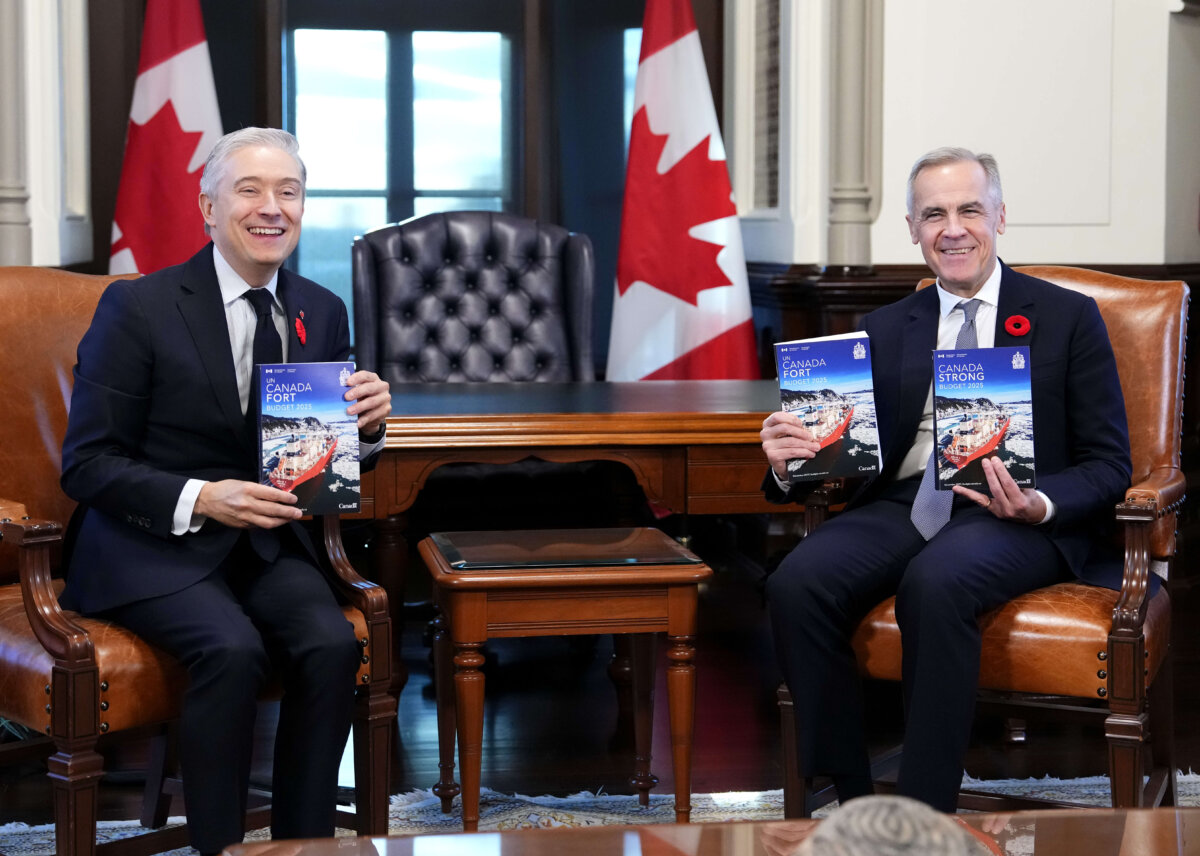

Prime Minister Mark Carney’s first budget tabled on Nov. 4 forecasts $2.7 billion in cuts to foreign aid over the next four years.
The budget predicts $561 million in cost reductions next fiscal year for Global Affairs Canada (GAC), rising to $1.1 billion per year of projected savings within two years, saying that Canada’s foreign aid spending will return to pre-COVID levels and focus on “countries that need it the most.”
GAC’s budget for this fiscal year is an estimated $8.1 billion.
The government says it’s returning its funding allocation closer to pre-pandemic levels.
“There will be reductions in development funding to global health programming, where Canada’s contribution has grown disproportionately relative to other similar economies,” the budget reads. “Some bilateral development programs will also be refined and adjusted.”
The government has not said which programs or nations will experience funding cuts, but says efforts will also be made to see how Canadian “contributions can be leveraged further,” along with reducing financial help for some international financial institutions.
In the fiscal year ending in March 2024, Canada expended $6 billion on regular foreign aid; along with $2.6 billion in offering international financial help, including loans to war-torn Ukraine; and additional development aid and assistance for refugees, amounting to $12.3 billion.
Meanwhile, the International Development Research Centre (IDRC) will face a series of annual reductions: $11.4 million next year, climbing to $23.5 million annually within five years. The IDRC’s current budget is $159.4 million.
Ottawa will also repurpose $138 million within GAC to assist in rebuilding Ukraine’s infrastructure, which as been damaged in its ongoing war with Russia.
Specific staffing cuts coming to GAC are not mentioned in the budget, and it’s unclear if currently unfilled positions including climate change ambassador; women, peace, and, security envoy; or forced labour ombudsperson will be filled or not.
Part of the trimmed costs will also be achieved by consolidating the office locations of Canadian diplomatic and trade offices abroad in shared locations with allied nations, along with “revamping emergency preparedness” and consular services. This comes after previous concerns raised about the costs of evacuating Canadian citizens from troubled countries such as Haiti and Lebanon.
The reductions in foreign aid come in the wake of Secretary of State for International Development Randeep Sarai’s Oct. 28 testimony before the House Committee on Foreign Affairs and International Development in which he said the IDRC would continue to receive all the funding it needs.
“I call it our secret weapon. I think IDRC is one of Canada’s best investments,” Sarai said, adding that it had created a number of successful programs including “climate-resilient potatoes in the Philippines,” which let impoverished families have a better life.
Conservatives have criticized some aspects of Canada’s foreign aid programs. During the Oct. 28 House Committee meeting, Conservative MP Lianne Rood asked about the benefit for Canadians from programs with titles like “Beans for Women’s Empowerment” and “Gender-Just, Low-Carbon, Rice Value Chains.”
Rood also raised concerns about funds being used via international bodies such as the U.N. and World Bank.
Sarai said the programs boost Canada’s “soft power” around the world and are carefully looked over before being funded. He added that many programs also benefit Canada by increasing the cost-effective imports available to Canada, fighting gender inequality, reducing global climate change, and reducing migration from developing nations such as Vietnam.
Rood’s criticisms echoed earlier remarks by Conservative Leader Pierre Poilievre.
“While you can’t afford food, Mark Carney spends $8.2 million tax dollars on gender-just, low-carbon rice in Vietnam,” Poilievre commented Oct. 6.
“Look, this is a … nonpartisan file,” Sarai said. “Everyone agrees that we should all focus on making the lives of those that are most in need better.”
Sarai said Canada was unlikely to hit the U.N. goal of spending 0.7 percent of gross national income on development assistance, but added that Ottawa wants to grow the amount of private capital going into development and target Canadian aid in areas of the world where Canada also has an economic interests.
The Canadian Press contributed to this report.
 Friends Read Free
Copy
Facebook
Tweet
Friends Read Free
Copy
Facebook
Tweet