
Ottawa’s recent call for limits on the notwithstanding clause poses a threat to “national unity” and signifies a disregard for the process that resulted in the establishment of the Charter of Rights and Freedoms, five premiers say.
The leaders of Ontario, Quebec, Alberta, Saskatchewan, and Nova Scotia are speaking out against the federal government’s appeal to the Supreme Court of Canada to impose restrictions on how provinces may use the notwithstanding clause.
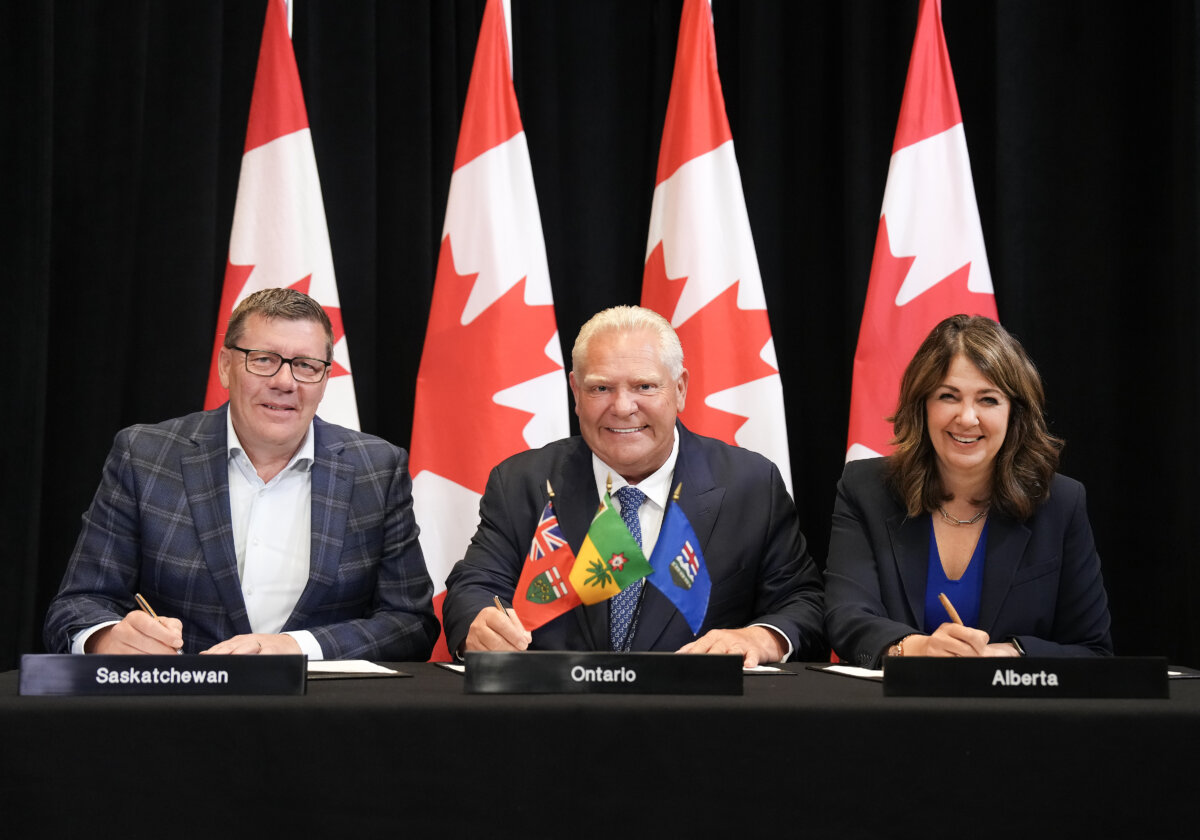
A joint letter from Ontario Premier Doug Ford, Quebec Premier François Legault, Alberta Premier Danielle Smith, Saskatchewan Premier Scott Moe, and Nova Scotia Premier Tim Houston calls on Ottawa to reconsider its approach “and withdraw its written legal argument immediately” to preserve national unity.
“The federal government’s arguments represent a complete disavowal of the constitutional bargain that brought the Charter into being,” reads the Oct. 7 letter sent to Prime Minister Mark Carney. “The federal government’s position amounts to a direct attack on the foundational constitutional principles of federalism and democracy.”
Ford, who posted the letter to his X account on Oct. 7, said the government should focus on “fixing its broken bail system” rather than removing the “right of elected governments to make decisions for the people they represent.”
The notwithstanding clause of the Constitution allows provincial legislatures or Parliament to enact laws that can effectively supersede certain provisions of the Charter, with this authority limited to a maximum period of five years.
Federal Justice Minister and Attorney General Sean Fraser announced on Sept. 18 that he filed a request with Canada’s top court arguing that repeated use of the clause by provincial governments amounts to “indirectly amending the Constitution” and that it’s the equivalent of “denying its very existence.”
Fraser responded to the premiers’ letter on Oct. 8, saying it would be “unimaginable” for a federal government to steer clear of a case affecting Charter rights that will have lasting impacts and suggests the premiers’ argument is “untenable.” He said this should be a legal matter decided through the courts, not a political debate.
The prime minister has also defended Ottawa’s decision to attempt to limit use of the clause.
“One of the most important responsibilities of the Government of Canada is to defend the Canadian Charter of Rights and Freedoms,” Carney said during question period on Sept. 17 after being questioned on the issue by Bloc Québécois Leader Yves-François Blanchet.
“The decision will be made by the Supreme Court, not by the members of Parliament from Quebec or anywhere else in Canada.”
The federal government’s petition to the Supreme Court of Canada last month appeared to be in response to Quebec’s secularism law. Quebec is considering use of the clause to override legal challenges of the law, known as Bill 21, which prevents public sector employees from wearing religious symbols while on duty. Legault has also said he would consider using the clause to push through his government’s upcoming public prayer ban legislation.
Use of the Clause
Ford, Smith, and Moe have been the most vocal against the Carney government’s bid to change how the notwithstanding clause can be used.
Moe said his government would “strongly oppose” any attempt to limit the the ability of provincial governments to use the notwithstanding clause.
“This would mean a significant infringement on the autonomy of provinces and their elected legislatures,” Moe wrote in a Sept. 19 post on X. “The common argument that using the notwithstanding clause is a violation of the Constitution is false.”
Ford also spoke against the move during a Sept. 25 press conference.
“This is the worst decision Prime Minister Carney has ever done, and it will be an absolute disaster, and I don’t believe it’s going to go through,” Ford said. “It just takes Quebec and Ontario to block it.”
Smith said in a social media post that while her government doesn’t support the content of Quebec’s bill, “we stand shoulder to shoulder with Quebec’s constitutional right to invoke the notwithstanding clause as its government deems fit.”
She described the clause as “an unassailable provincial constitutional right” and criticized the federal Liberal government for trying to prevent provinces from using it.
Smith has previously said Alberta would use the clause as a last resort to protect gender-related provincial laws such as preventing doctors from offering gender-affirming treatment like puberty blockers and hormone therapy to minors.
The law is being legally challenged in court by LGBT advocacy groups and a government spokesperson has said the province is prepared to use “all available legal and constitutional means at our disposal, including the notwithstanding clause should our government deem it necessary” to protect the law.
Ontario and Saskatchewan have both invoked the clause in the past.
Ford’s PC government used it in June 2021 to limit third-party election financing, and again in 2022 when negotiating a new contract with 55,000 Ontario education workers, but repealed it days later.
Saskatchewan invoked the clause in October 2023 to pass its Parents’ Bill of Rights, which made it mandatory for schools to receive parental consent before using the preferred name or gender identity for youth younger than 16.
Quebec has used the notwithstanding clause the most of all of the provinces, first in 1982 and then again in 1988. The clause has also been used by the province in more recent years. The Legault government used the clause in 2019 to preemptively pass Bill 21. The law bans teachers, judges, police officers, and jail guards from wearing religious symbols while at work. Legault’s administration used it again in 2021 to pass Bill 96, a law that amended Quebec’s Charter of the French Language.
The Canadian Press contributed to this report.
 Friends Read Free
Copy
Facebook
Tweet
Friends Read Free
Copy
Facebook
Tweet