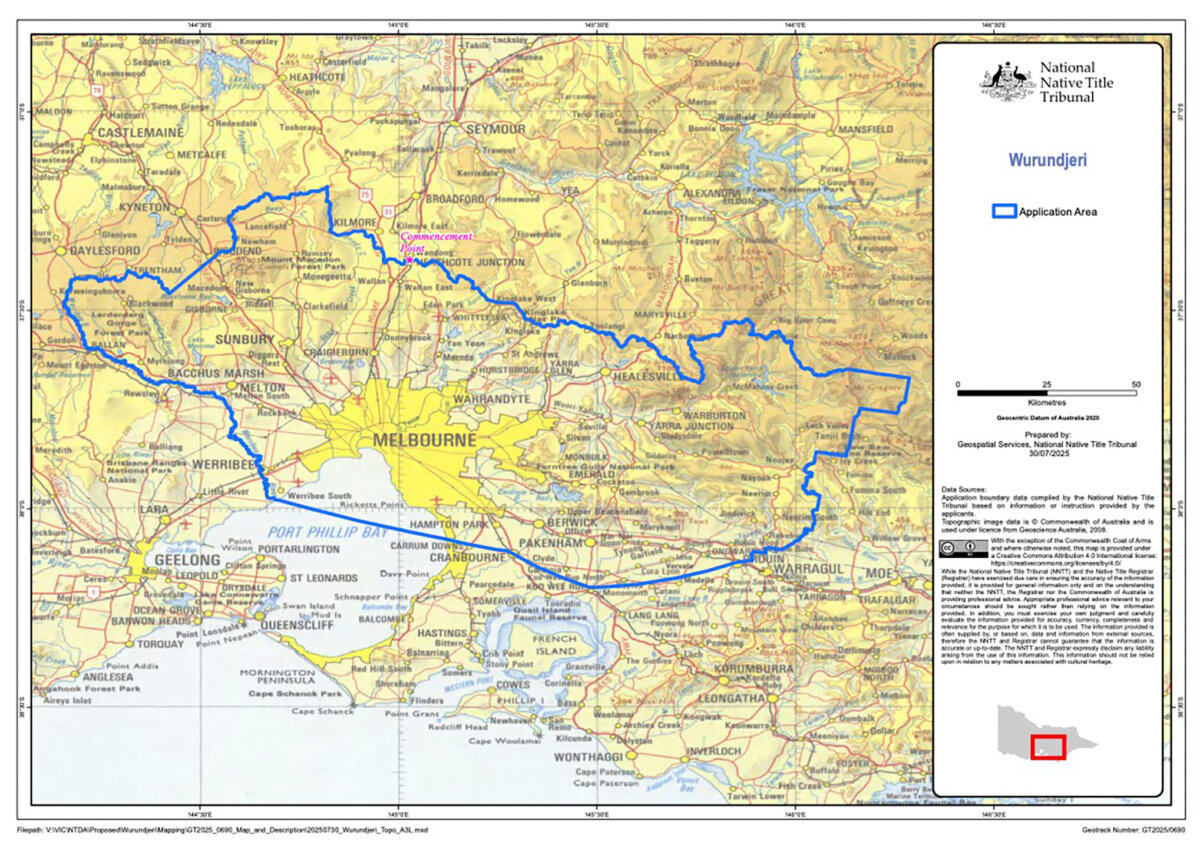

The majority of Melbourne and its surrounds have come under a massive Native Title claim just lodged by the Wurundjeri Woi-wurrung Indigenous people with the Federal Court.
The Wurundjeri Woi-wurrung, who claim “traditional ownership” of the region, lodged the application via law firm Slater and Gordon.
Native Title claims can often vary in terms of the volume of rights granted to Indigenous land groups, in this case, the Wurundjeri Woi say their claim will grant decision-making power over areas of cultural significance, resources, and require greater consultation over proposed activities.
They say it would have no affect on existing rights over property, private homes, businesses, Crown land, or public areas.
The massive expanse covers nearly all of the Melbourne metropolitan area, up to and including areas to the north of the Great Dividing Range, the Weeribee River to the west, Mount Baw Baw to the east, and Mordialloc Creek to the south.
Wurundjeri elder Perry Wandin told AAP he felt it was time for the Indigenous people to be recognised with Aunty Di Kerr agreeing.
“It’s about ensuring our connection to country is recognised in law as it has always existed in truth,” she said.
The Epoch Times contacted the Wurundjeri Woi-wurrung Indigenous group and Slater and Gordon for comment.
The ambitious move comes a week after Victoria officially passed its Indigenous Treaty Bill, which sets up an advisory body to the state parliament whose aim is finalising an official Treaty deal between Aboriginal groups and the state.
How Native Title Works?
A Native Title claim is a complex area of law aimed at balancing recognition of Aboriginal or Torres Strait Islander land possession claims against 200 years of already existing property claims by settlers and the general population.
A claim starts with a legal application for the recognition of traditional rights and interests over land and/or water.
If successful, a claim is then recognised under the law.
Native Title claims can tend to be symbolic in nature, especially when compared to land rights claims.
For example, a Native Title claim may acknowledge the traditional connection to a place with proven continuity, while a Land Rights claim may involve grants of land made by government without any need to confirm connection.
There is also a difference between exclusive and non-exclusive Native Title, which affects use of the land.
As of Oct. 2024, around 54 percent of Australia’s land and seas were listed as being under Native Title.
Not all Native Title claims are successful.
One Nation Critical of Claim
In a statement posted to X, One Nation Victoria said the move was proof that the recently legislated Treaty Bill was already causing division.
“This is exactly what we warned would happen,” they said in the statement.
“Once governments start dividing Australians by race, there is no end to the claims, bureaucracy and special privileges that follow.”
One Nation has pledged to disable the treaty legislation should it gain substantial power in the 2026 Victorian election.
“We are all Australians, and we all share the same level of responsibility to look after this land, as well as the privilege to call it home,” the statement said.
Close the Gap researcher and former Labor minister, Gary Johns, said Native Title deals could reduce the wealth of the state.
“The Native Title claim over Melbourne and the outskirts will make all the more certain that non-claimant Victorians will become second-class citizens,” he told The Epoch Times.
Johns said any new government must work with future Native Title holders to make dealings quickly and efficiently under current law.
“An option would be a one-off deal (the Noongar deal in Perth is a model) to forego Native Title rights for money, with the proviso that all funds be placed in a trust for the education of descendant children,” he said.
“Any other option would be a misuse of public money.”
The deal with the 30,000 Noongar Aboriginal peoples is covered by the South West Native Title Settlement over the south-west corner of Western Australia and its capital city of Perth.
It’s a massive $1.3 billion taxpayer-backed deal that is being paid from the state to the Noongar Boodja Trust, which manages the funds in according with the Settlement and applies its benefits to six regional corporations and a Central Services Corporation.
 Friends Read Free
Copy
Facebook
Tweet
Friends Read Free
Copy
Facebook
Tweet