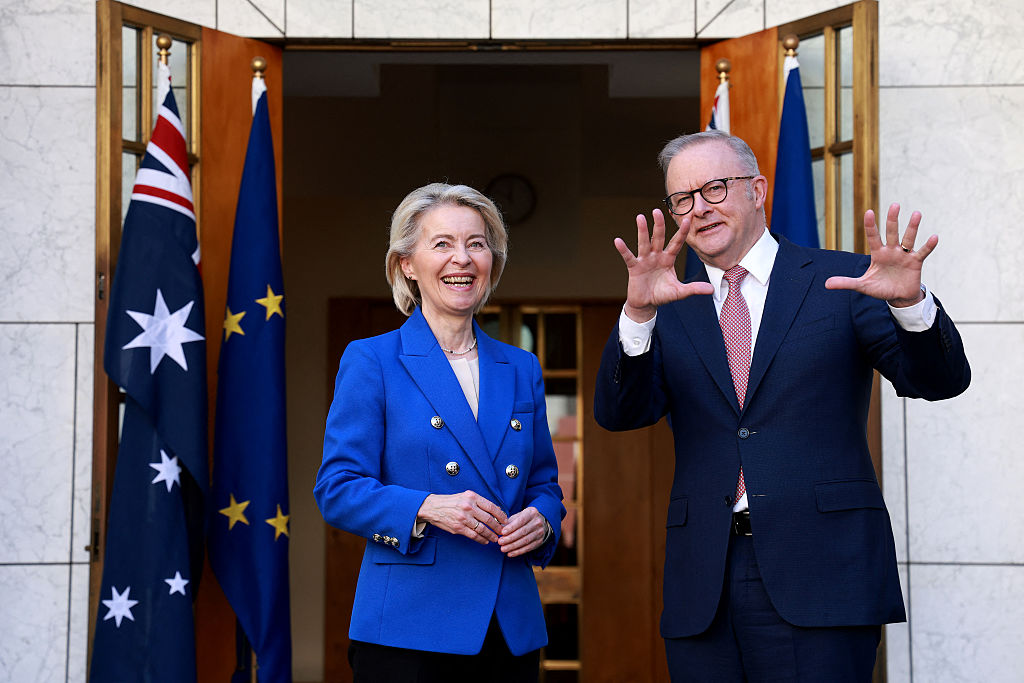

Australia and the European Union (EU) have signed a new agreement that means 98 percent of exports sent to the 27 member countries—a market of around 450 million people—will not be subject to import duties.
The announcement comes amid a visit to Australia by EU Commission President Ursula von der Leyen.
The total trade in goods between the two partners reached over AU$78 million (47 billion euro) in the 2024 calendar year, with the EU importing $16.9 billion (10.2 billion euro) from Australia and exporting $61.2 million (36.9 billion euro).
The two parties have been negotiating for more than 8 years, whereas New Zealand got its deal signed in May of last year after 4 years of talks.
An official statement said the agreement would have the effect of “bolstering Australia’s competitiveness, growth, and resilience in an increasingly uncertain global trade environment.”
A five percent tariff will be removed locally that will make European wine, spirits, biscuits, chocolates, and pasta cheaper at local checkouts.
Farmers and businesses will also benefit from less costly luxury motor vehicles like BMW and Mercedes-Benz, as well as machinery.
Further, Australian companies, including small and medium-sized enterprises (SMEs), will have better access to bid for lucrative European government contracts, worth around $845 billion annually, including rail and construction deals.
The Australian government said local wine producers and exporters will also benefit from the removal of about $37 million worth of tariffs.
The EU was Australia’s second-largest source of foreign investment in 2024, with total stocks of $869.3 billion.
Prime Minister Anthony Albanese said the deal creates “major new opportunities for Australian exporters in the European Union’s massive $30 trillion economy and will reduce costs for Australian consumers.”
Disagreements that had to be ironed out between the EU and Australia included naming rights for various products, such as prosecco and feta cheese, and the volume of beef and lamb Australia could export.
Lengthy phase-out periods for tariffs have been secured for some terms, like Feta, Romano, and Gruyere, while Australian manufacturers will be able to continue using well-known terms such as Parmesan and kransky.
Winemakers will keep making and selling prosecco domestically.
Von der Leyen’s Remarks
At a joint press conference, von der Leyen did not confirm whether the Trump administration’s tough tariff negotiations with the EU forced it to seek a free trade agreement with Australia, saying, “It was basically a door on both sides, where we started our negotiations, knowing that a situation where an agreement leads to a win-win situation for both sides.”
However, von der Leyen did say, “Today we are telling an important story to a world that is deeply changing.”
“[In] a world where great powers are using tariffs as leverage and supply chains as vulnerabilities … open rules-based trade delivers some positive outcomes. Trust matters more than transactions.”
Von der Leyen said in less than two months, the EU had added 2 billion people to its free trade market, in reference to the EU-Mercosur agreement with Latin America, its free trade deal with India, and now Australia.
The EU president expects European farmers to save $1 billion euro in reduced tariffs, and for exports to grow by 33 percent over the next decade.
Defence Partnership Effective Immediately
Australia and the European Union also signed a security and defence partnership, which Defence Minister Richard Marles said was “a significant milestone which sets up the framework for cooperation with European partners.”
Coming into effect immediately—unlike the free trade agreeement, which must wait on changes to Australian and EU regulations—the defence deal increases information sharing to counter global threats, including online radicalisation and terrorism financing.
It also commits the parties to building their “capacity to manage and the resilience to withstand” complex security threats and establishes a new dialogue on space security.
Foreign Affairs Minister Penny Wong also referenced the current geopolitical climate in welcoming the agreement.
“In these uncertain times, Australia is pursuing new alignments and maximising how we work with others, to better promote and protect our national interests,” she said.
Negotiations between the parties are not yet over. Australia will now commence discussions on involvement with Horizon Europe, which is worth $155 billion.
This is the European Union’s flagship research and innovation programme, and any agreement would support collaboration on critical and emerging technologies and on climate and energy research.
Australia’s involvement is expected to begin next year.
Minister for Education Jason Clare said Australia “should be rightly proud to be home to some of the world’s most brilliant researchers and the most-cutting edge research” and that participation in the programme “will help connect Australian researchers with some of Europe’s best and brightest.”
 Friends Read Free
Copy
Facebook
Tweet
Friends Read Free
Copy
Facebook
Tweet