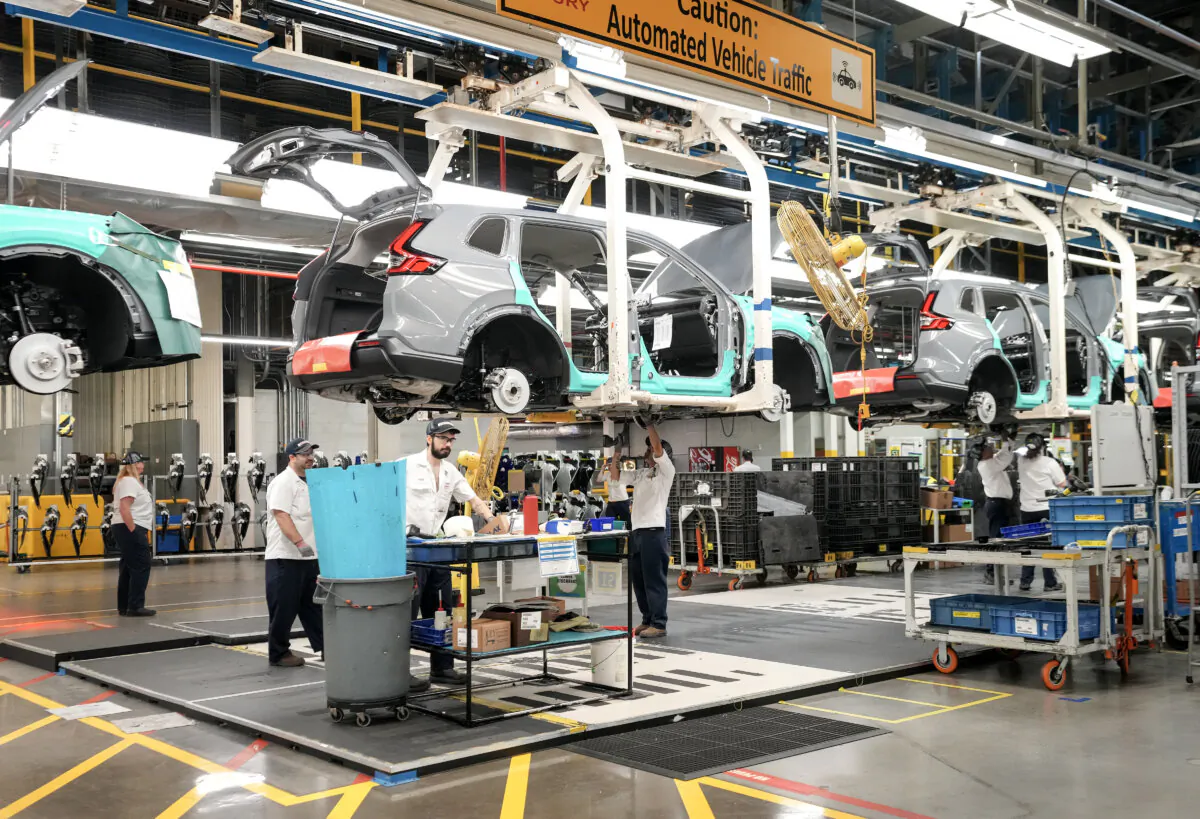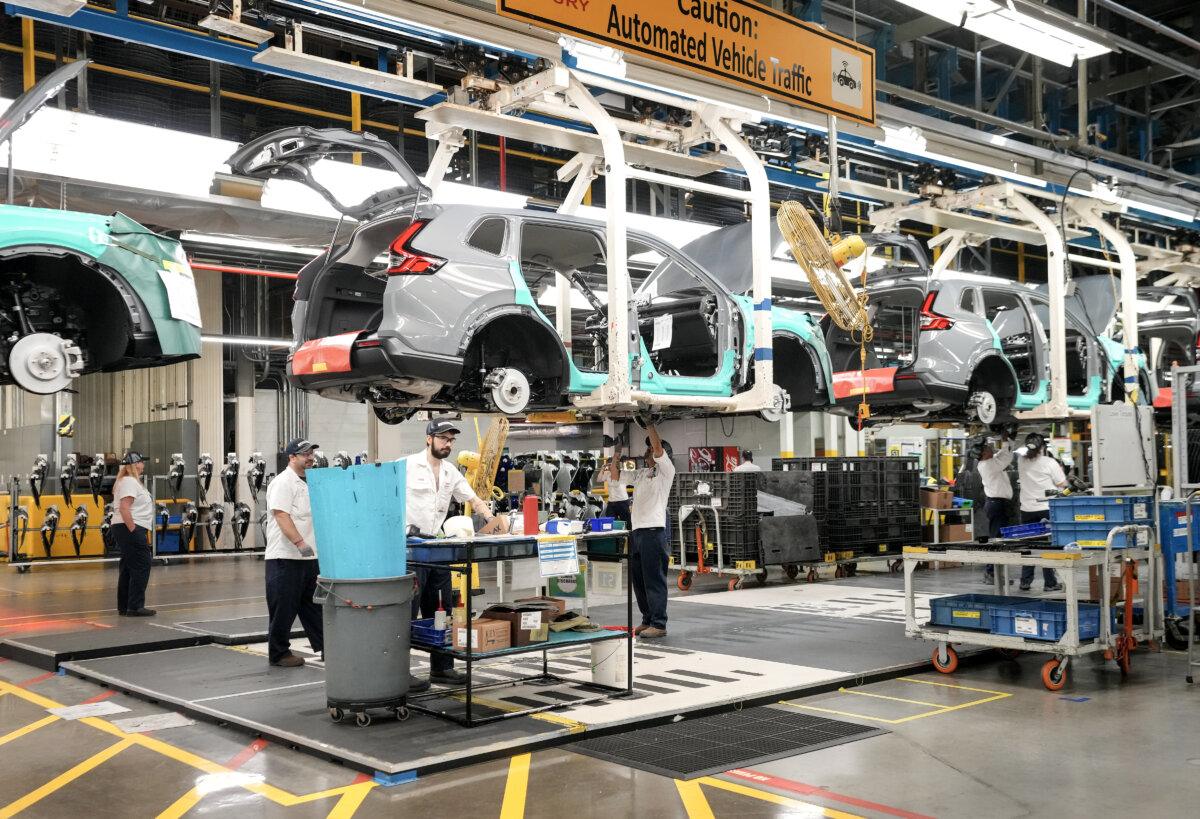

The heads of associations for Canada’s automotive manufacturers and dealers told MPs that they want to see an end to electric vehicle (EV) mandates that are harming competitiveness in the sector, as well as a negotiated deal with the United States ending automobile tariffs.
“Priority one is the elimination of the federal EV mandate, known as the Electric Vehicle Availability Standard. This regulation is prioritizing EV sales over the development of our North American EV supply chain,” Canadian Vehicle Manufacturers’ Association (CMVA) President and CEO Brian Kingston told the House of Commons Industry Committee on Oct. 27.
The federal government’s EV mandate, announced in 2023, requires that at least 20 percent of new light-duty vehicles sold in 2026 must be zero-emission, with that share rising each year until it reaches 100 percent in 2035. Automakers unable to meet the 2026 target can purchase compliance credits from competitors and limit sales of internal combustion vehicles. The mandate was introduced to reduce greenhouse gas emissions and create new jobs for Canadians.
The CEOs of Stellantis Canada, GM Canada, Ford Canada, and the CVMA met with Prime Minister Mark Carney in July to request an end to the EV mandate. Then, in September, Carney announced that 2026 model year vehicles would be waived from the Electric Vehicle Availability Standard requirements, while a 60-day review of the EV mandate would be launched and Ottawa would explore options to bring more affordable EVs to Canada.
Kingston said in the context of the United States’ 25 percent tariffs on vehicles and automotive parts, the federal government should focus on “things in Canada’s control,” which include eliminating the EV mandate. Kingston said the mandate is imposing “punitive costs on companies” that fail to meet the sales targets.
The CEO said that while the mandate adds costs for car manufacturers that fail to sell enough EVs, foreign automakers that import vehicles into Canada but do not manufacture there do not face the same penalties. “The result is there’s little incentive remaining to build vehicles in Canada today,” he said.
Kingston also told MPs on the committee that Ottawa needs to prioritize getting the United States to take the auto tariffs off Canada, and then renegotiating the United States-Mexico-Canada Agreement. The CEO said with 90 percent of Canadian automotive production heading south of the border, “there is no industry without U.S. access.”
According to Kingston, in the first 10 months of 2025, automakers will pay US$10.6 billion in tariffs on vehicles imported from Canada and Mexico, which does not include tariffs on steel and aluminum that will increase prices further.
“We’re now in a situation where it is more cost-effective to manufacture a vehicle in Japan or Germany and export it to the U.S., as opposed to manufacturing in North America, for North America. It doesn’t make sense,” he said.
Canadian Automobile Dealers Association national spokesperson Huw Williams said Ottawa’s EV mandate is “one of the major impediments that our dealers are worried about.” He said the decision to delay the EV mandate for 2026 was a “good first step,” but Ottawa needed to go further and eliminate it altogether.
Williams also said the federal government should eliminate the “luxury tax,” which applies to vehicles and aircraft priced above $100,000 and vessels above $250,000, unless an exemption applies. Williams said the tax is “inefficient” and can now apply to electricians and construction workers buying work trucks that are “not luxury vehicles.”
“We already have a perfect tax system, the GST, that as you pay more for any good, you pay more tax,” Williams said.
David Adams, president and CEO of Global Automakers of Canada, told the committee that the federal government should establish the modern equivalent of the 1961 Royal Commission on the Automotive Industry, which helped lead to the 1965 Auto Pact with the United States establishing free trade between the two countries.
Adams also said Ottawa should develop a new North American model prioritizing critical minerals, semiconductors, and vehicle software, ensuring “we are a partner that the U.S. truly cannot live without.” He also recommended Canada seek to diversify its markets, focusing on other G7 countries that it has free trade agreements with.
The Liberal government says EV mandates will help reduce greenhouse gas emissions and will help put “Canada on a path to achieve at least a 40 percent reduction in emissions below 2005 levels by 2030.”
The Conservatives say the mandates should be removed, arguing that they harm both the industry and consumers.
 Friends Read Free
Copy
Facebook
Tweet
Friends Read Free
Copy
Facebook
Tweet