
OTTAWA—The Bank of Canada has left its key rate at 2.25 percent for a third consecutive meeting, while warning the ongoing conflict in the Middle East will raise global inflationary pressures and squeeze Canadians’ purchasing power.
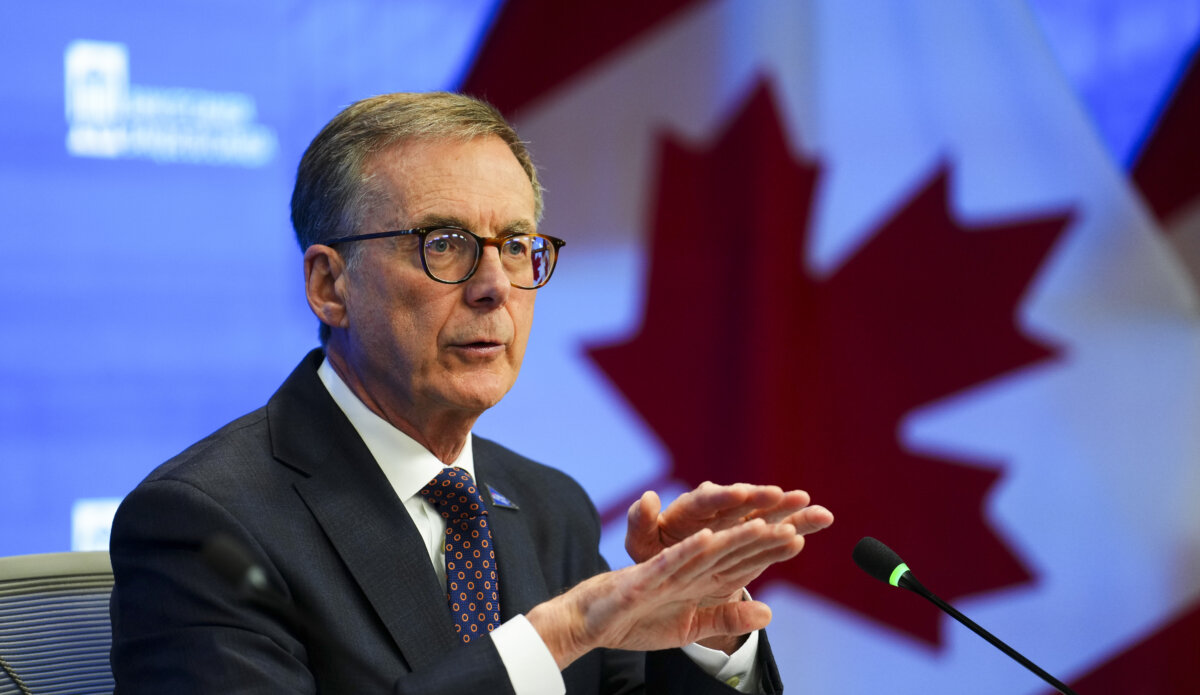
“The war in Iran is causing oil prices to move sharply higher, and this will push up inflation in the short term. Canada’s economy is dealing with a lot, and now we face more volatility,” Bank of Canada Governor Tiff Macklem said on March 18.
Oil prices have surged to nearly US$100 a barrel since the United States and Israel launched strikes on Iran on Feb. 28, and Iran responded by virtually closing the crucial Strait of Hormuz waterway and attacking the energy infrastructure of several Gulf countries. The Bank of Canada said the conflict has increased uncertainty in global energy and financial markets, and the scope and length of the war is uncertain.
The Bank of Canada warned that, in addition to energy disruptions, the war could affect supplies of other commodities like fertilizer due to shipping disruptions through the Strait of Hormuz. However, the Bank also said higher energy prices will boost income from oil exports, which would benefit the province of Alberta.
Following four rate cuts in 2025, the Bank of Canada has kept interest rates steady at 2.25 percent since October, saying the current rate was at an appropriate level to deal with inflation. The Bank also said there was continued unpredictability due to trade disruptions and the upcoming United States-Mexico-Canada Agreement review in July.
Macklem said that compared to the January Monetary Policy Report, risks to economic growth are now “tilted to the downside,” which could favour another rate cut. However, he said higher energy prices have created risks to the upside for inflation.
The governor said the Bank faces a “dilemma,” as raising interest rates to slow inflation could further weaken the economy, while easing them to support growth could raise inflation beyond the Bank’s 2 percent target. Macklem said with inflation near the target and the economy in excess supply, the risk of higher energy prices fuelling inflation looks contained for now.
“But the longer this conflict lasts and the wider it gets, the bigger the risks,” Macklem said. “Governing Council will look through the war’s immediate impact on inflation, but if energy prices stay high, we will not let their effects broaden and become persistent inflation.”
Statistics Canada’s latest inflation report showed that annual inflation fell from 2.3 percent in January to 1.8 percent in February, which was driven in large part by a rise in prices in February 2025 at the end of a two-month GST holiday. However, the Bank of Canada said inflation will be higher in the coming months due to a rise in gas prices.
An earlier Statistics Canada report also showed that Canada lost 84,000 jobs in February, pushing the unemployment rate up 0.2 points to 6.7 percent, after 25,000 jobs were lost in January.
The global economy was on pace to grow at around 3 percent prior to the Iran war, according to the Bank of Canada. U.S. economic growth remains solid and inflation continues to be slightly above target, while the European Union is seeing steady domestic demand and weaker exports. Meanwhile, China’s economy has had strong exports but weak domestic demand.
The Bank of Canada will release its next interest rate decision on April 29, where it will also release the next Monetary Policy Report.
 Friends Read Free
Copy
Facebook
Tweet
Friends Read Free
Copy
Facebook
Tweet