
Canada’s annual inflation rate fell to 1.8 percent in February from 2.3 percent in January, according to a new Statistics Canada report.
The slowdown was “largely driven” by a monthly rise in prices in February of last year at the end of a two-month GST holiday introduced by the Liberal government of then-Prime Minister Justin Trudeau, according to StatCan’s March 16 report.
Starting Dec. 14, 2024, Trudeau introduced a policy removing the GST on items like restaurant meals, drinks, toys, clothing, and Christmas decorations, citing cost of living pressures. Prices of these items jumped when the GST break ended on Feb. 15, 2025. This created a base-year effect that lowered the annual inflation rate this February, StatCan said.
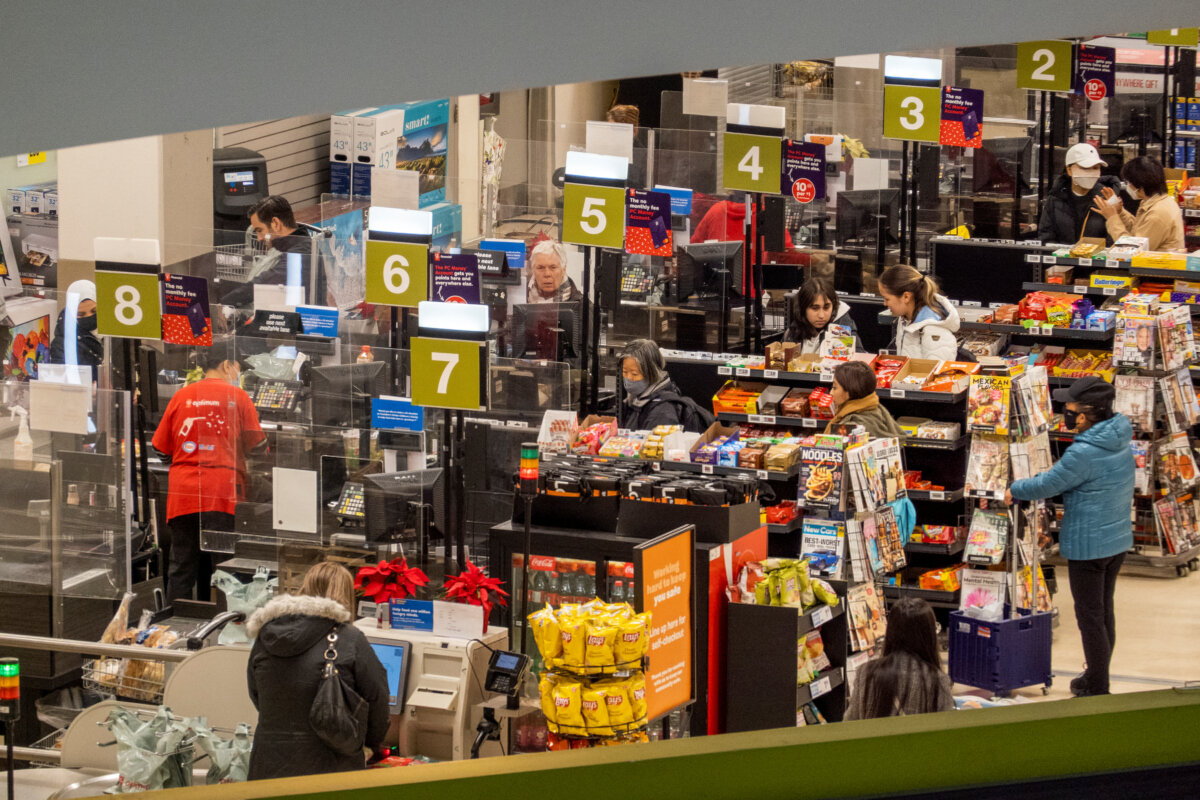
The price of food in stores rose by 4.1 percent in the year through last month, compared with an annual 4.8 percent increase in January. Statistics Canada said the “modest” price slowdown was led by fresh and frozen beef, which had risen by 13.9 percent in February after an 18.8 percent increase in January.
Overall, food prices in Canada have risen by 30.1 percent since February 2021.
Annual price increases of cellular services also slowed in February, increasing by 1.5 percent from 4.9 percent in January. Lower-priced plans from several wireless service providers led to a 3.3 percent drop in February compared to the previous month.
StatCan said gasoline prices fell by 14.2 percent year over year in February, while natural gas dropped by 17.1 percent. There was a smaller year-over-year decline in February because gasoline prices rose 3.6 percent monthly in the lead-up to the conflict in the Middle East, along with “oil supply disruptions in some producer countries.”
The monthly inflation rate is likely to be higher in March as the conflict in the Middle East boosts gas prices. The United States and Israel attacked Iran on Feb. 28, which led to retaliation from Iran and disruptions in the Strait of Hormuz, a key global oil route. Amid the conflict, Brent crude oil has risen from US$71 a barrel to US$98.
BMO Chief Economist Doug Porter wrote in a note to clients that February’s inflation numbers represented the “calm” before the “storm.” He said that while underlying inflation was cooling at the start of 2026, the latest StatCan report had a “stale feel” due to recent developments in energy markets leading to a 15 percent rise in gasoline prices.
Dalhousie University Agri-Food Analytics Lab director Sylvain Charlebois earlier told The Epoch Times that the closure of the Strait of Hormuz is “of great concern for the agriculture sector,” given that 30 percent of chemical fertilizers pass through the Strait.
Charlebois said the Strait’s closure could have “ripple effects” on Canadian energy, transportation, and eventually food costs.
Before the onset of the Middle East conflict, the 2026 edition of Canada’s Food Price Report had anticipated grocery prices would rise by between 4 percent and 6 percent this year, costing the average family of four an extra $994.63.
 Friends Read Free
Copy
Facebook
Tweet
Friends Read Free
Copy
Facebook
Tweet