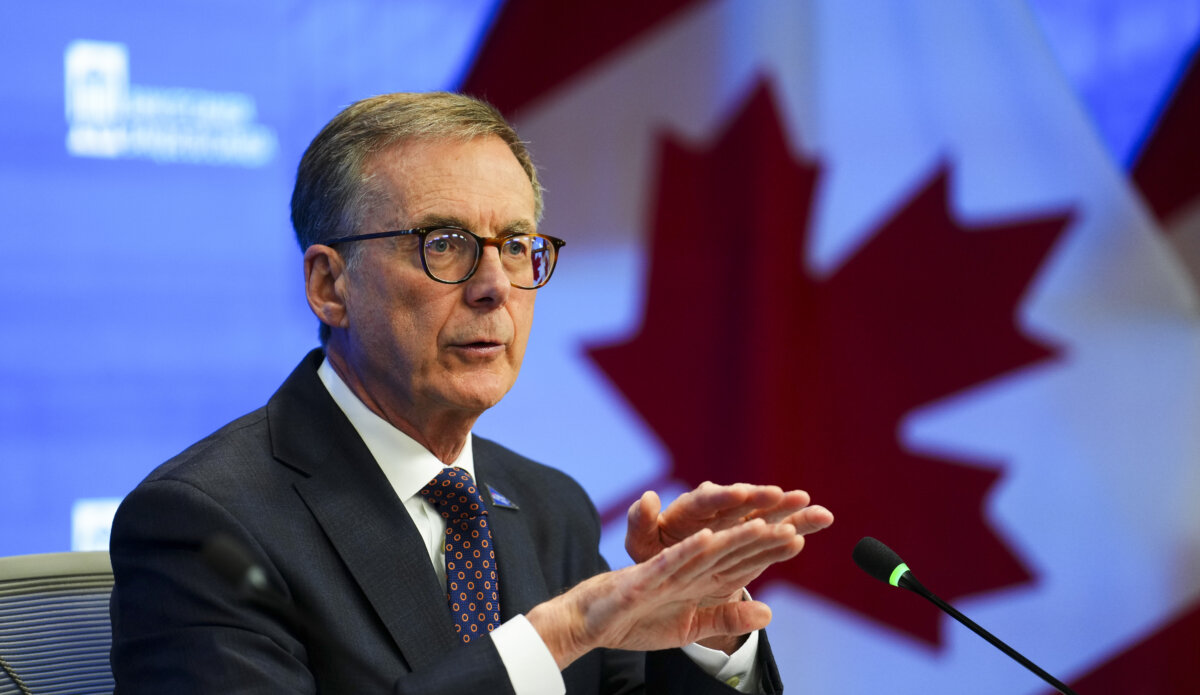

The Bank of Canada announced it is maintaining its policy rate at 2.25 percent, noting Canada’s economy has shown resilience in the face of U.S. tariffs.
“Nevertheless, uncertainty remains high and the range of possible outcomes is wider than usual. If the outlook changes, we are prepared to respond,” Bank of Canada Governor Tiff Macklem said on Dec. 10.
Macklem said if inflation and economic growth in Canada remain in line with the Bank’s October Monetary Policy Report, the current policy rate level would be at “about the right level” to keep inflation near 2 percent while helping Canada’s economy grow.
The Bank predicts that inflation will grow at 2 percent and Canada’s economy will expand at a “moderate” pace in 2026, according to Macklem. “We agreed that a policy rate at the lower end of the neutral range was appropriate to provide some support for the economy as it works through this structural transition while keeping inflationary pressures contained,” he said.
The governor said economic uncertainty remains “elevated” because of the “unpredictability” of U.S. trade policy, which includes the upcoming United States-Mexico-Canada Agreement (USMCA) review slated for 2026. Macklem said the trade volatility will make it more difficult to “assess the underlying momentum of the economy.”
The Bank said Canada’s economy grew by a “surprisingly strong” 2.6 percent in the third quarter of 2025, even with “flat” domestic demands, which reflected volatility in trade. It expects the final quarter of the year to have growth in domestic demand, but with weak GDP and a decline in net exports.
Macklem said with Statistics Canada making revisions to the country’s economic growth numbers for 2022, 2023, and 2024, it appears Canada’s economy was “healthier than we previously thought” before U.S. tariffs were imposed at the start of 2025. He said this suggested demand and supply were higher at the beginning of this year, which he said “may explain some of the resilience we’re seeing in more recent data.”
Canada’s labour market has shown signs of improvement with unemployment falling to 6.5 percent in November, but job markets in sectors sensitive to the trade dispute with the United States remain weak, and hiring intentions across the economy remain weak.
Inflation slowed to 2.2 percent in October due to falling gasoline prices and a decline in the growth of food inflation. The Bank said the Consumer Price Index inflation has remained at around 2 percent for most of the year, but it is likely to rise in the near future due to the impact of last year’s GST holiday.
Macklem said measures from the recent federal budget, such as an increase in military spending and policies to increase investment, will take “some time” to work its way through the economy. The Bank will incorporate updated fiscal measures into its next economic projection in January, Macklem said.
Macklem also reiterated that the Bank’s monetary policy cannot make up for job losses and reduced economic activity due to U.S. tariffs, but it can help Canada’s economy adjust to tariffs. “The Bank of Canada is focused on ensuring Canadians continue to have confidence in price stability through this period of global upheaval,” Macklem said.
The October Monetary Policy Report released on Oct. 29 said Canada’s economy has been put on the “lower path” due to U.S. tariffs, leading to a fall in demand for Canadian exports and higher costs for Canadians. The report expects there will be weak GDP growth of around 0.75 percent in the second half of 2025, with new U.S. tariffs on copper, furniture, and softwood lumber and Chinese tariffs on canola, peas, pork and seafood putting further strain on the economy.
The report expects inflation to fall from 2.4 percent in September to around 2 percent in early 2026, as the removal of Canadian counter-tariffs on the United States will put downward pressure on the metric. The report expects there to be an easing of inflation for services, excluding shelter, over its projection horizon.
 Friends Read Free
Copy
Facebook
Tweet
Friends Read Free
Copy
Facebook
Tweet