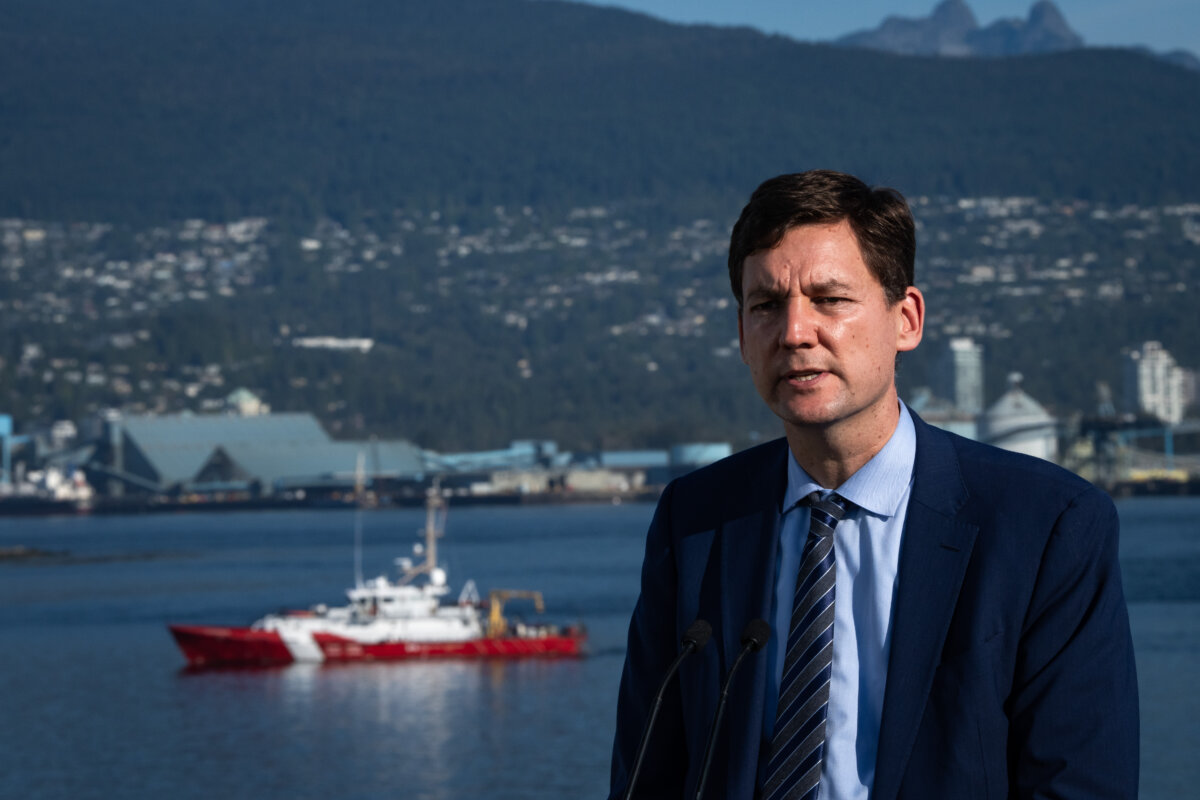

B.C. Premier David Eby and coastal First Nations have signed a declaration asking Ottawa to keep the oil tanker ban on the province’s north coast in place.
Eby said at a Nov. 5 press conference that lifting the oil tanker ban, a federal law prohibiting oil tankers on B.C.’s northern coast, would expose the region to potentially devastating oil spills with no effective cleanup method in place. The B.C. premier has long opposed lifting the ban, which became law in the summer of 2019.
Eby was joined at the Nov. 5 press conference in Vancouver by Chief Marilyn Slett, president of the Coastal First Nations, who also opposes lifting the ban. The declaration was co-signed by Haida Nation President Jason Alsop, Lax Kw’alaams Mayor Garry Reece, and hereditary elder Clarence Innis.
The B.C.-First Nations joint declaration says that lifting the oil tanker moratorium would put various major projects in jeopardy and cause environmental harm to the region.
“We urge the federal government to stand firm in its commitment to uphold the tanker ban,” the statement reads. “Protecting the North Coast is not an item for negotiation—it is a national responsibility, and it is a quantifiable investment in Canada’s treasured marine environment and the economic prosperity of future generations.”
Alberta Premier Danielle Smith opposes the oil tanker moratorium, saying it blocks her province’s plan to build a pipeline to transport crude oil to the coast for international export.
Smith’s office said in a Nov. 5 statement to the Epoch Times that the province recognizes the concerns voiced by Eby and is working to find a private proponent for the pipeline and attain First Nations approval.
“We have heard Premier David Eby’s concerns and are working to address them,” the statement reads. “We agree there needs to be a credible proponent and extensive First Nations engagement and co-ownership for this project to move forward.”
The premier’s office said it expects the federal government to back its pipeline proposal by fulfilling its role of regulating interprovincial trade and commerce.
Alberta announced on Oct. 1 that it will act as chief proponent in developing a pipeline proposal for submission to Ottawa’s Major Projects Office (MPO). The move has been opposed by Eby who says it’s “not a real project” because of its lack of private backing.
The MPO was launched in late August and aims to fast-track hand-picked projects deemed in the national interest.
The suggested pipeline route is expected to extend from Alberta’s oil sands to either Kitimat, B.C. or Prince Rupert, B.C., transporting one million barrels of oil per day. Smith has said the decision on the pipeline’s progression serves as a “test” of Canada’s functionality as a nation.
“If we can’t build with collaboration of the federal government and between provinces, if it’s everybody gets to get their products going to market, except Alberta, that’s not a country,” Smith said Oct. 1.
Energy Minister Tim Hodgson said last month that Alberta’s pipeline proposal will need the support of B.C. and coastal First Nations to move forward for potential fast-tracked approval by Ottawa’s MPO.
Prime Minister Mark Carney said the federal government “is interested in results” but wouldn’t comment last month on whether the oil tanker ban or the oil and gas emissions cap might be lifted.
Conservative Leader Pierre Poilievre has repeatedly said that Alberta’s pipeline project should be given immediate federal approval.
Canada is the fourth-biggest oil producer in the world, with net crude oil export receipts climbing from roughly 1.7 million barrels per day in 2012 to an average of 4.2 million barrels per day last year, according to the Canada Energy Regulator.
 Friends Read Free
Copy
Facebook
Tweet
Friends Read Free
Copy
Facebook
Tweet