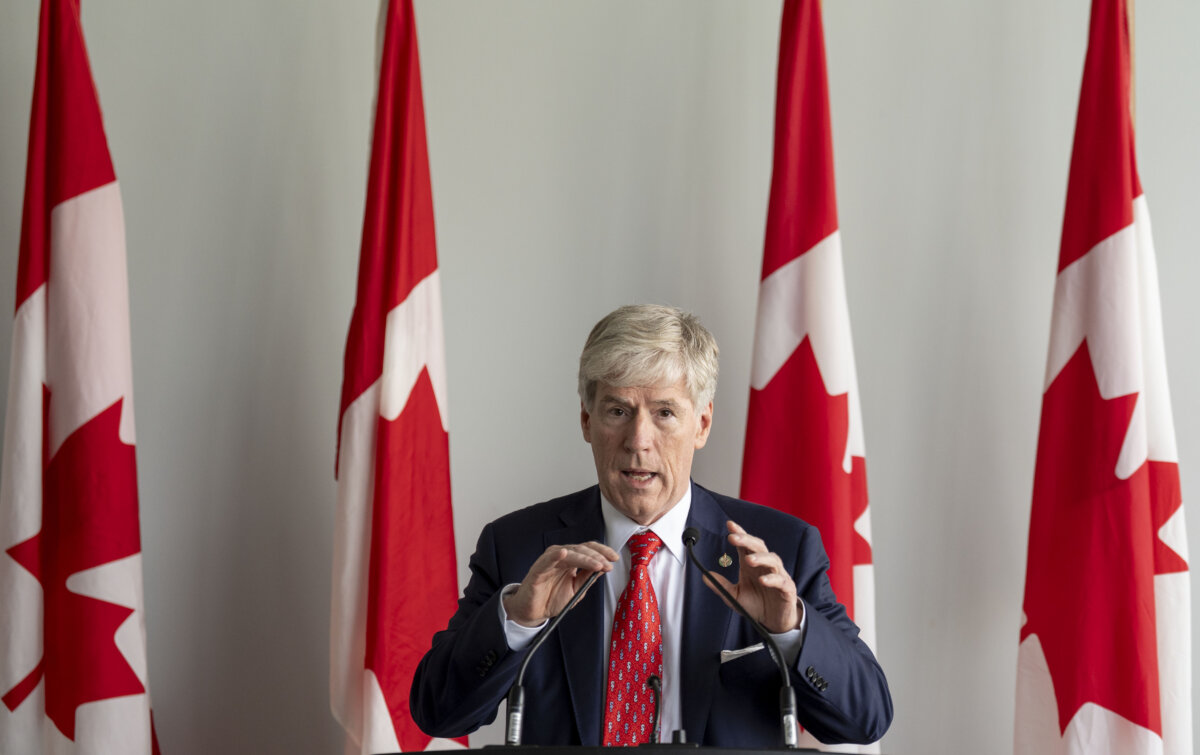

The oil pipeline proposal currently being developed by Alberta will need the backing of B.C.’s government and First Nations along the pipeline route for it to be built, federal Energy Minister Tim Hodgson says.
Alberta announced Oct. 1 that it would take the lead in crafting a pipeline proposal, with expertise and input from industry leaders, and submit the plan to the federal Major Projects Office (MPO) no later than May of next year. The MPO was created under the Carney government’s Building Canada Act and aims to fast-track approval for projects chosen by Ottawa as being in the national interest.
“We have said that to build, you need the support of the jurisdiction you build through and the support of First Nations. The proponent—in this case, the Province of Alberta—must attract that if they want to build,” Hodgson said Oct. 9 in comments to the Senate. He said questions about the proposal are “hypothetical” until an application is received by the MPO.
“That is between the Province of Alberta and the Province of British Columbia,” he added. “We have said we will be a constructive participant in that three-way discussion.”
The proposed pipeline route has not yet been determined, according to Smith, who said it would likely end at Prince Rupert, B.C., or Kitimat, B.C., and carry 1 million barrels of crude oil per day.
When asked about the proposal on Oct. 10, Carney said the project could be possible if it meets the required characteristics.
“This government believes in nation-building projects, in both clean and conventional energy,” Carney said when asked directly by reporters in Ottawa on Friday about whether he supports a pipeline from Alberta to B.C.
“Those projects have several characteristics. Material, economic benefits, linking together different parts of our economy. Consistency with our climate objectives and benefits and participation for Indigenous peoples. So those elements coming together can come together in a pipeline to the West Coast.”
BC Government Opposes Pipeline Plan
B.C. Premier David Eby has criticized the pipeline proposal Alberta has under development, saying it’s “not a real project” because it doesn’t have private backers and could hinder projects B.C. is ready to move forward on with First Nations approval. The second phase of LNG Canada’s port at Kitimat, B.C., and an expansion project for the Red Chris mine have both been flagged on the major projects list.
The proposal being developed by Alberta is “incredibly alarming to British Columbians, including First Nations along the coast whose support is required for the success of the billions of dollars in real projects that I’m talking about,” Eby said during a press conference in Victoria on Oct. 1.
Opposition to Alberta’s proposal has also come from a group of B.C. coastal First Nations, who issued a press release on Oct. 1 following the announcement saying they have opposed oil tankers along their coasts for “50 years,” adding that Smith’s proposal has “no support from Coastal First Nations.”
Smith’s Proposal
Smith has said that the response to the pipeline plan being developed by her province will be a “test” of Canada as a country.
“This is a test of whether Canada works as a country, because if we can’t build with collaboration of the federal government and between provinces, if it’s everybody gets to get their products going to market, except Alberta, that’s not a country,” Smith said Oct. 1.
Smith added that she’s confident private investment and private proponents will come forward once the pipeline project goes through the initial regulatory approval processes by being fast-tracked by the MPO. Smith says there are several pieces of federal legislation, such as an oil tanker ban off of the coast of B.C., that stand in the way of oil and gas development and drive away investments, and she wants to use the new MPO to remove the effect of those regulations.
During a House of Commons environment committee meeting on Oct. 9, Conservative MP Branden Leslie asked whether the MPO will be able to bypass the oil tanker ban. MPO staff member Sarah Jackson responded by saying she wouldn’t speak on whether a “hypothetical project” could be granted an exemption.
When asked about the tanker ban on Oct. 10 as well as the emissions cap on the oil and gas sector, which Alberta has also asked for, Carney didn’t rule out their removal.
“It depends,” Carney said. “What this government is interested in is results, not objectives. We want to see results. We want to see lower carbon conventional energy, lower carbon mining, lower carbon manufacturing because that is going to be a driver of competitiveness.”
Meanwhile, Conservative Leader Pierre Poilievre has also weighed in, saying the government should approve the project immediately.
“The government should greenlight it today,” Poilievre said during an Oct. 9 press conference. “If they get out of the way and grant a permit, there will be billions of dollars of private money that will rush in and build this pipeline with lightning speed.”
 Friends Read Free
Copy
Facebook
Tweet
Friends Read Free
Copy
Facebook
Tweet