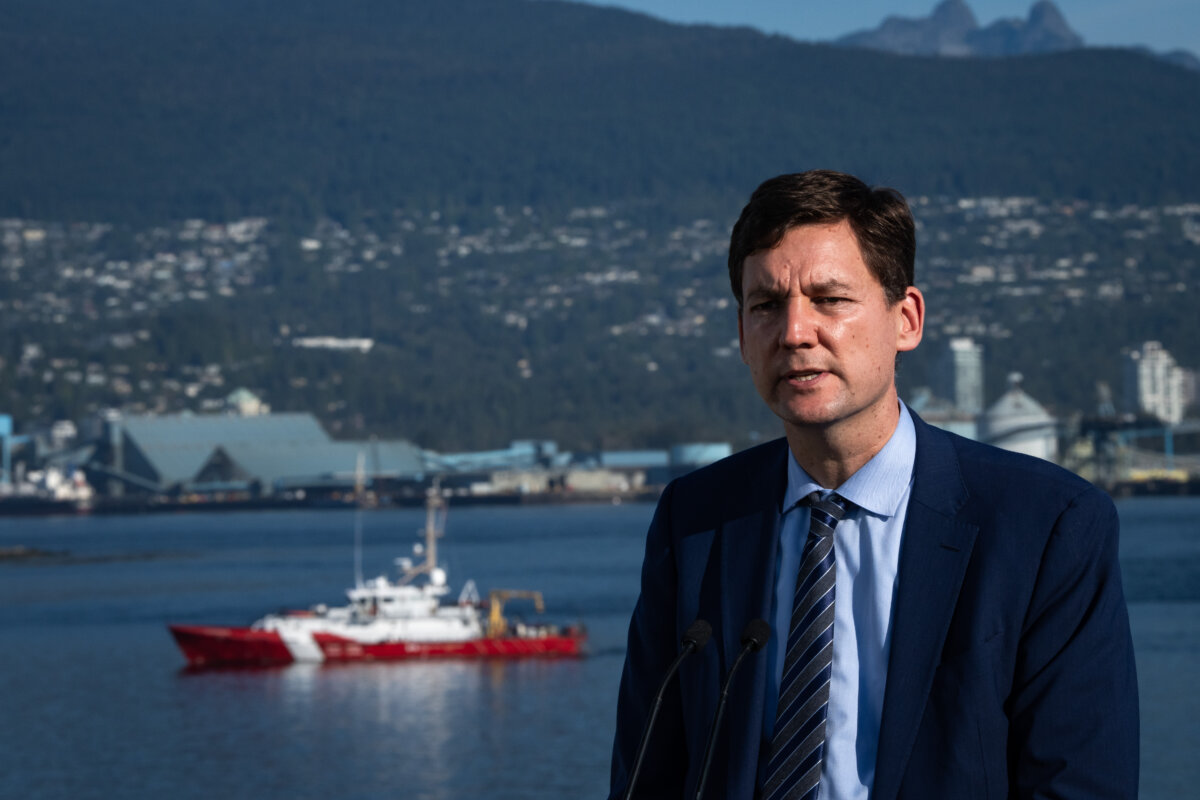

B.C. Premier David Eby says he is “disappointed” by the recent decision of a Saskatchewan potash and fertilizer company to set up a $1 billion export terminal in Washington state rather than at a port in his province.
Potash and fertilizer producer Nutrien has confirmed it has chosen the Port of Longview in Washington over ports in Vancouver or Rupert, B.C.
The premier told reporters during a Nov. 24 press conference that he was “really disappointed” by Nutrien’s decision, saying he would’ve been onboard with expanding ports in B.C. to meet Nutrien’s needs.
“Obviously there’s the potential for port expansion in British Columbia, which I’m a big fan and supporter of,” he said. “I think that we are ideally suited to ship bulk materials like potash to world markets.”
Eby said he believes the company’s decision will place the fate of Saskatchewan potash “in the hands of Donald Trump.”
“Trump could decide to put a tariff on Saskatchewan potash that passes out of the state of Washington. He may decide to close the border to Saskatchewan potash, if he decides Canada has done something that offends him,” Eby said. “It puts Saskatchewan’s resources in a precarious place, and it denies British Columbia a chance for port expansion. That seems like the worst of both worlds.”
Nutrien has said the Longview port was the best fit for its expansion plans. Nutrien corporate and trade media manager Shawn Churchill said in an emailed statement that it assesses “major projects against a disciplined set of operational, commercial, and financial criteria that reflect a multi-decade time horizon.”
Federal Transportation Minister Steve MacKinnon told reporters this week that he was “disappointed” by the company’s decision to choose a U.S. port over a Canadian one.
“We’re hoping to persuade the company to change its mind,” MacKinnon said.
The Saskatoon company, however, has said the decision to expand in Washington has not been finalized, and Churchill told The Epoch Times the company meets “regularly with government and lines of communication remain open.” A final investment decision is expected in 2027.
“We are focused on ensuring Canadian potash continues to meet rising global demand in the most competitive way possible,” Churchill added.
The company assessed roughly 30 criteria across both Canadian and U.S. ports before reaching a decision, Churchill said, adding that Longview offered strong rail connectivity, deep-water access, and construction feasibility.
“Port of Longview best met the technical and commercial requirements,” he said. “It is designed to complement our existing Canadian port capacity and to support long-term production growth in Saskatchewan.”
BC-Sask. Relationship
Saskatchewan’s Opposition NDP urged Premier Scott Moe during question period on Nov. 25 to consult with Eby on access to the Port of Vancouver.
“We’re losing major infrastructure projects to the U.S. because this government is missing in action,” NDP MLA Sally Houser said. “Will he do his job and advocate with the current B.C. premier for better port access?”
Moe was critical of Eby in his response, referencing the B.C. leader’s opposition to ending the ban on oil tankers operating off his province’s northern coast.
“We see much investment being targeted for the west coast of our continent and then we see an NDP premier stand up, that premier says we don’t want oil in this port because we can’t get a boat into it,” Moe replied. “Then that same NDP policy-making premier questions why another industry isn’t making that very investment in our nation.”
Eby has not said if his government plans to try to persuade Nutrien to invest in B.C., but the province has port expansion listed on its preferred projects for Ottawa to invest in as part of its economic push to become less reliant on the United States.
“We put port expansion on our major project list multiple times and … we’re ready to go,” Eby said in his press conference. “And I really encourage all the premiers in Canada who are shipping through British Columbia to engage with me on this important issue.”
Eby also criticized Moe in his comments, saying the premier should have contacted him to discuss the matter.
A recent Globe and Mail report citing unnamed government sources said Ottawa was nearing an agreement with Alberta and Saskatchewan on a proposal for a potential new oil pipeline stretching from Alberta to the B.C. coast, which would be built alongside a carbon capture project. The report added that the agreement could potentially involve exemptions to the oil tanker ban in areas where the pipeline accesses B.C. tidewater.
Eby made reference to the report in his comments this week.
“The piece that really bothered me the most was that instead of talking with British Columbia about potash shipments, the premier of Saskatchewan was allegedly talking with the federal government about Alberta’s fictional oil pipeline project, and that really was just the cherry on top,” Eby said.
Moe referred to Eby’s comments during question period, accusing the B.C. premier of driving away investment from Canada because of his lack of enthusiasm for a potential new oil pipeline stretching from Alberta to the B.C. coast and resistance to lifting the tanker ban.
Moe said Eby should not be surprised that “investment is fleeing this nation.”
“When it comes to having the opportunity to be part of the solution or part of the problem, time and time and time again in this nation we see the NDP being part of the problem each and every time,” Moe said.
Pipeline Project
A pipeline could be one of the so-called nation-building projects that Ottawa decides to pursue now that the Liberals have launched a Major Projects Office (MPO) as part of the Building Canada Act.
Alberta Premier Danielle Smith plans to submit a pipeline project to the MPO in the spring to transport the province’s oil and gas to the B.C. coast for export to international markets. She has said she wants the project to meet initial regulatory requirements through the government office to make it more attractive for private investors to support later.
Smith has spoken of a “grand bargain” which would see the proposed Pathways Alliance carbon capture project move forward alongside the proposed oil pipeline and has vowed to win Eby over on the project.
Eby suggested earlier this year that he would consider a pipeline if Smith was able to convince the federal government to approve one, but has emphasized his focus is on decarbonizing his province’s economy.
Eby last week reiterated that he would go along with the pipeline project if it was deemed necessary.
“We have been quite frank with Alberta and with the federal government that although we never supported the pipeline and we’re not enthusiastic about it, we’re good team players on Team Canada and we’re willing to do what we can to support an expansion project if it’s needed,” Eby told reporters in Surrey, B.C., on Nov. 21.
Carney said this week in the House of Commons that B.C. and First Nations have to agree to any pipeline being built to the Pacific coast.
He said a potential memorandum of understanding with Alberta would lay out “necessary conditions but not sufficient conditions” for a pipeline project, adding there is still work to do to get the provincial government and First Nations on board.
British Columbia has a history of pipeline opposition. The federal government purchased the Trans Mountain pipeline expansion project in 2018 for $4.5 billion after energy conglomerate Kinder Morgan abandoned it, citing opposition from the B.C. government as a contributing factor.
The Canadian Press and Matthew Horwood contributed to this report.
 Friends Read Free
Copy
Facebook
Tweet
Friends Read Free
Copy
Facebook
Tweet