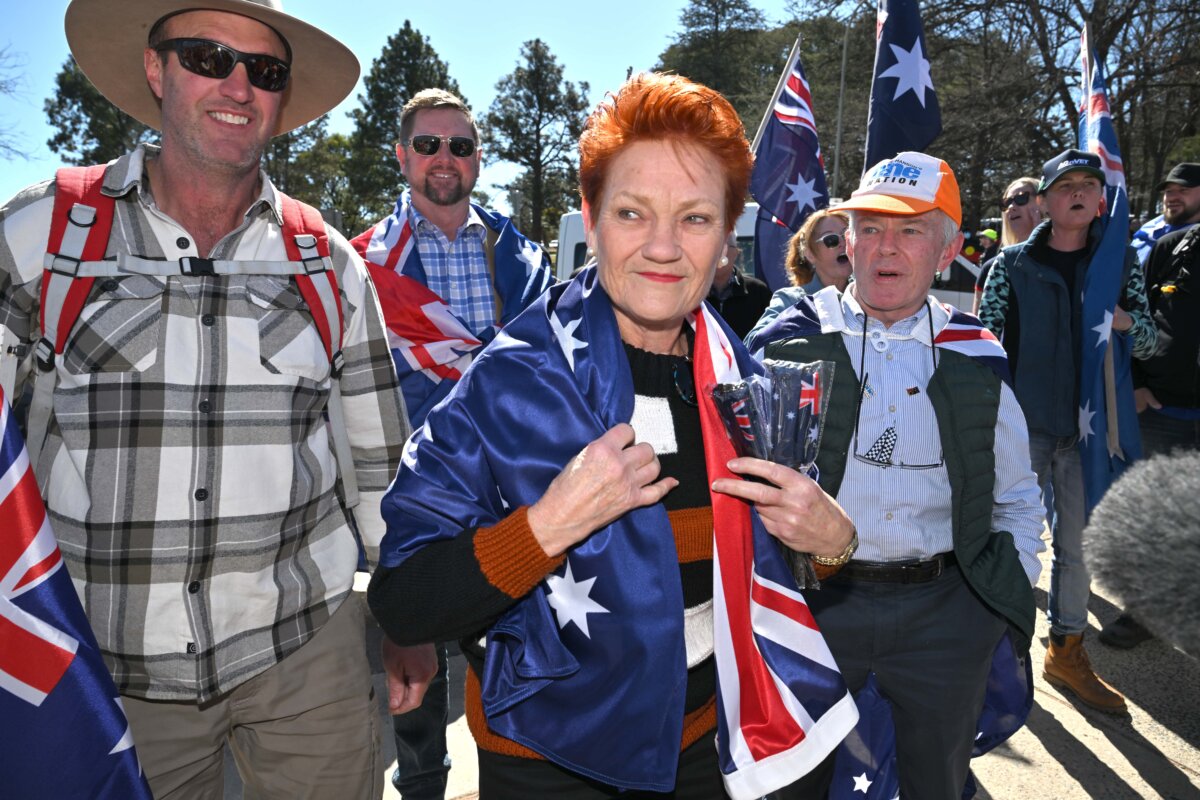

Former councillor and now-One Nation Riverina branch president, Paul Funnell, has high hopes for the conservative party, which has enjoyed a renaissance of support in the polls.
One Nation also claims to have onboarded 1,000 new members last weekend, and enjoyed a 100 percent surge in memberships since the May federal election.
Several polls, Newspoll, Redbridge, and Essential, have recorded a spike in support for the party, at the expense of the traditional centre-right Liberal-National Coalition.
The conservative-leaning minor party has also worked to expand its grassroots branch network across New South Wales, the Australian Capital Territory, the Northern Territory, and Tasmania.
Party leader Pauline Hanson, who recently visited U.S. President Donald Trump’s Mar-a-Lago home, says she’s aiming to have One Nation senators in every Australian state.
“If it continues to grow at the rate it is, they’d take over the country,” Funnell confidently tells The Epoch Times, but with the caveat that all political parties ebbs and flow in popularity.
Funnell says much of the recent momentum is down to the lack of faith in Labor and Liberal-Nationals.
“The Coalition have introduced just about every piece of legislation that’s destroying our way of life and Labor’s just running with it,” Funnell claims, adding that both parties have steered away from their traditional voter bases.
One Nation’s Up and Down History
One Nation appears to historically have been plagued by ups and downs, with bursts of success followed by steep declines.
In 1998, One Nation won 11 seats in Queensland’s state election, but by the next election in 2001, that number fell to just three seats.
Again in 2016, One Nation re-emerged as a worthy contender, winning four seats in the federal election and taking 4.3 percent of the national Senate vote—the party’s best outcome in almost two decades.
Yet in 2017, despite polling strongly in the regions, poor preference flows and other issues led them to only securing one seat.
By the 2019 federal election, One Nation’s national share of the vote had dropped to 3.1 percent.
The ‘4th Force’ in Aussie Politics: Analyst
Polling analyst Antony Green says the party’s latest resurgence could portend a long term political contender.
“In my opinion, One Nation has seen off most other political rivals to the right of the Coalition and has established itself as the fourth force of Australian politics,” he wrote.
History shows that when One Nation’s vote grows, it grows fastest in the country and the biggest impact is felt by the Liberal Party.
For all intents and purposes, if One Nation does once again rise from the ashes, its success will largely be driven by areas—regional and suburban—held by Nationals and Liberals, even more so in Queensland.
“If the current poll trend continued, there are rural seats where One Nation will finish second on primary votes and poll above 25 percent,” Green said.
City-Country Divide Stretching Major Parties
One Nation’s policy platform aligns closely with other conservative movements that have swept democratic nations in recent times, including Argentina, Italy, the Reform Party in the U.K., and U.S. President Donald Trump in America.
Funnell says similar trends are playing out locally with traditional parties not aligned with a large portion of the population due to its concerns with maintaining a hold on inner-city electorates.
He points to the Paris Agreement inked under the Turnbull Liberal government, and later expanded on further with the Morrison government setting net zero targets.
Further, he said that while the Labor Party introduced the Murray Darling Basin plan—contentious because of how it limits water use for farmers due to environmental concerns—the Liberal-Nationals have also supported it.
“One Nation has policies and will continue to drive policies, however unfortunately, there’s a large portion of people in the cities where, in the not too distant future, it’s going to smack everyone in the forehead and then it’s going to be too late,” Funnell states bluntly, alluding to concerns that net zero and tough environmental policies will impact farmers and eventually, food prices.
Funnell’s Role Terminating Sister City Deal With China
Before joining One Nation, Funnell was a councillor in Wagga Wagga City Council, who notably managed to briefly end its official “sister city” relationship with Kunming, in China’s Yunnan Province.
It also included two other friendship cities; Tieling, in Liaoning province; and Rugao, in Jiangsu province.
In the motion, Funnell said, “We must take a stance, there is no right way to do the wrong thing. Council must do the right thing and take a stance to demonstrate its rejection of the corrupt Chinese government that has caused such death, destruction, and turmoil across the world.”
In response, the Chinese Consulate-General in Sydney published a letter urging the council to “restrain” individual councillors so there would not be any further “negative impact” on their cooperation.
A week later, the council voted to overturn its decision, resuming ties with the sister city.
In July 2021, Funnell stepped away from his council role due to ill health.
And in June 2023, the NSW Civil and Administrative Tribunal (NCAT) accused the former councillor of misconduct, finding he intimidated and threatened staff and councillors during a code-of-conduct complaint.
At the time, Funnell told media he chose not to contest the matter, in order to avoid what he termed “malicious prosecution.”
Funnell now works in irrigation, as a sheep farmer and company director.
 Friends Read Free
Copy
Facebook
Tweet
Friends Read Free
Copy
Facebook
Tweet