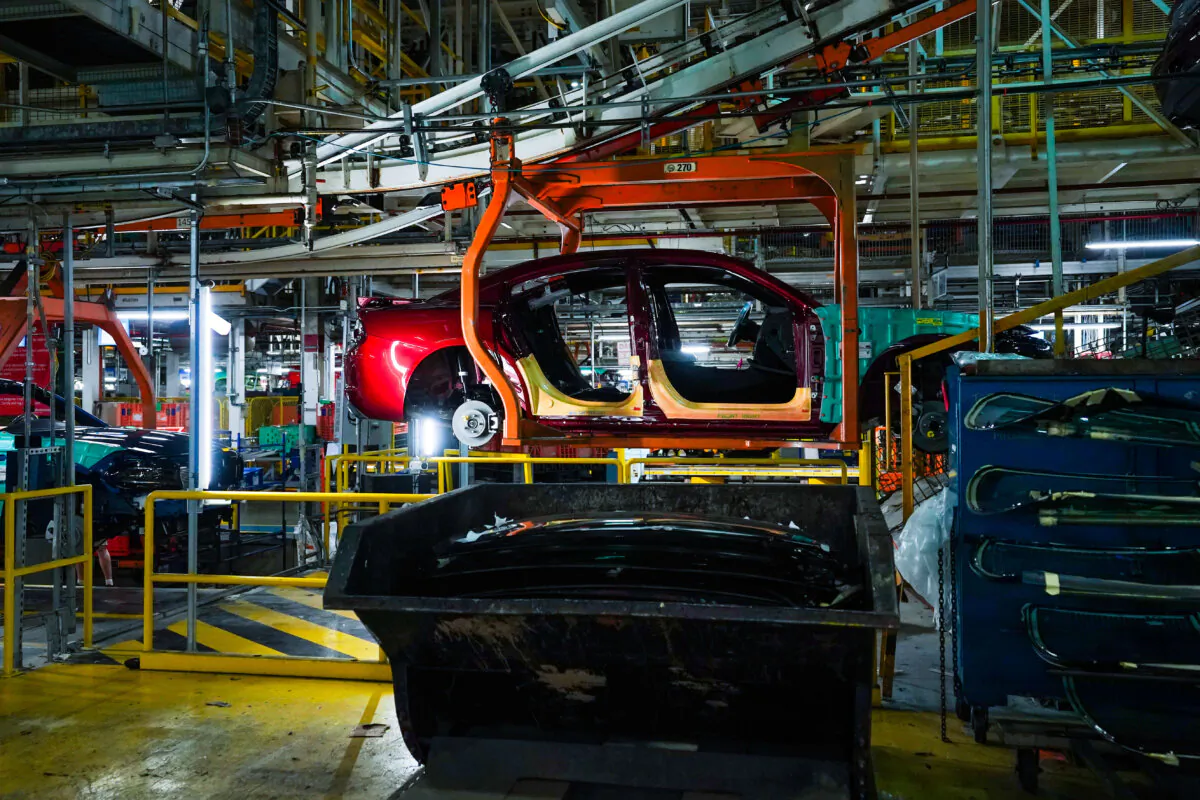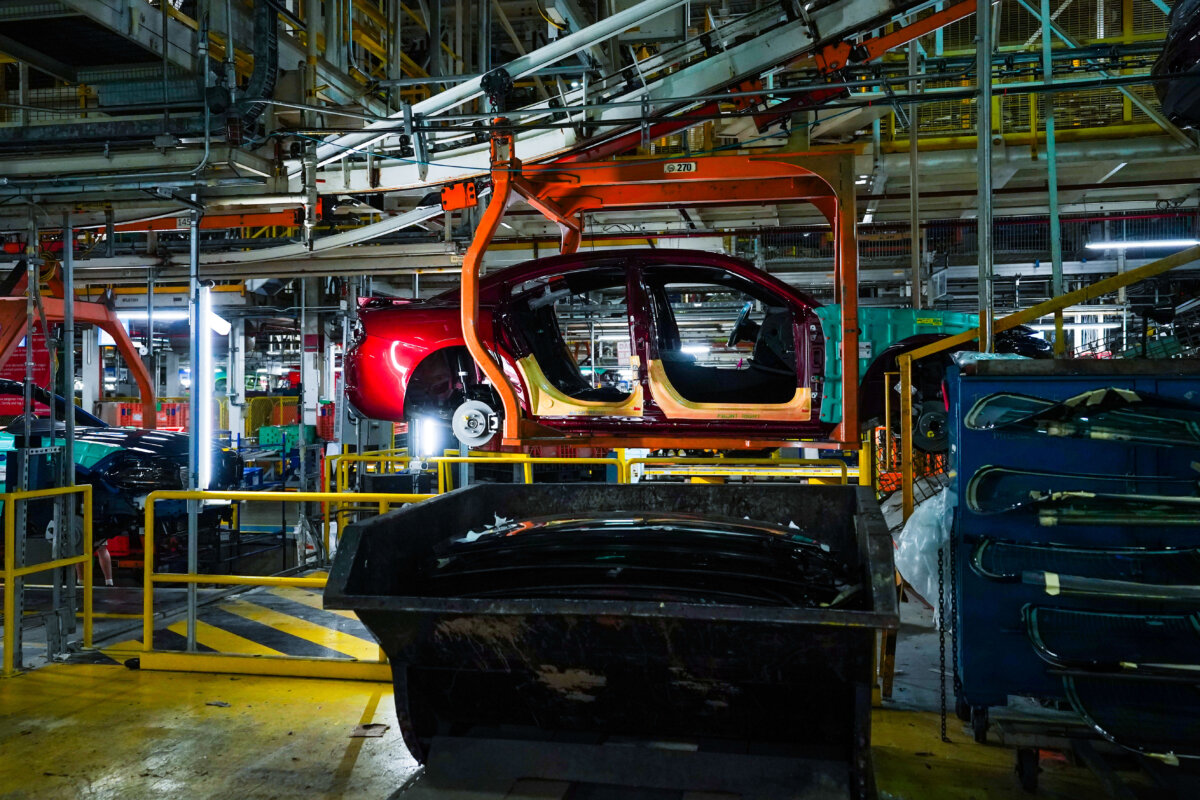

Ottawa is restricting the number of tariff-free vehicles that Stellantis and General Motors can bring in from the United States to sell in Canada, after the automakers announced plans this month to cut back assembly-line work at Ontario factories.
Stellantis and GM will no longer be eligible to get the full break on Canadian counter-tariff duties on American-made vehicles, Finance Minister François-Philippe Champagne and Industry Minister Mélanie Joly said in a late night press release on Oct. 23.
Canada imposed retaliatory tariffs on U.S. cars and light trucks in April, but carved out remission quota exemptions for some automakers to bring specific numbers of vehicles into the country. The government said at the time the exemption was contingent on the automakers continuing to make vehicles in Canada and moving ahead with investment plans in Ontario’s auto industry.
The government is now reducing the exemption quota by 50 percent for Stellantis and by 24 percent for General Motors after both companies announced production changes this month.
Stellantis said earlier this month it planned to relocate production of its Jeep Compass from Brampton, Ont., to Belvidere, Illinois while General Motors this week announced it will end production of BrightDrop electric vans at its CAMI plant in Ingersoll.
The announcements come at a time when U.S. President Donald Trump has been calling on the Big 3 American automakers to move vehicle production to the United States.
Champagne and Joly said in the joint statement that the announcements by Stellantis and GM represent a failure by both companies to uphold their “contractual obligations and respect their commitments towards Canada and their workers.”
“We are deeply disappointed with the production changes recently announced by General Motors and Stellantis,” Champagne said. “These unacceptable decisions are in contravention of their legal obligations to Canada and the Canadians workers, which is why we are reducing their import remission quotas.”
Joly met with GM, the Ontario government, and the union to “discuss next steps for Ingersoll workers” on Oct. 23, she said in an X post.
She said she expects an update from GM within 15 days, but has not said if Ottawa will consider legal action against the company for taking government funding to expand production but failing to do so. The federal and Ontario governments announced $259 million in investments in 2022 to support GM’s $2 billion plan to boost electric vehicle production in its Oshawa and Ingersoll plants.
Joly has already threatened legal action against Stellantis, noting in an Oct. 15 letter that Ottawa has given the company millions of dollars in funding on the understanding it would maintain its Canadian footprint.
Stellantis committed $3.6 billion in 2022 to retool the Brampton and Windsor, Ont., assembly plants to meet the company’s objectives for electric vehicle and battery development. Both the federal and provincial governments pledged $1.4 billion for the upgrade, bringing the total investment to $5 billion.
Joly called the company’s course reversal “unacceptable” in her letter, saying that “anything short of fulfilling that commitment will be considered as default under our agreements.”
The Epoch Times contacted Stellantis and GM for comment on the government’s decision but did not hear back before publication time.
Future Plans and Auto Tariffs
Prime Minister Mark Carney, during an unrelated Oct. 23 press conference with Ontario Premier Doug Ford, said his government is looking at what else could be done with the GM plant in Ingersoll.
While GM has said it will provide laid off employees from the CAMI plant with six months’ salary, with the potential for lump sum payments and other benefits, Carney said he is “not satisfied with that.”
He suggested the facility could be part of Canada’s upcoming “defence industrial strategy” and could employ the same workers as part of Ottawa’s plan to reduce Canada’s dependence on the United States.
Vehicles are Canada’s second-largest export and Carney has previously noted the sector employs 125,000 Canadians directly and nearly another 500,000 in related industries.
Trump has said he wants the United States to dominate auto manufacturing and has been hitting Canada’s auto sector with a 25 percent tariff on all finished vehicles that aren’t compliant with the United States-Mexico-Canada Agreement (USMCA) since spring.
Trump signed another proclamation on Oct. 17 that will impose a 25 percent tariff on imports of medium- and heavy-duty trucks, along with a 25 percent charge on components of these trucks entering the United States. The tariff rates are set to take effect on Nov. 1.
Canada has been in talks with the White House to try to lower tariffs on the auto sector, but trade talks took a turn for the worse late on Oct. 23.
Trump announced on his Truth Social platform that he is ending negotiations with Canada because of a TV ad campaign sponsored by the Ontario government opposing U.S. tariffs. The ad features the voice and images of the late Republican President Ronald Reagan speaking against protectionist measures.
The president alleged that the ad campaign was created to interfere with an upcoming U.S. Supreme Court hearing on his administration’s tariffs.
“They only did this to interfere with the decision of the U.S. Supreme Court, and other courts,” Trump wrote late on Oct. 23.“Tariffs are very important to the national security and economy of the U.S.A. Based on their egregious behavior, all trade negotiations with Canada are hereby terminated.”
Ford announced plans for the ad earlier this month. The Ontario premier has been vocal in his opposition of Trump’s 25 percent auto tariffs but also about the 50 percent steel tariff, both of which have had a significant impact on industries in the province.
Ford, during the Oct. 23 press conference with Carney said, Canada and the United States should continue to honour the Auto Pact signed by the two countries in 1965. Also known as the Canada-United States Automotive Products Agreement, it created a free-trade zone for automotive products between the two countries, allowing vehicles and parts to cross the border without tariffs.
“I always say, the auto pack has been around since the 1960s, you can’t unscramble an egg,” Ford said. “You have to make the omelet larger. We need to focus on the… American-Canadian fortress that strengthens our auto sector and manufacturing sector, against countries like China.”
Omid Ghoreishi and The Associated Press contributed to this report.
 Friends Read Free
Copy
Facebook
Tweet
Friends Read Free
Copy
Facebook
Tweet