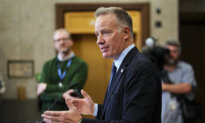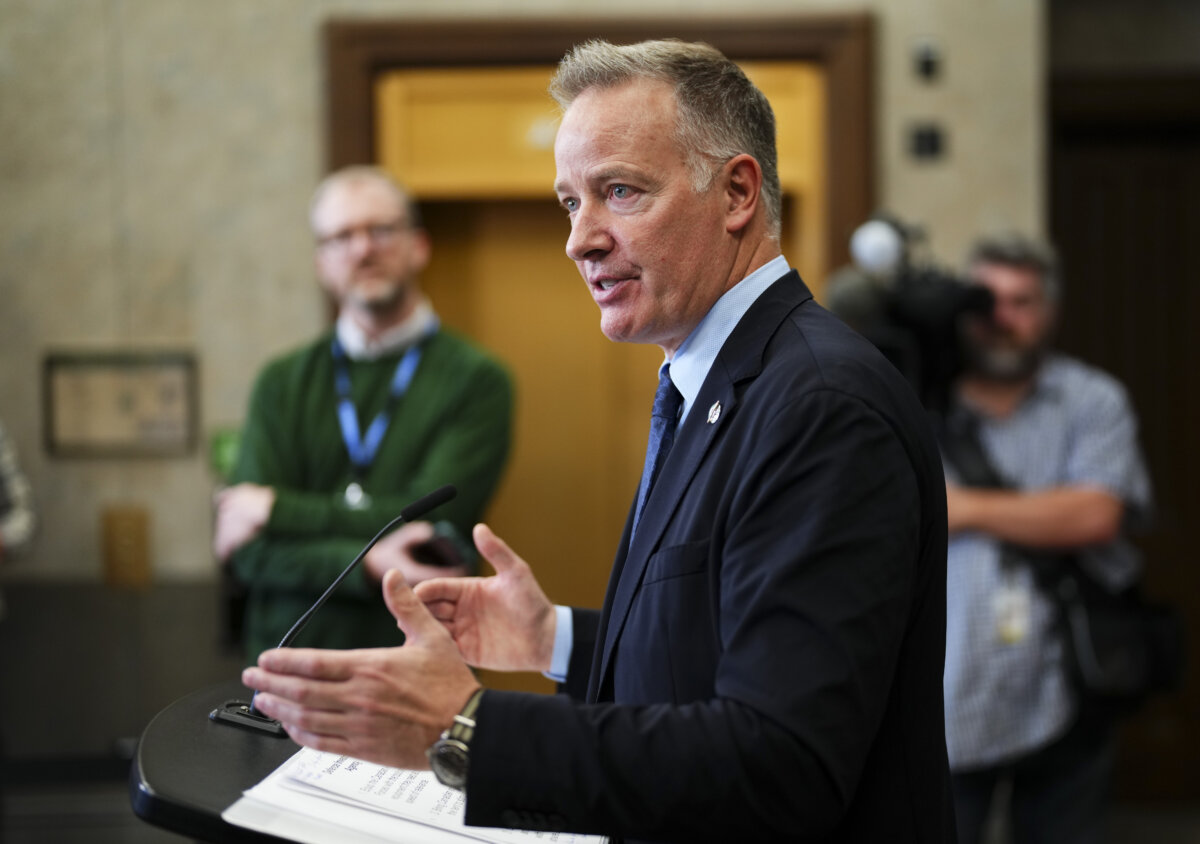

Secretary of State for Defence Procurement Stephen Fuhr says it’s unlikely Ottawa will withdraw from its contract with the United States to purchase 16 F-35 fighter jets, because the aircraft are currently under production.
Fuhr told CBC’s Rosemary Barton Live that he doesn’t think Prime Minister Mark Carney will try to get out of the contract for the American-made jets despite comments from former Defence Minister Bill Blair in March that Canada was reconsidering the purchase amid trade tensions with the United States.
“I don’t think that’s the direction we’re heading,” Fuhr said during the Oct. 5 interview. “We have 16 aircraft in various stages of production at the manufacturer.”
But a defence procurement spokesperson said in a media statement following the interview that Fuhr was referring to moving ahead with the 16 jets under contract, not with replenishing the entire fleet.
“Canada is contractually obligated to 16 aircraft, which are in various stages of production with the manufacturer,” the spokesperson said. “A decision on the full program is currently under review.”
The Liberal government announced in 2023 its decision to procure 88 F-35 jets from the U.S. defence contractor Lockheed Martin. Carney asked for a review of the deal shortly after becoming prime minister this spring.
The request came after Portugal’s outgoing defence minister said his country was considering replenishing its aging F-16 fighter jet fleet with European models rather than American ones. Carney’s call for the review was also at the height of his “elbows up” messaging regarding his stated approach to dealing with U.S. President Donald Trump amid trade disputes between the two countries.
Fuhr said Carney has yet to finalize the details of the contract, but said he would do so when he “is comfortable with making a decision.”
Fuhr said he has not been asked to consider the F-35 contract in relation to Canada’s current efforts to finalize a trade agreement with Trump.
“We’re a sovereign country,” he said. “We’ll make our own decisions and we’ll stand on our own two feet.”
New infrastructure is planned for 4 Wing Cold Lake, in Alberta and 3 Wing Bagotville, in Quebec, Canada’s two main operating bases, to support the Royal Canadian Air Force’s (RCAF) new F-35 fighter jets, Fuhr said.
Construction was set to begin at both bases in 2022, but a report from the Auditor General of Canada said both projects were more than three years behind schedule.
An assessment performed in December 2024 for Cold Lake and in January 2025 for Bagotville found that both facilities were on track for completion in 2031, according to the report.
National Defence developed an interim operations plan to be able to operate and maintain the CF-35 fleet when the first jets arrive in Canada at the end of 2028 until the permanent infrastructure would be ready to operate in Cold Lake.
The plan involved the purchase of movable facilities combined with renovations of existing facilities on the base. To that end, Canada granted a contract worth roughly $16 million to Raymond EMC Enclosures Ltd. in January for the design, production, and installation of individual secure enclosures that comprise the Tactical-Special Access Program Facility.
The enclosures are scheduled for delivery to Cold Lake between September 2026 and May 2027, and are regarded as a “key infrastructure component” to support the delivery of the first jets in 2028.
The first eight aircraft will be delivered to the F-35A Pilot Training Center in Luke Air Force Base in Arizona next year, to enable the training of Canadian pilots while the necessary infrastructure to support aircraft delivery in Canada is completed.
Ottawa has said the new fleet is expected to be in service beyond 2060.
Mixed Fleet Options
Blair’s announcement of the F-35 review in March also included a suggestion that the remaining aircraft in Canada’s fleet could be sourced from European suppliers, including the Saab Gripen, which is produced in Sweden.
Fuhr said a mixed fleet provides Canada with greater flexibility in addressing different threats, instead of depending on a single type of plane to resolve an issue.
“What happens if you have to persist in that space for months and months and years? The tool that you use, is it the right tool to do that job?” he said. “That’s a very simplistic way of looking at it. But we need to have a whole wide range of capability sets to deal with all the eventualities that we could face.”
Ottawa launched the Defence Investment Agency (DIA) headed up by Fuhr last week. The agency’s goal is to expedite the acquisition and delivery of equipment to the Canadian military.
An Oct. 2 statement from the prime minister’s office said the DIA would be authorized to collaborate more closely with allies such as the United Kingdom, Australia, and France. Canada currently buys most of its military supplies from the United States.
Fuhr described the agency as “unique” because it has “its own contracting authority.”
“It’s got its own resources and it’s got its own people,” he said “It’s structured in a way to succeed, and we’re going to make it work.”
 Friends Read Free
Copy
Facebook
Tweet
Friends Read Free
Copy
Facebook
Tweet