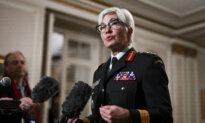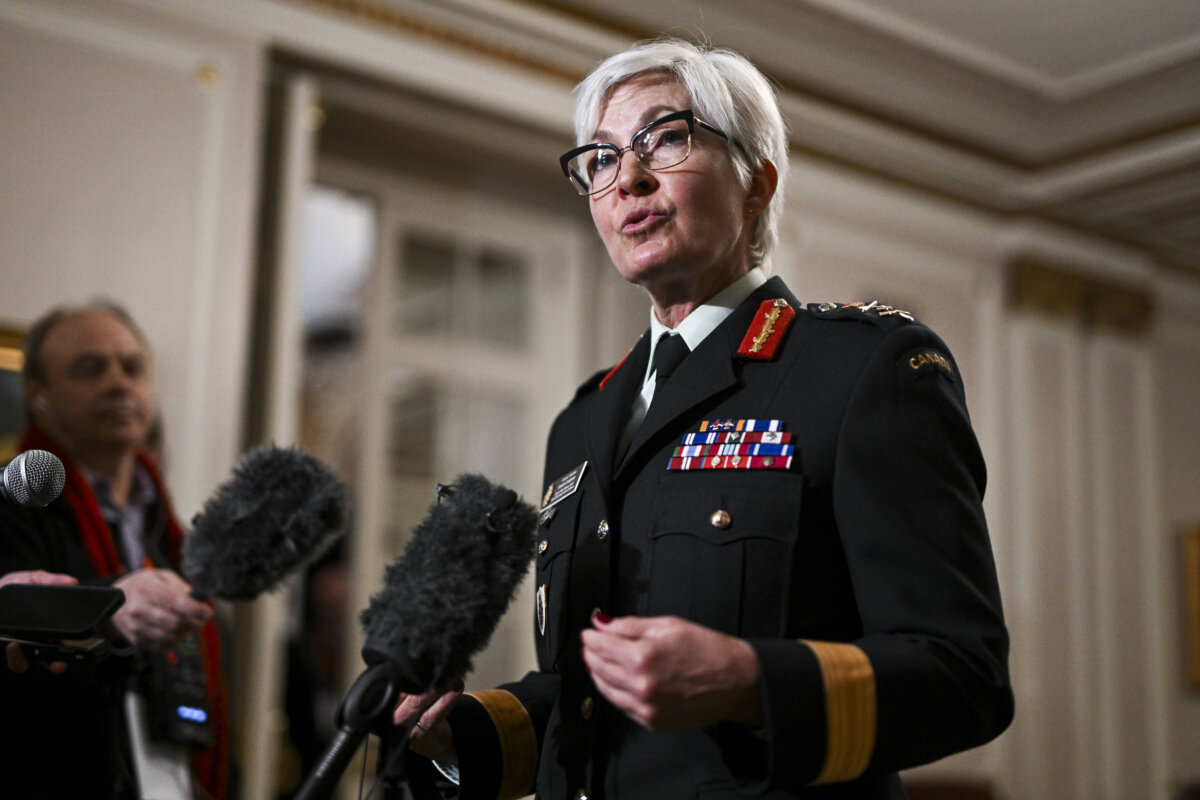

Chief of the Defence Staff Gen. Jennie Carignan says Canada may consider “defence and support” options to help Persian Gulf nations being hit by Iranian strikes as the conflict between Iran’s regime and the United States and Israel enters its sixth day.
Carignan said the Canadian Armed Forces (CAF) will present recommended options to Ottawa to help Gulf states ahead of a meeting with allies on March 6.
“We are not talking about participating [in] Epic Fury, per se,” Carignan told reporters March 5. “However, our Gulf partners may require defence and support. So within that context this would be the type of military options that we could consider.”
Operation Epic Fury is the name given to military operations against Iran’s regime by the U.S. government. Israel and the United States launched a combined military operation against Iran on Feb. 28 after multiple rounds of talks on Iran’s nuclear program failed. Iran has retaliated by hitting targets in Israel as well as neighbouring nations hosting American military bases.
Involvement
Carignan did not offer specifics about what recommended forms of CAF support might be, but her statement comes in the wake of comments by Prime Minister Mark Carney on March 4 that Ottawa won’t “categorically” rule out military involvement in the escalating conflict.
Calling military participation a “fundamental hypothetical,” Carney said Ottawa will stand with its allies during comments March 4 from Canberra, Australia (March 5 in Australia).
“You’ve asked a fundamental hypothetical in a conflict that can spread very broadly,” Carney told reporters after being asked about the issue. “One can never categorically rule out participation. We will stand by our allies when it makes sense.”
Lt. Gen. Steve Boivin of Canada’s Joint Operations Command said Canada currently has just over 200 soldiers in the Middle East at this time but is not involved in Operation Epic Fury.
“We’ve been focused on the force protection of our people, which means dispersing and staying in locations where the force protection is acceptable. In some cases, relocating them to a different country in the region or in some other cases redeploying them to Canada,” Boivin told media on March 5.
“With regards to Operation Epic Fury, we have not been involved in the planning of it and we’re not involved as we speak.”
Also on March 5, Ottawa said that CAF members serving on exchanges with the U.S. military in the Middle East are staying in their posts but have been given “other duties” that do not involve taking part in the military operation against Iran.
Debate
The Conservatives say that if Ottawa does decide to become militarily involved in the Iran conflict, the issue should first be debated in the House of Commons.
“The Conservatives are calling for a parliamentary debate before any sort of Canadian military deployment in the ongoing war in Iran, after Prime Minister Mark Carney said such a deployment is possible,” Conservative MP and foreign affairs critic Michael Chong posted March 5 on social media.
Chong added that Carney has contradicted himself multiple times since the start of the war about his government’s position on the conflict.
Initially stating support for the U.S. action to stop Iran from obtaining a nuclear capabilities on Feb. 28, Carney said several days later on March 4 that his government’s support for U.S. and Israeli strikes was made “with regret” as the United States and Israel did not pursue authorization for action under international law and this “is another example of the failure of the international order.”
Carney urged all sides in the conflict to abide by international rules of engagement, and said that Canada’s focus is on de-escalating the conflict.
The NDP is opposed to the war, and the Bloc Québécois says the strike wasn’t done in accordance to international law.
Europe
NATO Secretary General Mark Rutte said March 5 that the alliance does not plan to trigger the mutual defence clause after an Iranian ballistic missile was shot down while headed to Turkey.
However, Italy has already said it is planning to send air defence assets to Gulf countries for reasons of energy security and protecting Italians in various Gulf nations.
Italy, Spain, France, and the Netherlands said they are also planning to send naval vessels to the Red Sea following a drone attack on a British airbase on March 2.
For its part, the U.K. announced March 5 that it has sent four more Typhoon fighter jets to Qatar to help the Gulf state fend off Iranian attacks.
Canadian Civilians in Region
Describing the situation as “quite dire and dangerous for the Gulf states,” Carignan said the military will also consider options to extract Canadians from the Middle East and has sent liaison officers to the region to “be in a posture to plan and adjust to the situation over there.”
Ottawa says it is in the process of booking flights for more than 2,000 Canadians who are trying to leave the Middle East amid the ongoing war.
Foreign Affairs Minister Anita Anand said March 4 that more than 106,000 Canadians and permanent residents have registered with Global Affairs Canada, including 1,171 in the United Arab Emirates (UAE), 237 in Qatar, 164 in Lebanon, 93 in Israel, and 74 in Iran.
Anand said the situation is “changing by the hour,” noting some countries have closed their airspace, left it partially open, or still have it open.
Iran
The United States and Israel began the military intervention into Iran on Feb. 28, with U.S. Secretary of War Pete Hegseth saying the aim is to destroy the ruling regime’s missile capability and navy, as well as to prevent it from developing nuclear weapons. Iranian regime leader Ali Khamenei was killed in the strikes on the first day of the war.
In the wake of U.S. and Israeli strikes, Iran attacked various nations in the region hosting American military bases, striking infrastructure, military facilities, and civilian locations in Israel, Bahrain, the UAE, Kuwait, Qatar, Saudi Arabia, and Oman. In the last several days, Iran’s attacks have widened to include targets in 14 surrounding nations, including Azerbaijan and Turkey.
Iran’s strikes have disrupted the flow of oil, air traffic, and daily economic life and security in a number of its Arab neighbours’ nations.
Israel has reported around a dozen civilians killed by Iranian strikes, while Israeli attacks against Iranian-supported Hezbollah in Lebanon have killed around 70, according to Lebanon’s health ministry. Israel has not reported any military casualties in the war thus far.
In addition, UAE officials said three individuals were killed in Iranian missile attacks, along with Bahrain reporting one individual dead after a fire following the interception of an Iranian drone.
Six U.S. soldiers have been killed as the result of Iranian counterattacks, according to the U.S. Department of Defense, while Iran’s Red Crescent Society says at least 787 people have been killed in Iran, but did not provide a breakdown of civilians versus military targets.
Jennifer Cowan contributed to this report.
 Friends Read Free
Copy
Facebook
Tweet
Friends Read Free
Copy
Facebook
Tweet