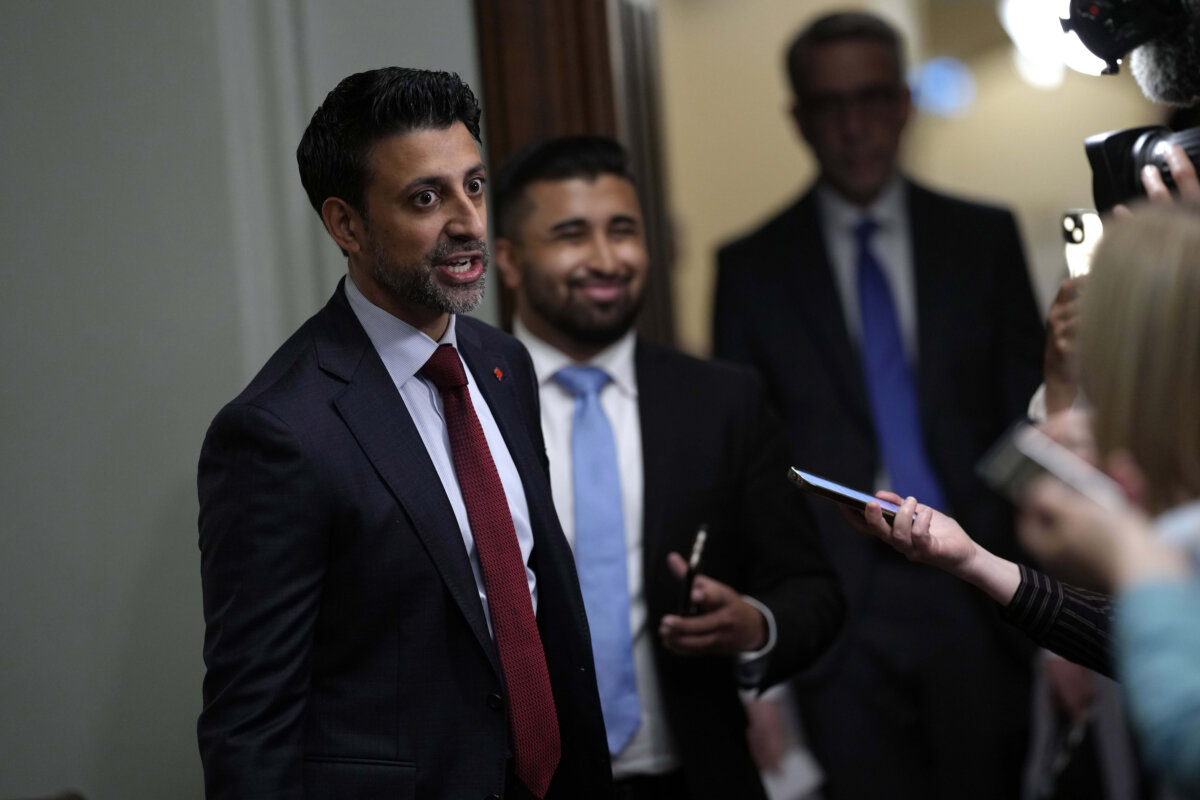

Trade Minister Maninder Sidhu says trade talks with India won’t resume just yet, as the two countries conduct “scoping” discussions to find areas of cooperation.
Sidhu, who visited India this week, said New Delhi and Ottawa are working to advance new joint ventures in many sectors from AI to critical minerals, but are still in preliminary discussions about formally restarting trade talks.
The two countries are seeking to rebuild ties that have been frayed since 2023, when then-Prime Minister Justin Trudeau accused Indian government agents of being involved in the assassination of B.C. Sikh activist Hardeep Singh Nijjar. India has denied any involvement.
Sidhu told reporters on Nov. 13 that agriculture, energy, AI, critical minerals and the aerospace industry were topics discussed during a meeting with India’s Minister of Commerce Piyush Goyal. Sidhu added that the talks with Goyal “went really well,” and showed “areas of opportunity” where Canada and India can work more closely together.
“We believe that India and the Indo-Pacific region is key on reaching the goal that Prime Minister Carney has set for Canada, hitting $300 billion of non-U.S. exports in the next 10 years,” Sidhu said during the press conference in New Delhi.
“India will need 70 percent more energy by 2040, and Canada, as the world’s energy superpower, is well positioned as a reliable and stable partner which can help India achieve its growth targets with clean energy such as LNG and nuclear.”
Foreign Affairs Minister Anita Anand said Oct. 30 that Canada is updating its Indo-Pacific Strategy including a focus on exporting Canadian LNG to the region. India ranks fourth in the world in LNG imports, and announced two months ago it will boost its LNG import capacity by 27 percent as of 2030. India is subject to high U.S. tariffs after U.S. President Donald Trump said New Delhi is assisting Russia in its war on Ukraine by buying Russian oil and gas.
Sidhu’s visit this week represents Canada’s first high-level engagement on trade with India since 2023. His three-day visit from Nov. 11-14, at the invitation of Goyal, included meeting with Air Canada’s lead in New Delhi, as well as addressing the Confederation of Indian Industry Partnership Summit in the capital.
Sidhu noted that Canada and India’s bilateral trade exceeded $30 billion last year and said Canada is well positioned to meet India’s growing energy needs. He also said Canada is open to new opportunities that fall outside of direct trade talks. He said this includes welcoming Indian investment money into Canadian mining and infrastructure ventures.
“When you look at new government, new focus, new Prime Minister, the conversations here are about exploring opportunities, sectors of opportunities, not necessarily trade talks, but really in the early phases of scoping what it could look like,” Sidhu said.
Sidhu also referenced employment ties between the two nations, saying that Canadian companies have roughly 50,000 workers in India, while Indian investors in Canada provide work to some 36,000 individuals.
Building Momentum
A Nov. 13 joint statement from India and Canada noted that Sidhu’s recent visit built on momentum achieved when Prime Minister Mark Carney and Indian leader Narendra Modi met on the sidelines of the G7 Leaders’ Summit in Kananaskis, Alta.
Global Affairs Canada (GAC) also noted a joint statement issued Oct. 13 by Anand and her Indian counterpart Subrahmanyam Jaishankar calling for “renewing momentum” between Canada and India. At the time the two announced a “roadmap” for a full restoration of Canada-India relations and beneficial bilateral relations going forward.
“The Ministers reaffirmed the strength and continuity of the India–Canada economic partnership and reiterated their commitment to deepening bilateral cooperation through sustained dialogue, mutual respect, and forward-looking initiatives,” GAC wrote in its Nov. 13 release. “The Ministers committed to maintaining an open, transparent, and predictable investment environment and to exploring avenues for deeper collaboration across priority and emerging sectors.”
Anand and Jaishankar agreed to bring diplomatic staffing levels back up to pre-2023 levels in both countries and seek “greater trade and resilience” as the relationship progresses as part of rebuilding ties. GAC also pointed out that Anand and Jaishankar agreed to engage at the ministerial level and meet early next year to hold further discussions, something Sidhu welcomed.
“Having a ministerial dialog on investment and trade after many, many years is very important to start afresh, to look at things,” Sidhu said Nov. 13.
 Friends Read Free
Copy
Facebook
Tweet
Friends Read Free
Copy
Facebook
Tweet