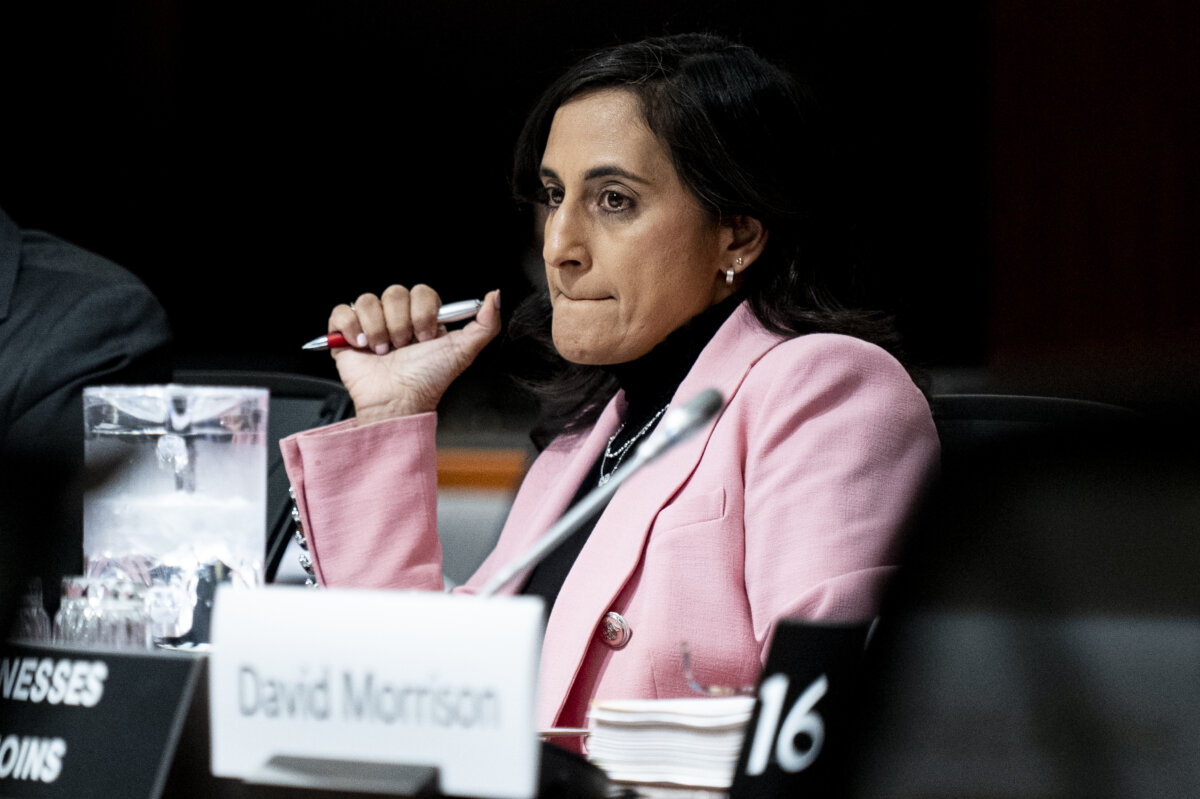

Foreign Affairs Minister Anita Anand said Canada will update its Indo-Pacific strategy to more closely align with the goals of the Carney government, particularly the objective of doubling non-U.S. exports in the next 10 years and boosting export of liquefied natural gas (LNG) and oil.
Testifying before the House Committee on Foreign Affairs and International Development Oct. 30, Anand said that “the world wants more Canada,” and part of satisfying that demand will include shipping more LNG to the Indo-Pacific region.
“The world has changed since the Indo-Pacific Strategy was released, and we need to ensure that our foreign policy is responsive to Canada’s needs now,” Anand said, referring to the current strategy released in 2022. “That is why the prime minister recently announced that Canada is embarking on a new mission to double our non-U.S. exports … in the next decade. And that is why the LNG exports that we have seen from Canada’s West Coast will continue.”
On Oct. 22, Prime Minister Mark Carney said that Canada aims to double exports to non-U.S. trading partners in the next decade because Canada’s dependency on the United States as its primary trading partner had become a liability amid ongoing trade tensions.
The United States is by far Canada’s largest trading partner. Last year, Canada had about $1.3 trillion in goods trade with the United States, compared to around $261 billion with the whole Indo-Pacific region.
New Strategy
Responding to questions from Conservative foreign affairs critic Michael Chong about the new strategy, Anand highlighted Canadian LNG as well as critical minerals as two resources that can help grow Canada’s exports to non-American destinations.
“I’ve had this very conversation with my counterparts in Japan, in India, with my South Korean counterpart when I met him in New York, in Mexico, and the list goes on,” Anand said. “The reality is that Canada is already seen as a leader in LNG. What we need to do is continue our competitive advantage and leadership in this area, and that is the intention of the Government of Canada.”
Chong said Canadian LNG has the potential to start displacing gas from nations such as Qatar and Russia, especially for Indo-Pacific partners such as Japan, as well as allies such as Germany in the European Union. Anand agreed it was “exactly right” that growing LNG exports and having more energy trading relationships is key for Canada’s economic interests as well as for enhanced defence and security in the Euro-Atlantic sphere and Indo-Pacific.
Asked by Chong when the strategy updates would come through, Deputy Minister of Foreign Affairs David Morrison said the updated strategy will be completed “as soon as possible,” but did not provide a date.
Canada’s Previous Indo-Pacific Strategy
Canada’s most recent Indo-Pacific strategy was released in November 2022 under the Trudeau administration by then-Foreign Affairs Minister Mélanie Joly.
In the announcement at the time, Joly said China and North Korea were the most significant threats in the Indo-Pacific region, while committing $2.2 billion over five years toward furthering diplomacy, security, and trade in the area.
The strategy also focused on guarding Canada from geopolitical and cybersecurity dangers as well as bolstering defence ties with Japan and South Korea and growing trade across the region.
The Indo-Pacific is defined by Ottawa as a region comprised of 40 nations from Pakistan to the Pacific Islands. In a 2022 press release on Joly’s announcement, the government noted that the Indo-Pacific accounts for more than 33 percent of the world’s economic activity and is home to 65 percent of the global population.
“By 2040, it will be home to two-thirds of the global middle class,” the release noted, adding that “the Indo-Pacific is Canada’s second-largest merchandise export market, after the United States, with annual 2-way trade valued at $266 billion in 2022.”
Indo-Pacific Diplomacy
Carney is currently on a trip to Malaysia, Singapore, and South Korea, where he recently attended the Association of Southeast Asian Nations Summit in Kuala Lumpur and is set to attend the Asia-Pacific Economic Cooperation Economic Leaders’ Meeting in Gyeongju, South Korea. from Oct. 31 to Nov. 1.
The Prime Minister’s Office described the trip as an effort to “deepen trade relationships in the Indo-Pacific region, shore up defence partnerships, and unlock new opportunities for Canadian workers and businesses.”
Anand visited India, Singapore, and China earlier this month where she met with government officials as Ottawa seeks to grow Indo-Pacific trade links. This included the resumption of diplomatic relations with India, as well as what Anand called a productive conversation with her Chinese counterpart about the “strategic partnership” between Ottawa and Beijing.
Questioned Oct. 30 about what she meant in her comments about closer cooperation with China and about China’s human rights atrocities against minorities as well as foreign interference and anti-democratic policies, Anand said that “in my conversations, bilaterally and multilaterally, I never shy away from raising these important issues.”
Last week, Chong criticized Anand’s “strategic partnership” remark, saying Carney had previously noted that China is the biggest threat to national security in Canada.
“Last election, during the debate, the prime minister was asked to name the biggest threat to the security of Canada. He answered in one word, ‘China.’ And now, the foreign affairs minister is talking about a strategic partnership with Beijing, including security,” Chong said Oct. 23 in the House of Commons. “These two things seem contradictory.”
LNG Growth
Canada’s first large-scale LNG shipment left the newly constructed LNG Canada export terminal in Kitimat, B.C., at the end of June of this year, bound for Asian markets. The facility achieved 10 export cargoes by early September, although the precise destination of exports has not been disclosed beyond “Asia.”
The $18 billion Kitimat terminal, which took more than seven years to construct, is the first of seven LNG projects being developed in B.C., including the $20 billion Ksi Lisims LNG project, which was approved in mid-September by the B.C. government and plans to generate up to 12 million tonnes of LNG per year by 2028.
The B.C. government estimated in its spring budget that natural gas royalties will climb to $1.4 billion per year by the 2026–2027 fiscal year. B.C. Premier David Eby said just the Ksi Lisims facility alone will likely create $16.8 billion in gross domestic product (GDP) for Canada over three decades.
In addition, this past September, Carney said one of the first five major projects to be fast-tracked for approval due to being hand-picked as being in the national interest will be the second phase of the LNG Canada terminal at Kitimat in order to double its production capacity.
Foreign Influence Registry On the Way
Along with the planned update to Canada’s Indo-Pacific strategy, on Oct. 30 Anand announced $7 million in humanitarian assistance for the Caribbean in the wake of Hurricane Melissa, noting Canada’s continued focus on responding to disasters and crises around the world. She also reiterated the $22 billion in assistance given to Ukraine since Russia’s 2022 invasion, and pledged Canada’s continued dedication to a $73 million program for boosting Arctic sovereignty and well-being.
When asked by Chong about foreign interference in elections and dealing with interference from China, Anand said that the Foreign Influence Transparency Registry. enacted in the summer of 2024, should be in place by year’s end, and will be under the oversight of Public Safety Minister Gary Anandasangaree.
The registry means any individual or group working for a foreign nation or organization while involved in or influencing Canadian political or governance matters has to register details of what they are doing and who they are meeting.
Anandasangaree previously said in August that the registry would be put in place by the fall of 2025.
 Friends Read Free
Copy
Facebook
Tweet
Friends Read Free
Copy
Facebook
Tweet