
The B.C. government has given the go-ahead for a $20 billion liquefied natural gas (LNG) project on the province’s North Coast that will produce up to 12 million tonnes of LNG per year by 2028.
The indigenous-led Ksi Lisims LNG project has received the green light from both the province and Ottawa.
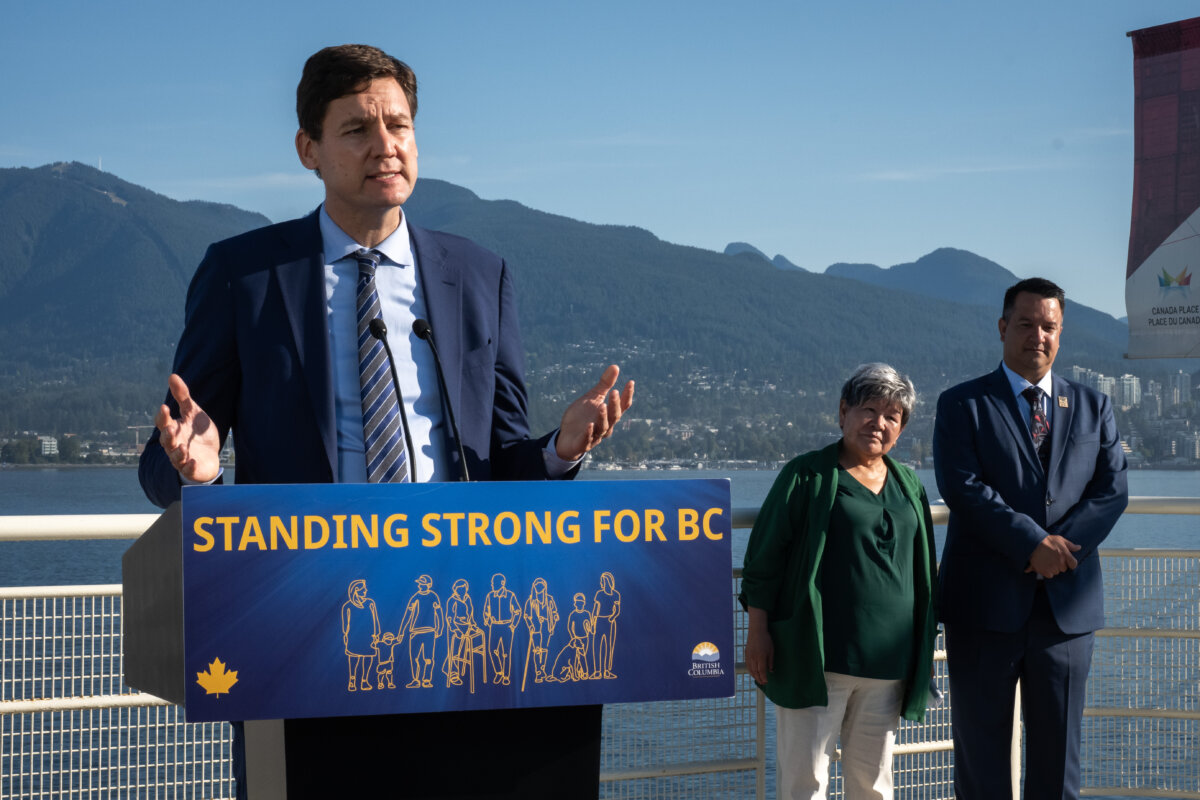
It is expected to generate as much as $16.8 billion in gross domestic product (GDP) for the Canadian economy over a 30-year span, with a potential contribution of $15.5 billion in British Columbia, Premier David Eby announced during a Sept. 16 press conference.
“There’s never been a more critical time to diversify our economy and reduce reliance on the U.S., and B.C. is leading the way in Canada, with clean electricity, skilled workers, and strong partnerships with First Nations,” Eby said, noting that the project will create 800 jobs during construction and more than 200 jobs once it is up and running.
Ksi Lisims LNG is a joint venture between the Nisga’a Nation, Western Canada natural gas consortium Rockies LNG, and Texas-based LNG project developer Western LNG.
The province noted in a press release that the partners advancing the Ksi Lisims project have yet to make a final investment decision.
If all other required permits and authorizations are received, the floating natural-gas liquefaction facility and marine export terminal will be built on Pearse Island, located approximately 55 kilometres north of Prince Rupert near the Alaskan border, the province said.
The facility is expected to be net-zero ready by 2030 and, once connected to BC Hydro’s clean-electricity grid, it will produce LNG with net-zero emissions.
Ksi Lisims is set to become one of the biggest LNG producers in the province. It will be second behind the 14 million-tonne production capacity of the initial phase of the LNG Canada terminal in Kitimat, which started exporting LNG to Asia in June.
Eby said the project will “help young people build a future in the Northwest.”
“It creates education, training, and other opportunities that wouldn’t exist in the absence of this project,” he said. “It helps keep Nisga’a people on their land connected to their communities with employment and cultural opportunities that would not otherwise be there.”
Environmental Concerns
Environment Minister Tamara Davidson and Energy Minister Adrian Dix said the decision to grant the project an environmental assessment certificate was made after “carefully considering” the environmental assessment by B.C.’s Environmental Assessment Office (EAO).
The EAO consulted with 10 First Nations at varying levels, but four of six First Nations asked to provide consent did not do so.
Davidson and Dix said they opted to approve the new LNG project despite not receiving consent from several of the First Nations.
The ministers are “satisfied” the conditions and requirements outlined in the environmental assessment certificate reasonably avoid, minimize, and accommodate the possible negative impacts on First Nations and their interests, the province said in an information bulletin.
A number of environmental groups have also voiced concern about the project.
Ecojustice said it took part in multiple public comment periods on behalf of the Northwest Institute for Bioregional Research, the Skeena Watershed Conservation Coalition, and the Wilderness Committee prior to the province’s decision.
The groups criticized the ministers’ decision in a joint Sept. 16 press release, calling it “a failure of environmental leadership.”
“By approving this project, the provincial and federal governments are putting fossil fuel expansion ahead of the safety and well-being of our communities and ecosystems,” Ecojustice lawyer Imalka Nilmalgoda said in the press release.
Eby, however, said the project has been designed to minimize environmental impacts, adding that he has “great faith” the Nisga’a and its president Eva Clayton will ensure the project does not harm the environment.
Clayton, who was also at the press conference, said it would be developed “in line with our Nation’s high environmental standards.”
“This milestone reflects the strength of Indigenous leadership and our commitment to sustainable economic self-determination,” Clayton said in a press release. “Ksi Lisims LNG represents a transformational opportunity for all participating B.C. Nations. This is what reconciliation looks like: a modern Treaty Nation once on the sidelines of our economy, now leading a project that will help write the next chapter of a stronger, more resilient Canada.”
LNG Push
Eby said the project comes at a time when Canada needs to lessen its dependence on the United States in the face of tariffs put in place by U.S. President Donald Trump.
“We are going to build this country and we’re going to do it right and we want to make sure that it is Canadian products making it to market, supporting Canadians,” Eby said at the press conference.
Energy and Natural Resources Minister Tim Hodgson said in an interview last month that LNG could play a role in turning Canada into an energy superpower, noting that there are several countries interested in buying Canadian LNG. He also hinted at the time that LNG could be on the government’s list of nation-building initiatives under its One Economy Act.
Prime Minister Mark Carney confirmed Ottawa’s interest in LNG last week when he announced that Phase 2 of LNG Canada was one of five projects the government’s new Major Projects Office (MPO) would work to fast-track.
The project, which has been in the works for some time, will double LNG Canada’s production of liquefied natural gas, making the Kitimat plant the second-largest facility of its kind in the world.
There are currently seven LNG export projects—including Ksi Lisims and LNG Canada—at various stages of development in British Columbia, according to Natural Resources Canada.
Also in the works is the Woodfibre LNG Project in Squamish, B.C., which is set to be the world’s first net zero LNG export facility and Tilbury LNG Phase 2, an expansion of the existing FortisBC facility in Delta that is currently awaiting government approval.
Cedar LNG and Summit Lake PG LNG both remain in the proposal stage.
Ottawa has said these ventures could require a capital investment approaching $109 billion and could yield a production capacity of 50.3 million tonnes of LNG annually.
 Friends Read Free
Copy
Facebook
Tweet
Friends Read Free
Copy
Facebook
Tweet