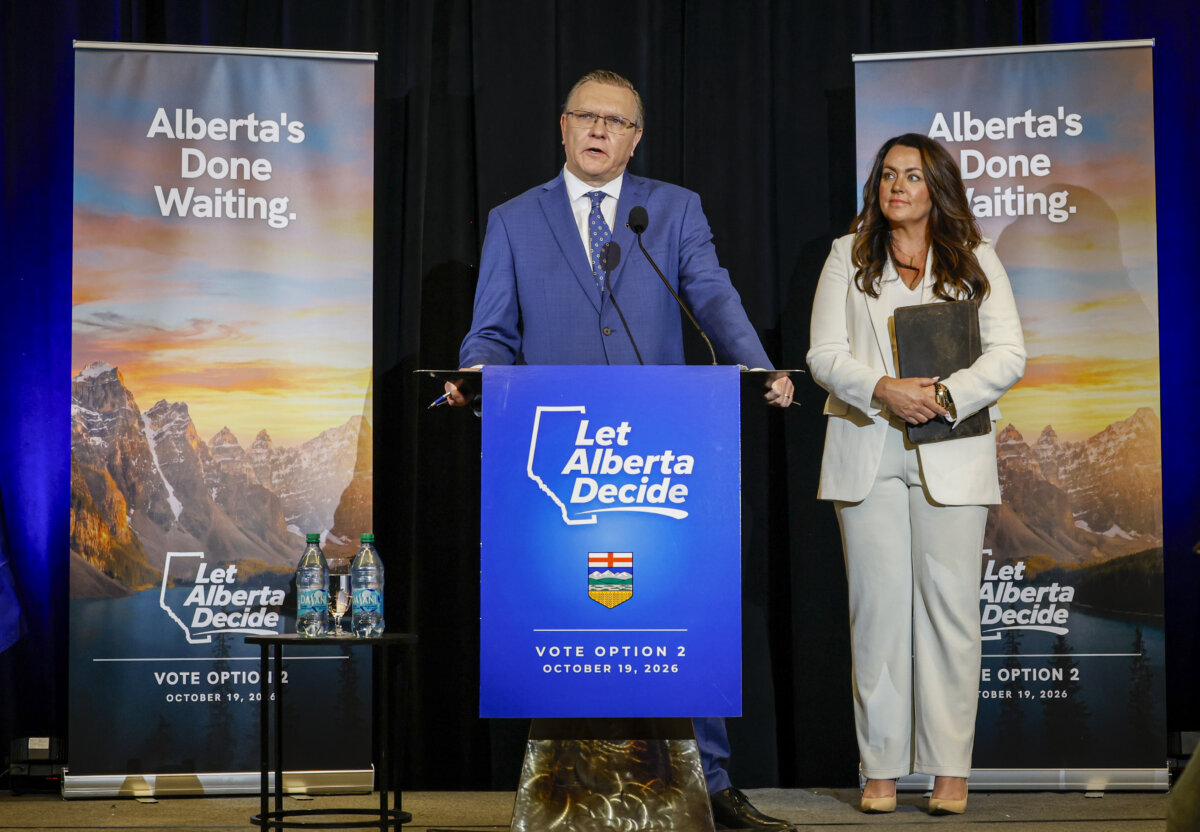

A group advocating for Alberta separation has released a report outlining what it believes a transition to independence could look like, saying that an independent Alberta would not be “starting from scratch.”
“Most of the institutions and services Albertans rely upon every day already exist and operate in Alberta,” the Alberta Transition Council says in the report released Sept. 3. The group is co-led by Alberta lawyer Keith Wilson and technology strategist Dennis Kalma.
The report says a transition to independence would involve a change of legal authority and a transfer or bridge of responsibilities, and Alberta would also need to establish the sovereign functions it does not currently have.
The group says the report was prepared with input from 45 Albertans with experience and expertise across a wide range of fields, and a review of 21 topic-specific white papers.
“The White Papers examined what would have to continue, what would have to change, what would require negotiation, and what new functions Alberta would need if it becomes an independent country,” it says.
Should independence occur, Alberta’s existing budget, treasury, accounting, payroll, procurement, and debt-management systems would continue operating as they currently do, but Alberta would take on additional expenditure responsibilities, revenue streams, and sovereign financing requirements, it says.
“Alberta would assume agreed federal responsibilities while also assuming taxing powers and revenue streams presently administered by Canada,” the group says.
Private banks, credit unions, branches, customer accounts, and lending relationships would remain the same, but the regulatory jurisdiction, deposit-protection rules, payment-system access, and liquidity backstop would change, the group says. A new Alberta currency would not be required on day one of independence, nor would it be necessary to rebuild the commercial banking system, it says.
On the issue of immigration, the report proposes temporarily mirroring familiar Canadian visa and permit categories while creating an Alberta immigration authority to handle status decisions. Existing federal immigration expertise could be retained, while new responsibilities would include citizenship, passports, protection claims, and international security information-sharing.
The report says Albertans could ideally retain both Canadian and Alberta citizenships after independence, though Alberta could not guarantee Canadian citizenship without an agreement with Ottawa. Existing permanent-resident status, work permits, and study permits would be temporarily recognized to avoid forcing people to reapply immediately, the group says. The report also recommends transferring federal immigration records to Alberta and creating a process to reconstruct records if necessary.
The report also says an independent Alberta would maintain existing indigenous and treaty rights, reserve protections, services, and legal records. It proposes consent-based negotiations with each of Alberta’s 48 First Nations, allowing them to choose how their relationship with Canada or Alberta evolves, while preserving indigenous mobility and providing transition support and funding.
Separately, a special policy report from the Canada West Foundation titled “Alberta in Confederation: The economic, trade and constitutional realities of separation” says that Albertans could take on significantly more debt following a transition to independence.
“Alberta’s gross liabilities in 2024 stood at $132 billion. This means Alberta’s debt per person would rise from about $27,000 per person in 2024 to between $80,000 and $95,000 per person after separation,” it says.
“Of course, this abstracts from all the additional costs a separate Alberta would incur. Examples include border control and immigration, national defense, foreign embassies and consulates.”
The Alberta Transition Council however argues that Alberta would be better off on its own. “Alberta’s fiscal strength is the foundation of a wealthier, lower-tax sovereign nation. The math already works,” the group says.
Alberta Premier Danielle Smith has called for Alberta to remain within Canada.
In a post to X made on Sept. 1 to mark Alberta Day, she wrote: “Let us continue building a strong and sovereign Alberta within a united Canada, confident in who we are, proud of what we contribute and ready to seize the opportunities ahead.”
 Friends Read Free
Copy
Facebook
Tweet
Friends Read Free
Copy
Facebook
Tweet