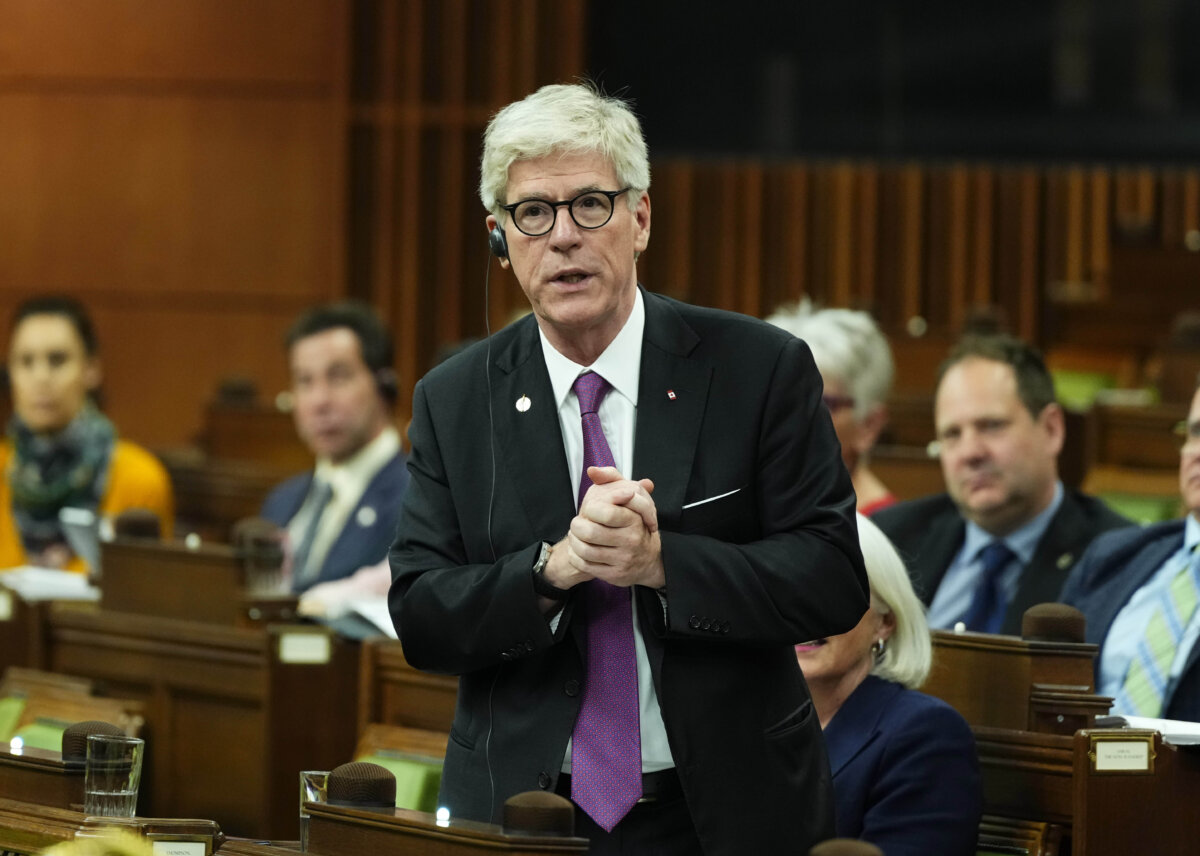

Liquified natural gas (LNG) could play a role in turning Canada into an energy superpower, Energy and Natural Resources Minister Tim Hodgson says.
Hodgson expressed confidence about the market potential for Canadian LNG during a recent interview on podcast The Vassy Kapelos Show, saying he “knows” there are buyers for such products.
“What I can tell you from the conversations that the prime minister has been having, the minister of foreign affairs has been having, the minister of international trade has been having, the conversations I’ve been having, our allies are very interested in Canadian LNG,” he said.
He hinted that LNG could be on the government’s list of nation-building initiatives under its One Economy Act once Parliament reconvenes this fall, but did not offer any details about specific projects the Liberal government is considering.
Hodgson was non-committal throughout the interview about the government’s plans, saying he didn’t want to talk in “hypotheticals.” He also would not say if Ottawa would do away with environmental policies enacted by the previous administration that have come under criticism from the Opposition Conservatives and some premiers, such as the West Coast tanker ban or the oil and gas emissions cap.
He would not say if Prime Minister Mark Carney planned to maintain policies aimed at combatting climate change, such as the emissions reduction targets, put in place by the government of his predecessor Justin Trudeau.
“The objective that we have is, as Canadians, to produce the best product we can possibly produce for world markets,” he said. “That’s low-cost, low-carbon production, and that’s what we’re doing. Our LNG is the cleanest LNG in the world.”
Hodgson said he has no concern about competing with the United States for LNG customers, noting that Canada’s product has the lowest carbon footprint of any producer globally.
“Our production is much cleaner than the American in terms of carbon footprint,” he said. “The objective that we have is … to produce the best product we can possibly produce for world markets. That’s low cost, low carbon production, and that’s what we’re doing.”
There are currently seven LNG export projects and one infrastructure project that are at various stages of development in British Columbia, according to Natural Resources Canada.
One of these is LNG Canada in Kitimat, which started shipping Canadian gas at the end of June. Phase 2 of the project is still in the works.
Also in the works is the Woodfibre LNG Project in Squamish, which is set to be the world’s first net-zero LNG export facility and Tilbury LNG Phase 2, an expansion of the existing FortisBC facility in Delta that is currently awaiting government approval.
Cedar LNG, Ksi Lisims LNG, and Summit Lake PG LNG all remain in the proposal stage.
These ventures could require a capital investment approaching $109 billion and could yield a production capacity of 50.3 million tonnes of LNG annually, the government has said.
Ottawa’s current enthusiasm for LNG appears to be a diversion from the Trudeau-era stance that the country should be focusing on developing alternative energy sources such as green hydrogen.
Trudeau said in 2022 there wasn’t a market for shipping Canadian LNG to Europe and dismissed the idea of building an export terminal on the Atlantic coast, describing the project as too expensive. He said Canada would push ahead with LNG projects already under construction on the country’s West Coast, but wouldn’t invest in it further.
“One of the challenges around LNG is the amount of investment required to build infrastructure for that,” he said at a 2022 press conference. “There has never been a strong business case because of the distance from the gas fields, because of the need to transport that gas over long distances before liquefaction.”
Policy Plans
The Liberal government has said it plans to approve a number of so-called nation-building projects this fall under its One Economy Act, formerly known as Bill C-5, which received royal assent earlier this summer.
Also known as the Building Canada Act, it hands the government sweeping powers to approve and fast-track projects that have the potential to boost the economy.
Hodgson was pressed several times during the interview for details on how the government will choose which nation-building projects to move ahead with, and if Ottawa would scrap Trudeau-era environmental policies like the Impact Assessment Act, to fast-track such projects.
The newly-minted cabinet minister would not offer any specifics on whether the government would rescind the environmental and energy regulations set out in the Impact Assessment Act or if Ottawa would roll back emissions targets and other such policies on a case-by-case basis.
Hodgson said the government would “deal with projects as they come up.”
“My job is to focus on projects of national interest. If those projects come up for projects of national interest, we will deal with them through Bill C-5,” he said, noting that he had no interest in talking “about hypotheticals.”
“Let’s wait for the early fall when we are ready to announce our projects,” he added. “I am quite comfortable that our bill, the Building Canada Act, will deliver for Canadians.”
The Conservatives supported the Liberal’s Bill C-5 in June after a number of amendments were made.
The party described it as an improvement on the status quo, but said it would rather see the West Coast tanker ban, industrial carbon tax, and Impact Assessment Act scrapped to boost Canada’s economy and resilience in the face of U.S. tariff threats.
“It’s baby steps when we needed a giant leap,” Conservative Leader Pierre Poilievre said in June in reference to the act.
“We would vote in favour of accelerating even one project, even though we think there are literally thousands of projects that need to be accelerated. So our test is not whether or not legislation is perfect—but whether it is better than the way things are.”
 Friends Read Free
Copy
Facebook
Tweet
Friends Read Free
Copy
Facebook
Tweet