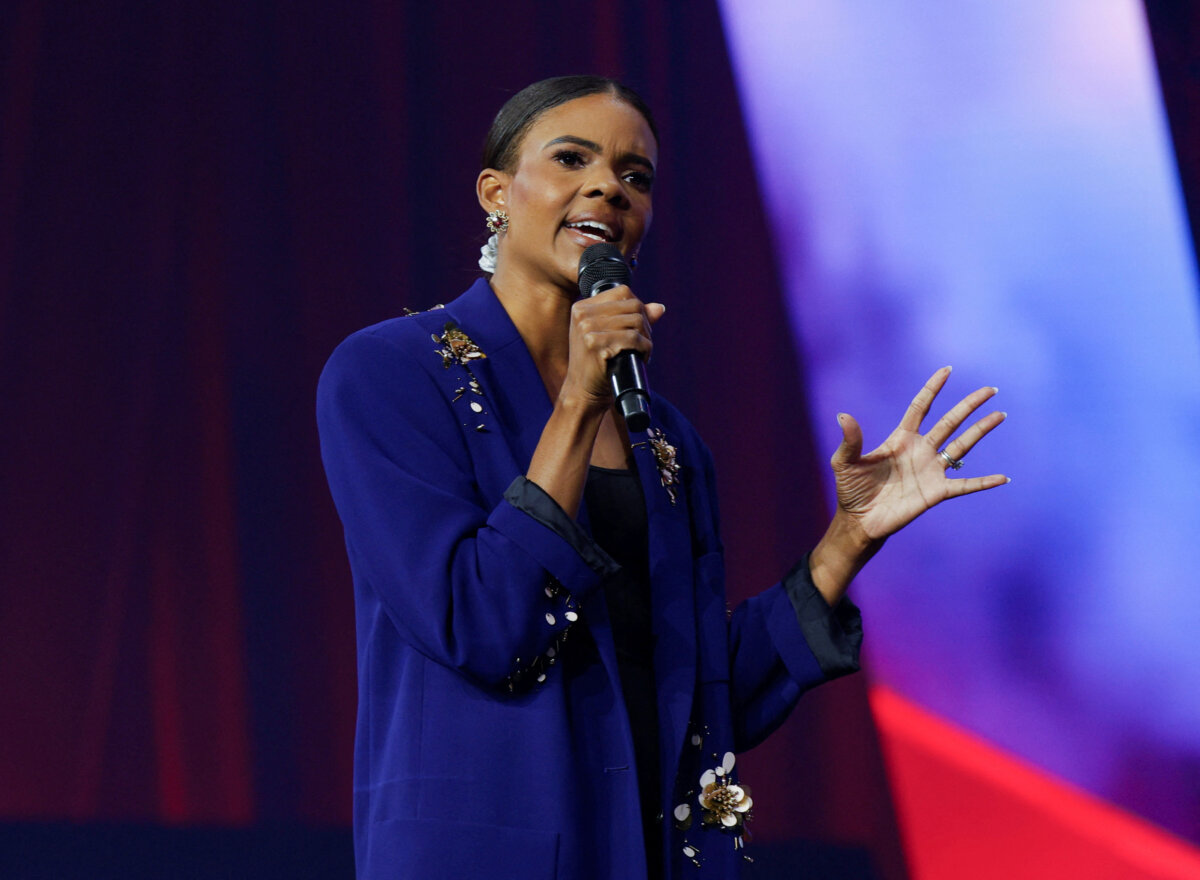

Commentator Candace Owens has lost her appeal in the High Court of Australia over a decision to deny her a visa to enter the country.
The unanimous finding found the decision by Home Affairs Minister Tony Burke did not infringe Owens’ implied freedom of political communication under the Australian Constitution.
The online commentator, known for her right-leaning viewpoints and outspoken criticism of progressive ideologies, was booked to visit the country on a speaking tour in November 2024.
The minister blocked her visa at the time, saying her “controversial and conspiratorial views” may “incite discord” in the community. He also said he reasonably suspected she did not pass the “character test” required of everyone entering Australia.
“From downplaying the impact of the Holocaust with comments about [Nazi doctor Josef] Mengele to claims that Muslims started slavery, Candace Owens has the capacity to incite discord in almost every direction,” Burke said last year. “Australia’s national interest is best served when Candace Owens is somewhere else.”
The Court revealed that Burke had outlined the reasons for his refusal by making a list of Owens’ views he found abhorrent under the headings “Holocaust denial,” “Islamophobia,” “Anti-racism, Black Lives Matter and anti-Semitism,” “Women’s and LGBTQIA+ rights,” and “COVID-19 and anti-vaccination.”
Burke stated he found those views to be “extremist and inflammatory” while considering the link between speech and behaviour, including comments from former Race Discrimination Commissioner Tim Soutphommasane that “hate speech leads to political violence if you allow it to escalate.”
Minister Says He Considered the Effect of Her ‘Presence’
The minister accepted that Owens had not used her influence and various social media platforms—on which she has around 18 million followers—to promote direct and overt violence, and that her representative had provided a signed undertaking that she would abide by her visa conditions and not engage in any disruptive or violent behaviour towards the Australian community.
But he said he was “not limited to [just considering her] personal behaviour whilst in Australia, but [may also consider] the effect her presence may have on others in the community.”
Owens appealed that decision, arguing that the section of the Migration Act relied on by Burke was invalid because it infringed the Constitution’s implied freedom of political communication, or that the minister had misconstrued that section of the Act.
Court Rules Freedom of Speech Does Not Apply Here
However, the Court unanimously held that the relevant section does apply if “the person were allowed to enter or to remain in Australia, there is a risk that the person would stir up or encourage dissension or strife in the Australian community, or a segment of that community … to a degree that is harmful,” and that the minister had not misconstrued the Act (pdf).
A majority of judges found the Act “effectively burdens the implied freedom, but that any burden imposed … is justified,” and that such a burden was “inevitable.”
“The implied freedom [of political communication] is not a ‘personal right,’ is not unlimited and is not absolute,” the judgment said.
Justice Simon Steward, in his opinion, said the implied right of political communication “does not confer anything akin to a ‘First Amendment’ right, but [is] instead a limit on legislative power.”
He too, referred to alternatives available to Owens to communicate her message to the Australian public “that did not necessitate her physical presence in Australia.
“She could, for example, have: given speeches virtually; sent emails containing her views; used, and no doubt does use, social media; and/or written a book which might have been sold here, or distributed for free. Thus, the only burden which [the Migration Act] could have imposed was to deny her the benefit of expressing her views in person in this country. This is sometimes described as the ‘lightning bolt’ effect of speaking in public. ”
Further, he said, Owens, an American citizen, had “no right to invoke the protection afforded by the implied freedom [in the Australian Constitution] or to use it as a means of entry.”
Owens was ordered to pay the Commonwealth’s legal costs.
 Friends Read Free
Copy
Facebook
Tweet
Friends Read Free
Copy
Facebook
Tweet