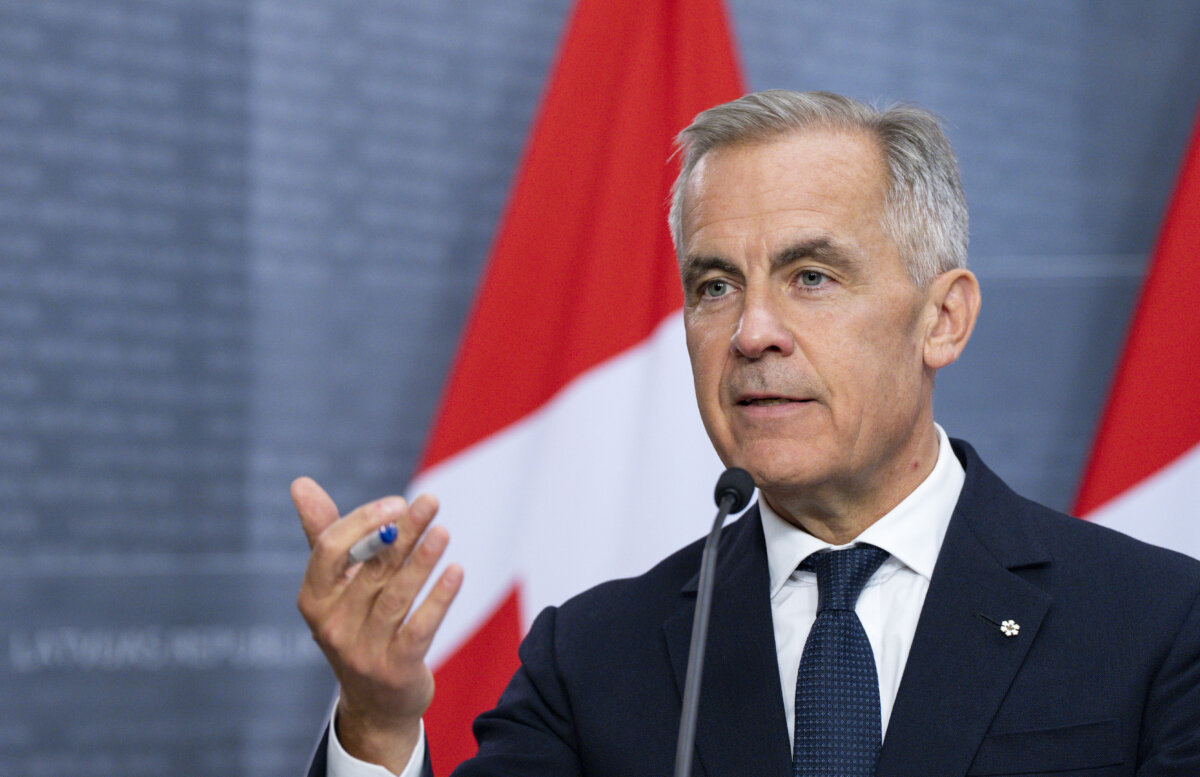

Prime Minister Mark Carney said his government will be reining in spending in the upcoming federal budget, citing concerns with the growth of government spending relative to Canada’s economic growth.
Carney told reporters ahead of a cabinet retreat on Sept. 3 that the federal government’s spending had been increasing by an average of 7 percent a year for more than a decade.
“That’s twice the rate of growth of the economy on average. It’s not a sustainable situation. So we need to rein in spending. We need to find efficiencies,” Carney said.
The same day, the federal government concluded six weeks of consultations ahead of Budget 2025, which involved 50 roundtables and 60 bilateral meetings with business leaders, workers, unions, and entrepreneurs across the country. More than 84,000 people also shared their views on the upcoming budget online as part of public consultations, the government says.
Carney said his government is currently in the process of “finding efficiencies” with government spending, and it will continue to do so until the time that the budget is introduced. He said Ottawa needed to “spend precious taxpayers’ dollars as carefully as possible.”
Carney said the government will be encouraging investment in large projects and new housing. Ottawa recently launched its Major Projects Office to streamline regulatory approval processes and coordinate financing to get large projects like railways, mines, pipelines, and ports built faster. It will also be launching Build Canada Homes, a new agency to encourage homebuilding through low-cost financing and support prefabricated homes.
During the last election, Carney pledged to lower government spending and cap the size of the federal government. Carney also pledged to separate the federal government’s spending into operating and capital budgets and to balance the operational budget within three years.
Finance Minister François-Philippe Champagne recently sent letters to cabinet members requesting they put forth “ambitious savings proposals” that would lead to operational spending falling by 7.5 percent for the 2026–27 fiscal year, followed by 10 percent cuts in the following year, and 15 percent in 2028–29.
Conservative Leader Pierre Poilievre said during a Sept. 3 press conference that Carney had “not found a single penny in new savings” since becoming prime minister in April. Poilievre said the new Liberal government’s proposals would increase total government spending by 8 percent, while giving 33 percent more federal public servants salaries of more than $100,000 per year.
“It doesn’t matter what he says. It matters what he does, and the numbers are very stubborn things,” Poilievre said, adding that the government needs to cut consultants, corporate welfare, and foreign aid.
A report by C.D. Howe projected that Canada could hit an average yearly deficit of $78 billion over the next four years, adding about $350 billion to the country’s federal debt. Outgoing Parliamentary Budget Officer Yves Giroux also recently estimated that this year’s federal deficit could reach between $60 billion and $70 billion.
 Friends Read Free
Copy
Facebook
Tweet
Friends Read Free
Copy
Facebook
Tweet