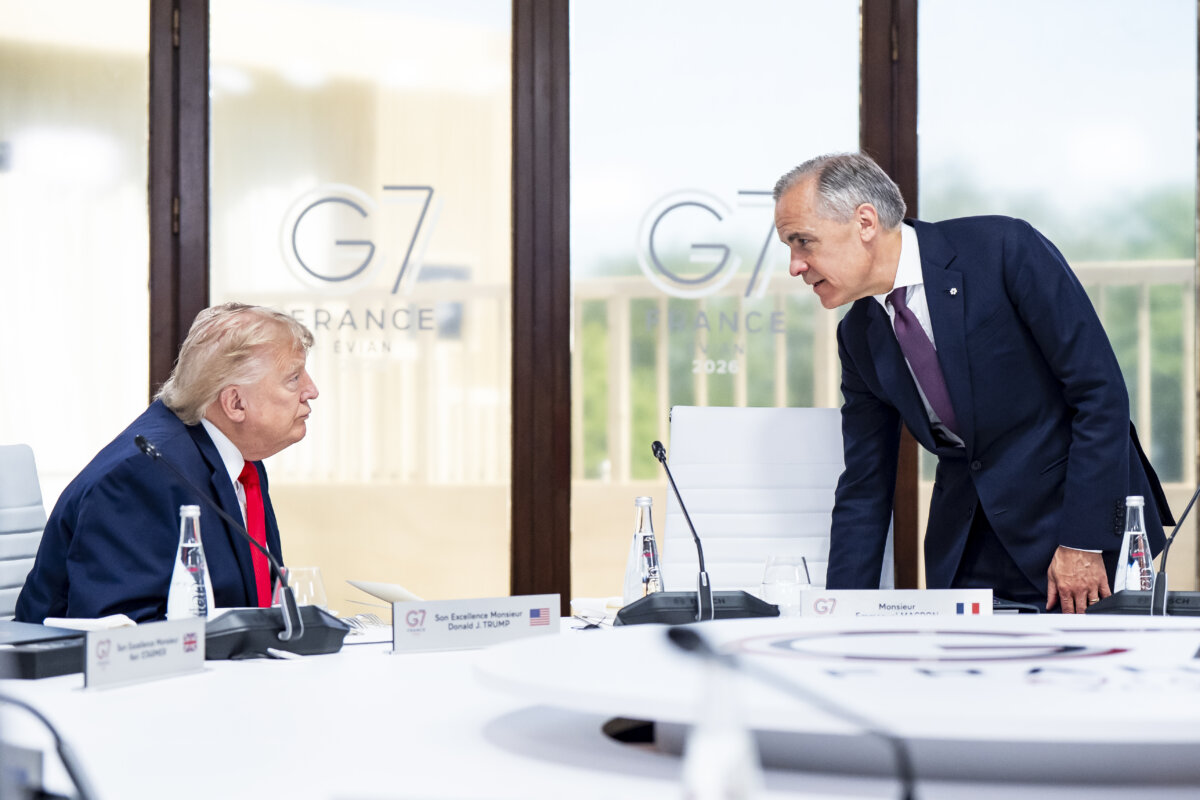

Prime Minister Mark Carney says it’s “no secret” that U.S. President Donald Trump dislikes the Canada–United States–Mexico Agreement (CUSMA) on free trade, after the president said he would prefer to leave the agreement than renew it.
“It’s no secret the president, in recent years, has not been the biggest fan of CUSMA or other trade deals, but there are specific things that we can work together on,” Carney told reporters on June 18 after he was asked about Trump’s comments the previous day.
Trump told reporters at the G7 summit on June 17 that he would rather leave CUSMA unsigned and terminate the deal, which is currently undergoing a joint review. He noted that while he might sign it, the United States does “better as a country if we don’t have an agreement.”
Carney said he had a number of conversations with the U.S. president at the G7 summit on a “range of issues,” and noted that Canada-U.S. Trade Minister Dominic LeBlanc and U.S. Trade Representative Jamieson Greer continue to “work through a number of issues, which are all related.”
“In effect, the underlying structure of CUSMA has been preserved, it continues to operate for 85 percent of our exports. Without any action, it will remain in place for the next decade,” Carney said, citing comments made in recent weeks by Greer.
Carney added that while there is an opportunity to extend the trade deal, there has “always been the opportunity for any of the parties to cancel it with six months notice.”
Canada, the United States, and Mexico are currently in negotiations around a potential renewal of CUSMA before the sixth anniversary of the deal on July 1. Canada and Mexico have said they want a 16-year extension of the deal, but the United States has not made its position public.
The deal, which came into force on July 1, 2020, is currently expected to expire in 2036, but if the three countries choose to renew the deal, it would remain in force until after 2042.
However, if one party does not confirm during the joint review that it wants to extend the deal, it would trigger annual reviews for the rest of the initial 16-year term, until 2036, or until parties decide to renew it.
If one or more countries withdraw from the deal, the agreement would remain valid for the remaining parties, and countries could instead pursue bilateral deals.
Trump said he signed CUSMA to replace the North American Free Trade Agreement (NAFTA) in 2018 because there was “no way out of NAFTA, which was the worst trade agreement ever made.”
He said he put a six-year termination clause in the deal when it was first established during his first term, and that Canadian and Mexican officials had “hoped” he wouldn’t be in office to potentially terminate the deal.
“I would prefer not having an agreement, but I’m open to doing it. We’ll see what happens,” Trump said.
Carney told reporters on June 17 that he had “seven or eight discussions” with Trump during the G7 summit about the economy, Canada–U.S. relations, artificial intelligence, Iran, and Ukraine, despite not having a scheduled bilateral meeting.
He said there was “no message” in the lack of a bilateral meeting, and noted that LeBlanc held discussions with Greer at the summit.
Trump repeated his long-standing grievances about Canada and Mexico to reporters on June 10, including the U.S. trade deficit and his view that the United States does not need what the two countries provide.
LeBlanc said on June 11 that the July 1 review deadline is “not a cliff,” as trade talks will not stop and annual CUSMA reviews could take place until 2036. He noted that he expects there will be both bilateral arrangements between Canada and the United States and between Mexico and the United States, as well as an “adjacent” trilateral framework.
Matthew Horwood and Noé Chartier contributed to this report.
 Friends Read Free
Copy
Facebook
Tweet
Friends Read Free
Copy
Facebook
Tweet