
U.S. President Donald Trump says he would prefer to leave the Canada-United States-Mexico Agreement (CUSMA) instead of renewing the trade deal that he negotiated during his first term.
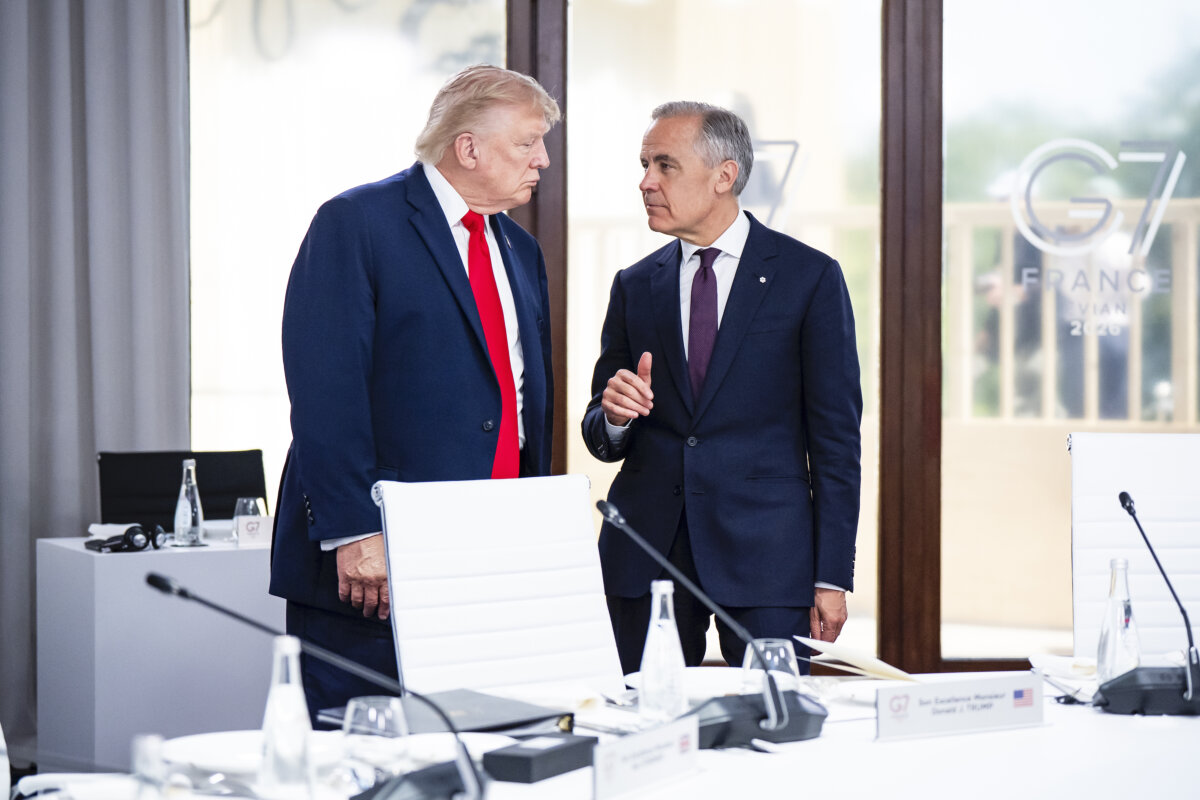
“I would rather leave it unsigned. I’d rather have it terminated. … I may sign it, but I would rather–we do better as a country if we don’t have an agreement,” Trump told reporters while at the G7 Summit in France on June 17.
The three countries are currently in negotiations around a potential renewal of CUSMA before the sixth anniversary of the deal, which falls on July 1. Both Canada and Mexico have said they want to see a 16-year extension of the CUSMA agreement, but Washington has not made its position public.
CUSMA is currently set to expire in 2036, but if the three countries choose to renew the deal, then it would remain in force until after 2042. However, a delay of the renewal could lead the agreement to enter into a period of annual reviews for the next 10 years, and the withdrawal of one or more countries from the deal could lead instead to countries pursuing bilateral deals instead of continuing with the trilateral agreement.
Trump told reporters that he held North American Free Trade Agreement (NAFTA) negotiations during his first term and eventually signed CUSMA to replace NAFTA in 2018 because there was “no way out of NAFTA, which was the worst trade agreement ever made.”
The U.S. president said he had put a six-year termination clause in CUSMA, which came into effect on July 1, 2020, and Canadian and Mexican officials had “hoped I wouldn’t be” in office to potentially terminate the deal.
The U.S. president clarified to a reporter that he was not referring to implementing annual renewals for the next decade and that his preference is letting the deal be “terminated.”
“I would prefer not having an agreement, but I’m open to doing it. We’ll see what happens,” Trump added.
Earlier in the day, Prime Minister Mark Carney downplayed the fact that he did not hold a formal bilateral meeting with Trump at the G7 Summit and said he had “seven or eight discussions with President Trump over the course of the last 36 hours.” He said these talks were about the economy and Canada-U.S. relations, in addition to other subjects.
While the first bilateral round of formal talks around the CUSMA review between the United States and Mexico ended on May 29, and two more rounds have been scheduled for June and July, discussions between Canada and the United States have moved at a slower pace.
Janice Charette, Canada’s chief trade negotiator to the United States, said back in April that she believes it is unlikely the two countries will resolve all issues around CUSMA before July 1. She added that the date is “not a cliff” but “kind of a checkpoint.”
Canada-U.S. Trade Minister Dominic LeBlanc also said on June 11 that the July 1 deadline is “not a cliff,” given that annual CUSMA reviews could instead take place until 2036. LeBlanc also said he anticipates there will be both bilateral arrangements between Canada and the United States and between Mexico and the United States, on top of an “adjacent” trilateral framework.
LeBlanc said he has had lengthy conversations with his American counterparts on the renewal of CUSMA and has discussed the items Washington has identified as trade irritants.
Noé Chartier contributed to this report.
 Friends Read Free
Copy
Facebook
Tweet
Friends Read Free
Copy
Facebook
Tweet