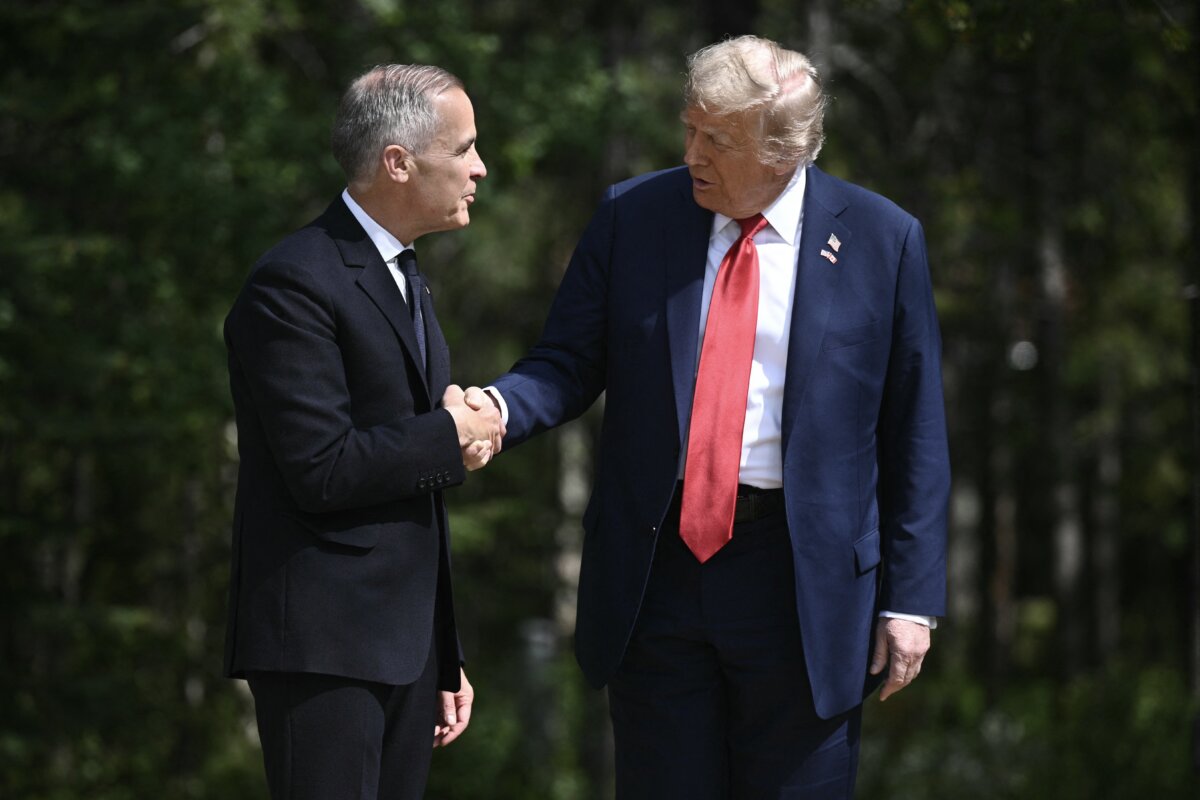

Prime Minister Mark Carney and U.S. President Donald Trump held a phone conversation for the first time since the Aug. 1 trade deadline passed.
In an Aug. 21 statement, Carney said he had a “productive and wide-ranging conversation” with the U.S. president that morning.
“We focused on trade challenges, opportunities, building a new economic and security relationship between Canada and the U.S., and supporting long-term peace and security for Ukraine and Europe,” he said.
A readout of the call from Prime Minister’s Office (PMO) said the Aug. 21 conversation included discussion on trade challenges, opportunities, and the “shared priorities in a new economic and security relationship between Canada and the U.S.”
The statement also said that Carney and Trump had agreed to “reconvene shortly.”
The U.S. raised tariffs on Canada from 25 percent to 35 percent beginning on Aug. 1, citing the issue of illicit drugs flowing over the shared border, saying Ottawa had “failed to cooperate” to curb it. Washington also cited Canada’s retaliatory measures as justification for the increase.
The Liberal government has said Canada accounts for just 1 percent of fentanyl coming into the United States, and said it has been “working intensively to further reduce these volumes.” Ottawa has also taken steps to improve border security and reduce illegal drug trafficking in recent months, including through a $1.4 billion package to boost border security and the appointment of a “fentanyl czar.”
Carney had sought to make a deal with the United States before July 21, but moved the deadline to Aug. 1 after Trump sent a letter threatening to raise tariffs from 25 percent to 35 percent. One day before the increased tariffs came into effect, Trump said Carney had called him, but the two had not spoken. The U.S. president did speak with Mexican President Claudia Sheinbaum that day, and kept Mexico’s tariffs at 25 percent for another 90 days.
The 35 percent tariffs, which went into effect on Aug. 1, apply to Canadian goods not covered under the United States-Mexico-Canada Agreement. The United States has also applied 50 percent tariffs on steel and aluminum, 25 percent tariffs on automobiles and auto parts, and 10 percent tariffs on energy and potash.
The PMO said the two leaders also discussed on Aug. 21 how to “build on the President’s leadership” to support a peace deal between Russia and Ukraine, which have been at war since 2022. Trump met with Russian President Vladimir Putin on Aug. 15, and later with Ukrainian President Volodymyr Zelenskyy and several European leaders on Aug. 18, to discuss an end to the war.
Trump said following that meeting at the White House that several countries would provide Ukraine with security guarantees, and that a trilateral meeting between himself, Zelenskyy, and Putin could soon be arranged.
On the same day that Carney and Trump spoke, U.S. Secretary of State Marco Rubio and Canada’s Foreign Affairs Minister Anita Anand also met in Washington, where they discussed the the issue of security in Haiti, the Middle East conflict, the Ukraine war, and the issue of China’s aggressions.
“We agreed on the need to support Haiti, end Hamas’ efforts to stand in the way of peace in Gaza, and to counter China’s coercive activity in our hemisphere,” Rubio said in a social media post.
The U.S. State Department added that Rubio and Anand “also discussed peace negotiations to end the Russia-Ukraine war and mechanisms to strengthen our hemisphere’s response to China’s coercive activity.”
 Friends Read Free
Copy
Facebook
Tweet
Friends Read Free
Copy
Facebook
Tweet