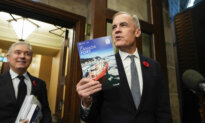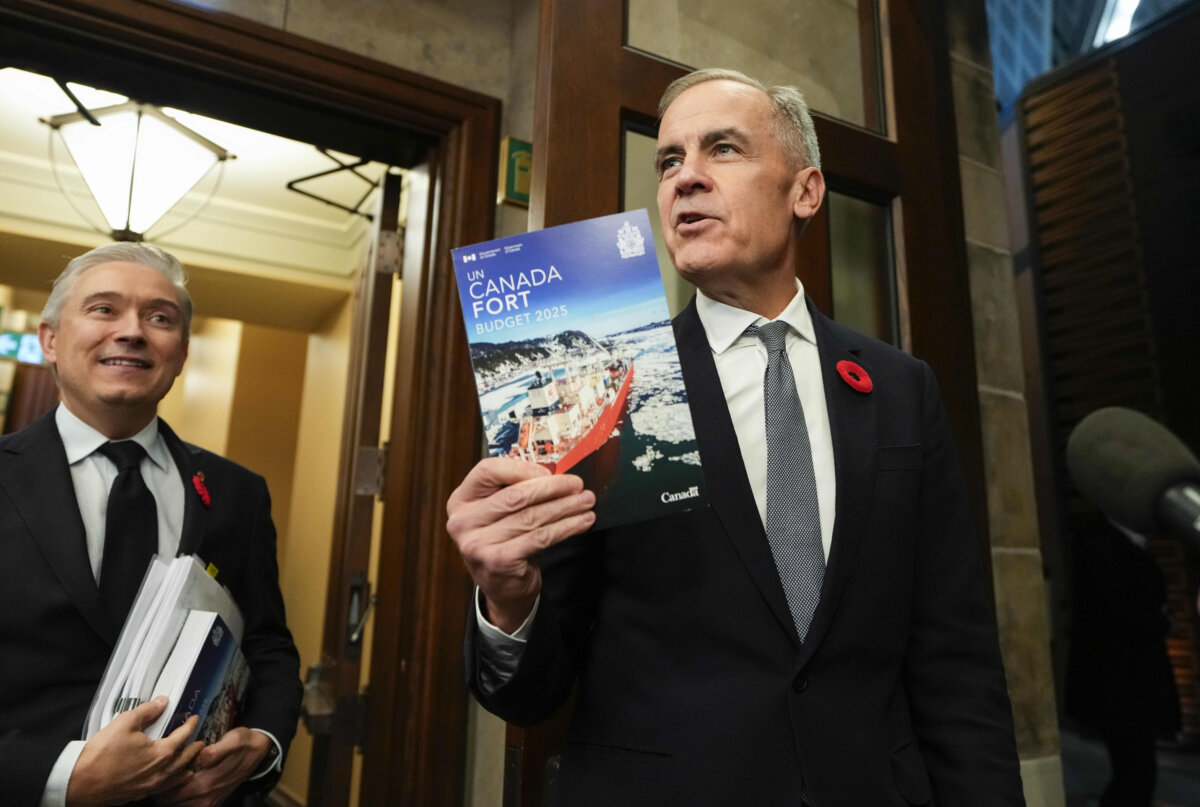

Finance Minister François-Philippe Champagne tabled the Carney government’s first budget on Nov. 4, forecasting a $78.3 billion deficit this fiscal year and a debt-to-GDP ratio expected to climb before stabilizing in the years ahead.
Champagne said his government’s budget is a response to the “fundamental” changes in the international order and trading system, making an apparent reference to U.S. tariffs.
“The level of uncertainty is higher than what we have seen and felt for generations,” he said. “The challenges are great, but the opportunities for Canada are even greater.”
Champagne said the budget’s “generational investments” have four key priorities: infrastructure, productivity and competitiveness, defence and security, and housing.
Funding Allocations
The budget document says more than 75 percent of the measures that the government is taking in the current fiscal year are to respond to “significant global economic shifts.”
In 2025–26, the impact of decisions made since the 2024 Fall Economic Statement includes $12 billion toward investing in defence, responding to tariffs, and “building a strong economy”; another $10 billion for addressing the climbing cost of living through cutting taxes, building homes, and cancelling the consumer carbon tax; and another $7 billion for “additional actions to support Canadians,” the budget document says.
With respect to the priority of infrastructure, Budget 2025 allocates $115 billion over five years toward major projects related to trade and transport ($5 billion), indigenous communities and municipal infrastructure ($19 billion), core public infrastructure ($54 billion) like water/wastewater and transit systems, and other infrastructure and assets ($37 billion) such as health innovation.
A total of $81.8 billion is earmarked for the Canadian Armed Forces over five years, starting the current fiscal year, as the government aims to hit NATO’s defence spending target of 2 percent of GDP.
The government also proposes to allocate $2 billion over five years, starting in 2026–27, to Natural Resources Canada for a “critical minerals sovereign fund,” and $925.6 million over five years, starting in 2025–26, to support a large-scale AI infrastructure project.
Savings
The budget states that the government will find savings under its current comprehensive expenditure review, saying the initiative will save $13 billion annually by 2028–29 alongside other savings and revenues, which will total $60 billion over five years.
Budget 2025 also plans to slash the number of public servants by some 40,000 positions by the end of the 2028–29 fiscal year, to reach roughly 330,000, which is a 10 percent decrease from the peak of nearly 368,000 in 2023–24. The government says this will be achieved via “normal attrition through retirements, voluntary departures, and previous savings exercises,” as well as further measures the government is taking to slow spending and return the public service to a “sustainable size.”
The budget states that over the next four years, from 2026–27 to 2029–30, among other measures, Ottawa plans to save $5.8 billion by aligning pension benefits with the consumer price index, $4.4 billion by adjusting medical cannabis benefits to reflect the market price of marijuana, $2.7 billion by reducing international aid to pre-pandemic levels, $2.3 billion by streamlining infrastructure programs, and $500 million by transferring the Canadian Coast Guard from the Department of Fisheries and Oceans to the Department of National Defence.
The Liberal government also changed its plan to plant two billion trees by 2031, which was first announced in 2021 and included $3.2 billion over a decade to complete the task. Over 228 million trees have been planted since then, and the government intends to fulfill the contracts it currently has in place, which will see the total number of trees planted reach nearly one billion trees in the coming years, thus saving $200 million over four years.
Previously Announced Measures
The budget outlines several initiatives that Ottawa announced earlier in 2025, including an initial $13 billion for the new Build Canada Homes agency and $5 billion over six years, starting this fiscal year, for a Strategic Response Fund to help Canadian industries respond to trade disruptions and supply chain volatility.
It will also include $3.7 billion over three years, starting this fiscal year, for temporary Employment Insurance (EI) measures to respond to U.S. tariffs; $2 billion for constructing a small modular nuclear reactor in Ontario; and $1.7 billion over four years, starting in 2026–27, to increase RCMP policing capacity across Canada.
The budget also says that making the national school food program permanent, which Carney pledged to do in October, will cost $216.6 million per year beginning in 2029–30.
Immigration
The budget details plans to slash the number of new temporary residents entering Canada, including workers and students. Ottawa projects that 385,000 temporary residents will enter Canada in 2026, then 370,000 in each of 2027 and 2028, compared to 673,650 in 2025. The drop reflects a significant reduction in the number of student permits issued to foreign nationals, down from a previous target of nearly 306,000 to 155,000 in 2026. The target will be further reduced to 150,000 in 2027 and the same in 2028. As for temporary worker permits, the targets are 230,000 in 2026 followed by 220,000 in 2027 and the same in 2028.
The plan also reduces the target for permanent resident admission targets to 380,000 per year for each of the three years from 2026 to 2028, down from 395,000 in 2025.
The government said this new immigration levels plan will cost $168.2 million over four years, starting in 2026–27, and $35.7 million on going, due to the “net loss in fee revenue” from fewer temporary resident admissions.
Fall Budget
Budget 2025 makes a few changes to Canada’s tax structure by introducing a “productivity super-deduction,” which will allow businesses to recover the cost of new capital investments faster. Ottawa says this would make it more attractive for companies to invest in machinery, equipment, and technology.
In addition to including a fiscal anchor of balancing day-to-day operating spending with revenues by the 2028–29 fiscal year, the budget has a second fiscal anchor of maintaining a declining deficit-to-GDP ratio.
This years’ budget was also introduced in the fall rather than in the springtime, which Champagne said in October would be done to better align the government’s financial planning with the priorities of businesses, investors, and the provinces and territories. As such, Ottawa will also introduce its fiscal update in the spring instead of in the fall as was done previously.
Opposition Parties Respond
Adopting the budget will be considered a confidence vote, meaning a majority of MPs need to vote in favour of it or an early election could be triggered. The minority Liberals need either the Conservatives, Bloc Québécois, or the NDP to support the budget bill in order for it to pass.
The Conservatives had not explicitly stated whether they would vote in favour of or against the Liberals’ budget bill without having seen it, but leader Pierre Poilievre had said the budget should be “affordable,” cut taxes and spending, and not increase the deficit beyond $42 billion.
After the budget was tabled on Nov. 4, Poilievre said the party would “not be able” to support the budget. He said his party will instead put forth an amendment to the budget getting rid of the industrial carbon tax and cutting “the wasteful spending to bring down debt, inflation and taxes.”
Bloc Québécois Leader Yves-François Blanchet said he could “hardly see how” his party could vote in favour of the budget given that it contains a $78 billion deficit and “nothing of what we did ask [for] in the budget.”
The Bloc had made six “unavoidable” demands in order for it to support the budget, including higher Old Age Security payments starting at age 65 along with increased health and infrastructure transfers to the provinces with no strings attached.
NDP Interim Leader Don Davies said his party would “take the time to study” the budget and “consult with stakeholders” before deciding whether to vote in favour of it.
The NDP had not made any specific demands ahead of the budget but had said the party would not support a budget with austerity measures. Davies previously said MPs from his party could choose to abstain from voting on the budget.
 Friends Read Free
Copy
Facebook
Tweet
Friends Read Free
Copy
Facebook
Tweet