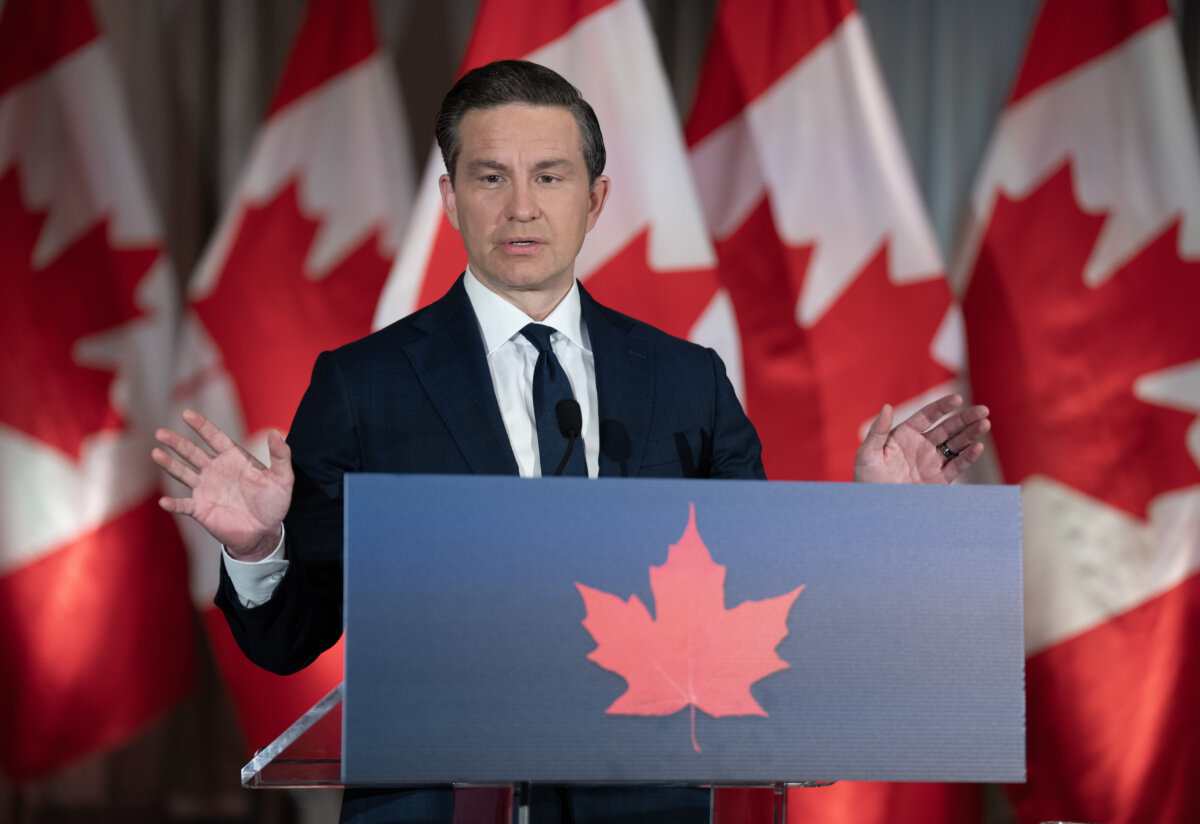

Conservative Leader Pierre Poilievre said days before the release of the federal budget that he’s willing to work with the Liberals to draft an “affordable” budget that his party could support.
“I’m willing to work all through the night—tonight and tomorrow—to come up with an affordable budget that will make an affordable life for Canadians. But we will not vote to raise grocery prices and increase housing costs as the Liberals have done over the last decade,” Poilievre told reporters during a Nov. 2 press conference in Ottawa.
In response to a reporter’s question on whether he wanted to see an election before Christmas, Poilievre said he wanted an “affordable budget that will give Canadians an affordable life before Christmas,” and accused Prime Minister Mark Carney of “playing games and trying to force an election.”
Poilievre has previously accused the Liberal government of wanting to trigger an election to “distract” from broken promises around reducing U.S. tariffs on Canada and lowering the cost of living. A second election in 2025 could be triggered by the Nov. 4 budget, which is a confidence vote, if not enough MPs vote in favour of it.
Government House Leader Steven MacKinnon told Poilievre during question period in the House on Oct. 29 that there would be an “affordable budget for an affordable life” presented on Nov. 4.
“We certainly hope the Opposition Leader will order his troops to vote for it, instead of ordering the very nervous ones to vote against it and cause a very expensive Christmas election here in Canada,” MacKinnon added.
MacKinnon said on Oct. 26 that the minority Liberal government did not have the necessary votes to pass its budget. Given that the party is three seats shy of a majority government, they need the support of the Conservatives, Bloc Québécois, or New Democrats to pass it.
While the Conservatives have not explicitly said whether they will vote in favour of the budget, Poilievre said the deficit should not exceed $42 billion, which is the last official deficit projection for fiscal 2025-26. Parliamentary Budget Officer Jason Jacques has estimated the budget will include a deficit of $68.5 billion. MacKinnon said in September that the deficit would be “substantial.”
The Bloc has issued a list of six demands that they say must be met if they are to support the budget, which includes increased health and infrastructure transfers to provinces with no strings attached, and increased Old Age Security payments. Bloc Québécois Leader Yves-François Blanchet also said earlier this month that the projected deficit was “unbelievable” and he did not see how his party could support the budget.
Interim NDP Leader Don Davies said earlier this month that while his party had not made any specific demands for the upcoming budget, the NDP would not support an austerity budget.
In September, Carney said the budget would be “an austerity and investment budget at the same time.”
Carney said on Nov. 2 that the budget would “respond head on to the challenges of our time,” by lowering the cost of living, supporting Canadians’ economic opportunities, and protecting the border. The prime minister also said the budget aims to generate “unprecedented levels of investment” that will create jobs for Canadians.
When asked if he was confident the budget was going to pass, Carney said he was “100 percent confident that this budget is the right budget for this country at this moment.” When questioned on whether he was prepared for another election, the prime minister said, “I’m always prepared to stand up for the right thing.”
Budget Vote
During the press conference, Poilievre was asked if members of his party would be able to abstain from voting on the budget, which NDP Leader Davies has said his party may consider. Poilievre responded that his party would see what the budget includes on Nov. 4, “but I can’t tell you any more than that until I see the thing.”
MPs are able to vote in favour of legislation, vote against it, or abstain from voting altogether. If the NDP were to abstain from voting on the budget, then the Liberals would have enough votes to pass it and avoid an election.
The NDP, under former leader Jagmeet Singh, was in a supply-and-confidence agreement with the Liberals from March 2022 to September 2024, under which it supported the governing party in key confidence votes in exchange for legislation sought by the NDP.
The NDP voted to support the Liberal Party in three subsequent non-confidence motions introduced by the Tories last year. The party dropped from 24 seats to just 7 in the April federal election, and Singh also lost his own seat, announcing he would step down as leader shortly thereafter.
 Friends Read Free
Copy
Facebook
Tweet
Friends Read Free
Copy
Facebook
Tweet