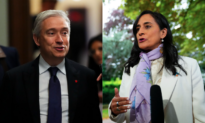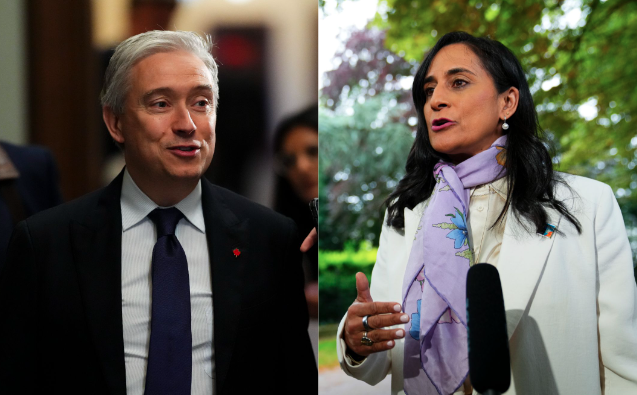

Finance Minister François-Philippe Champagne and Foreign Affairs Minister Anita Anand are visiting Mexico this week in a bid to strengthen ties amid uncertainty in the relationship with the United States.
Champagne and Anand will be in Mexico City on Aug. 5 and 6 to meet with Mexican President Claudia Sheinbaum and their counterparts to “advance key shared priorities,” such as economic growth, security, and trade, Global Affairs Canada (GAC) said in a release.
The ministers will also meet with a group of Canadian and Mexican business leaders as part of ongoing efforts to “deepen bilateral cooperation and advance shared economic interests.”
Additionally, Anand will participate in a joint meeting of the Committee for North America and the Committee for Foreign Affairs of Mexico’s Senate in an effort to further parliamentary relations between Canada and Mexico.
“This visit will also serve to strengthen bilateral dialogue in anticipation of Prime Minister Carney’s upcoming visit to Mexico,” GAC said. The date of the official visit has not yet been released.
When Prime Minister Mark Carney met with Sheinbaum on June 17 at the 2025 G7 Leaders’ Summit in Kananaskis, Alta., they agreed to meet again in Mexico in the coming months.
The Prime Minister’s Office said the leaders discussed several topics at the summit meeting, including economic and energy security, building reliable supply chains, and agreed to strengthen ministers’ relations in trade, energy, agriculture, and security. The two leaders also discussed safeguarding North American competitiveness and rules-based trade ahead of the review of the United States-Mexico-Canada Agreement (USMCA) in 2026.
US Tariffs
During the G7 summit, Carney and U.S. President Donald Trump had agreed to reach a trade deal within the next 30 days, butthe deadline was delayed to Aug. 1 after Trump threatened to rise the tariff on Canadian goods not covered by the USMCA to 35 percent.
On July 31, Trump hiked tariffs on Canadian goods from 25 percent to 35 percent. Meanwhile, on the same day, he gave Mexico a 90-day extension to reach a trade deal following a phone call with Sheinbaum, which Trump called “very successful.”
The initial U.S. tariffs on Canada and Mexico were set at the same rate of 25 percent, with Trump citing concerns about fentanyl trafficking and illegal immigration coming into the United States from the two countries.
The White House said that since Canada “failed to cooperate” in stopping the flow of fentanyl and other illicit drugs into the United States through their shared border, Trump “found it necessary” to increase tariffs on Canada from 25 to 35 percent.
Meanwhile, Carney said in an Aug.1 statement that only 1 percent of the fentanyl entering the United States comes via the Canadian border and noted that Canada has been “working intensively to further reduce these volumes.”
Canada has taken a number of steps to address Trump’s concerns, including following his designation of five Mexican drug cartels and two street gangs as terrorist organizations in an effort to fight against drugs like fentanyl. It is now illegal for anyone to participate in or support these organizations’ activities, or deal with their property.
Noé Chartier and Omid Ghoreishi contributed to this report.
 Friends Read Free
Copy
Facebook
Tweet
Friends Read Free
Copy
Facebook
Tweet