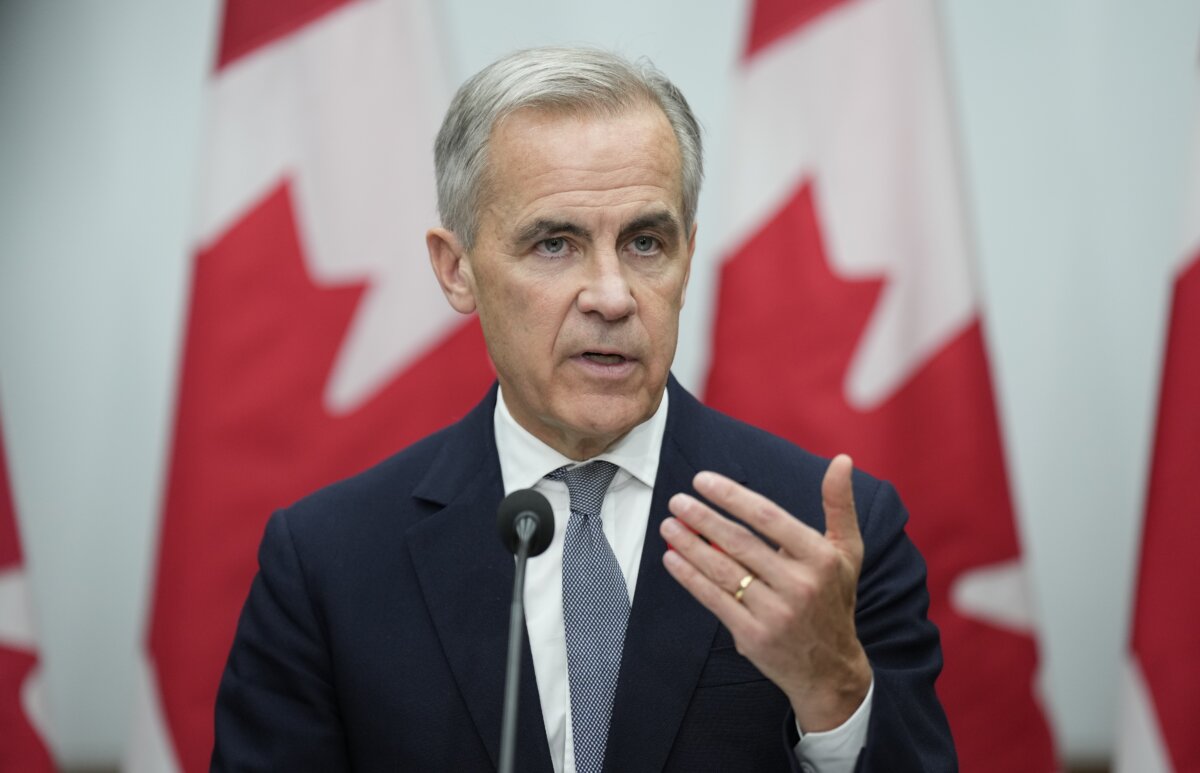

Prime Minister Mark Carney has unveiled the second batch of so-called nation-building projects that will be referred to the Major Projects Office (MPO) for fast-tracking.
The new list includes mining projects in New Brunswick, Quebec, and Ontario, a liquified natural gas (LNG) project and a transmission line in B.C., and a hydroelectricity project in Nunavut.
“Each of the projects that we’re referring to the Major Projects Office today, in and of itself, is transformational, but the bigger point is that their impacts will be amplified by being part of bigger national strategies to boost Canada’s competitiveness, including to realize our country’s full potential as an energy superpower,” Carney said at a Nov. 13 press conference in northern B.C.
This announcement follows the first batch of projects announced in September, which were all projects in late stages of approval.
The new list includes more projects at earlier approval stages, including a hydro project still in the conceptual stage.
Projects are being referred to the MPO to help fast-track infrastructure approvals and can receive federal funding. The MPO aims to reduce project approval times from five years to two years. The new mechanism was implemented following Parliament’s adoption of the Building Canada Act under Bill C-5 last June.
Critical Minerals Projects
The latest projects announced are in line with Ottawa’s push to develop the critical minerals sector.
The Northcliff Resources’ Sisson Mine project in Sisson Brook, N.B., would produce tungsten; a critical mineral used in high-strength steel production, defence, and industrial applications. The project has already undergone environmental assessments, indigenous consultations, and comprehensive studies.
The Nouveau Monde Graphite Phase 2 project in Quebec includes an open-pit graphite mine that is expected to provide critical minerals for defence applications and battery supply chains. The project will also include the Bécancour Battery Material Plant and is expected to generate more than 1,000 new jobs and $1.8 billion in investment.
The Crawford Nickel project located north of Timmins, Ont., includes an open-pit nickel-cobalt mine and an on-site metal mill with an expected lifespan of 41 years. The mine would produce 240,000 tonnes of ore per day, while the mill could process 120,000 tonnes per day. The project is currently in the impact statement phase, where the impacts of the project are assessed and indigenous and public consultations take place.
LNG Project
Ottawa is not proposing any new pipeline projects, but, as with the previous round of major projects, it is supporting the development of another LNG project in B.C. as part of the second set of initiatives.
Cabinet ministers have said there is much appetite for Canadian LNG after holding talks in recent months with foreign governments and companies in Europe and Asia.
The Ksi Lisims LNG project includes a new gas pipeline to supply feed gas for liquification, a new electricity transmission line, and a floating LNG facility and marine terminal located on Pearse Island, B.C. The project would produce 12 million tonnes of LNG per year, destined primarily for markets in Asia. The project is currently in the “post decision” stage, meaning it has already gone through consultations and assessments, and approved by the environment minister in September.
Electricity Projects
Two electricity-related projects are also among the newly announced set of major projects to be fast-tracked by the MPO.
“Core to becoming an energy superpower will be to fully capitalize on Canada’s advantage in clean energy by substantially expanding our clean electricity grid,” Carney said on Nov. 13.
“Clean electrification is the path. It’s the only path to building a sustainable, prosperous economy,” he added.
The hydroelectricity project in Nunavut, known as the Iqaluit Nukkiksautiit Project, includes a 15-30 megawatt water power plant that has the potential to become the area’s main electricity source, replacing diesel-generated electricity. The project received $6 million in federal funding in February to navigate regulatory processes, conduct engineering and design work, develop financial models, and maintain public engagement. It also received $7 million in funding from Crown-Indigenous Relations and Northern Affairs Canada in 2021.
The North Coast Transmission Line is expected to feature new 500 kilovolt transmission lines and associated infrastructure from Prince George to Terrace, B.C., in two phases. Both phases are currently undergoing studies and regulatory approvals and are expected to begin construction next year, with the first phase becoming operational in 2030 and the second phase becoming operational in 2032.
First Set of Projects
Carney announced the first set of major projects recommended for approval under the MPO in September, which included the second phase of LNG Canada in British Columbia, the Darlington New Nuclear Project in Ontario, the expansion of the Port of Montreal, the McIlvenna Bay Foran Copper Mine Project in Saskatchewan, and the expansion of the Red Chris Mine in northwestern B.C.
The projects selected during the first round were largely in advanced stages of approval already, and had also largely cleared indigenous consultations.
Carney also announced six “strategies for projects” that are at earlier stages and require more development. These included fast-tracking critical minerals projects in areas such as Ontario’s Ring of Fire region, emissions reduction via the Pathways Plus carbon capture and storage project in Alberta, the Arctic Economic and Security Corridor infrastructure project, the Port of Churchill Plus project to expand trade corridors in Manitoba, and a high-speed railway from Toronto to Quebec City.
Matthew Horwood and Noé Chartier contributed to this report.
 Friends Read Free
Copy
Facebook
Tweet
Friends Read Free
Copy
Facebook
Tweet