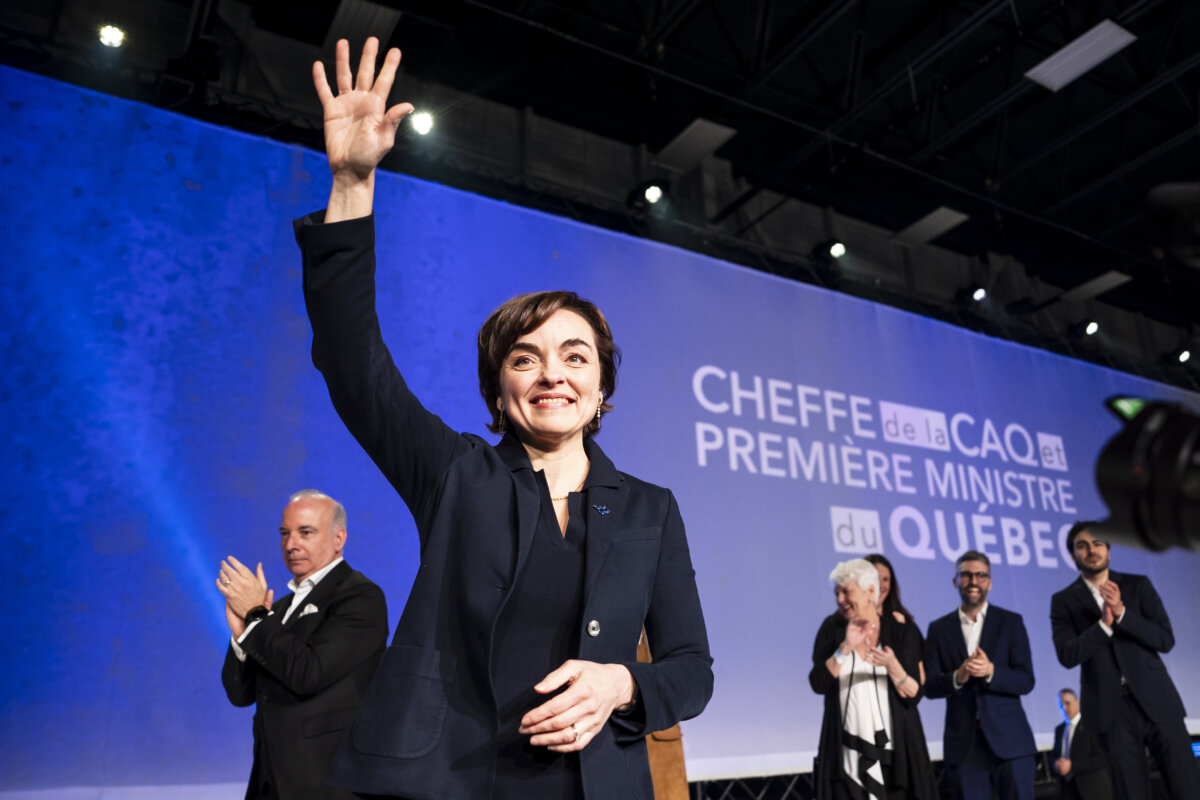

Christine Fréchette has won the leadership of the governing Coalition Avenir Québec and will be sworn in as Quebec’s new premier after winning nearly 58 percent of the vote on April 12.
Fréchette is replacing François Legault as premier of Quebec and leader of the Coalition Avenir Québec (CAQ).
Legault created the CAQ in 2011 and led the party ever since, but announced he is stepping down as premier and leader of the party in January after months of declining poll numbers and ahead of the provincial election scheduled for October.
CAQ members gathered at the party’s leadership convention in Drummondville, Que., northeast of Montreal, on April 12, where Fréchette was announced as the new CAQ leader roughly one hour after polls closed.
“I am so happy and proud that you put your trust in me,” Fréchette told CAQ members at the convention. “Today we’re moving on to a new step. You voted for a new kind of leadership, a new generation.”
Fréchette, a former provincial minister and an MNA since 2022, claimed 57.9 percent of the vote, while her only rival, fellow MNA and former provincial minister Bernard Drainville, garnered 42.1 percent of the vote. The leadership race had an approximate 77 percent voter turnout, with roughly 15,800 of the party’s 20,500 members voting.
Fréchette, who is a former Parti Québécois staffer, resigned as the province’s economy minister to run for CAQ leadership. She had focused her leadership campaign on economic issues, including on reopening the debate around shale gas and hydraulic fracturing.
She promised in her victory speech to be a sound leader with a more streamlined government, pointing to global conflicts and commercial tensions and saying she understands the strain on Quebec families.
“You deserve a government that will make your life easier,” she said, noting she wants to invest in the province’s hydroelectricity, natural resources, technology, and culture, and protect the French language.
Fréchette said her leadership style will be informed by her experience growing up in the aftermath of failed separation referendums, tense negotiations with the federal government, and high youth unemployment rates.
Drainville, a former Parti Québécois minister, had focused his campaign on more right-leaning ideas and positioned himself as the candidate best suited to defend Quebec’s identity and to adopt a stricter immigration policy.
Fréchette thanked Drainville for a leadership race based on strong ideas and said he made her a better candidate. She also said she hopes to lead the CAQ to victory in the general election this fall, saying the province does not want to return to old debates on separatism. The Parti Québécois has said it would hold a separation referendum if it forms government.
Legault’s Resignation
Legault, who became premier of Quebec in 2018, said during his resignation announcement on Jan. 14 that he would formally resign once the party selects a new leader.
He said the decision was made in the best interests of both the CAQ and the province, and acknowledged that many Quebecers had been calling for change, including a change in leadership.
He also said he wanted the next election to be about challenges facing Quebec, such as restructuring the economy to provide good jobs for future generations, and stopping the decline of the French language in the province, particularly in the Montreal area.
“There are issues at stake in Quebec that are far too important. There are issues that go beyond me personally. We need an economic and nationalist party now more than ever,” Legault said in a speech at the April 12 convention as he handed off the leadership of the CAQ to Fréchette.
The latest Léger poll conducted for Quebec media outlets said the CAQ is garnering only nine percent of the vote. Meanwhile, poll aggregator Qc125 is projecting that if an election was held today, the CAQ would not win any seats, even though the party won two back-to-back majority governments in 2018 and 2022.
Léger polls in January indicated Fréchette could allow the CAQ to gain traction among voters, with one poll saying a CAQ led by Fréchette would garner 25 percent of votes in the provincial election, while a CAQ led by Drainville would fall to 15 percent, which is lower than that observed under Legault.
More recent polls have suggested that regardless of the CAQ’s leader, the party is trailing far behind the Parti Québécois, Quebec Liberals, and Conservatives.
Reactions
Quebec Liberal Party leader Charles Milliard congratulated Fréchette for becoming Quebec’s 33rd premier.
“Having the opportunity to serve Quebecers at this level is the privilege of a lifetime, and I wish her success in the responsibilities that await her,” Milliard said in an April 12 post on X.
He also congratulated Drainville for his leadership campaign, saying his ideas “will have found an echo among a segment of the population that we must listen to,” and thanked Legault for his “commendable” years of service to Quebecers.
Parti Québécois Leader Paul St-Pierre Plamondon congratulated Fréchette, adding that the coming weeks “will hold a colossal task in store for her, and I wish her the very best of luck in carrying out her new duties.” He also saluted Drainville, noting he ran a “courageous” leadership campaign.
“His defeat marks the defeat of the ‘blue’ nationalist current in favour of the caquistes who align more closely with this party’s ‘red’ line of thinking. This outcome will therefore have real consequences on the political landscape, and I will speak more about this later this week,” he said in an April 12 social media post.
Conservative Party of Quebec Leader Eric Duhaime also congratulated Fréchette, saying he is “happy to see a second woman rise to the highest office in Quebec.”
He also congratulated Drainville, saying he performed better than the polls initially predicted for him. “42% of CAQ supporters essentially just voted for conservative ideas and values,” he said.
Noé Chartier and The Canadian Press contributed to this report.
 Friends Read Free
Copy
Facebook
Tweet
Friends Read Free
Copy
Facebook
Tweet