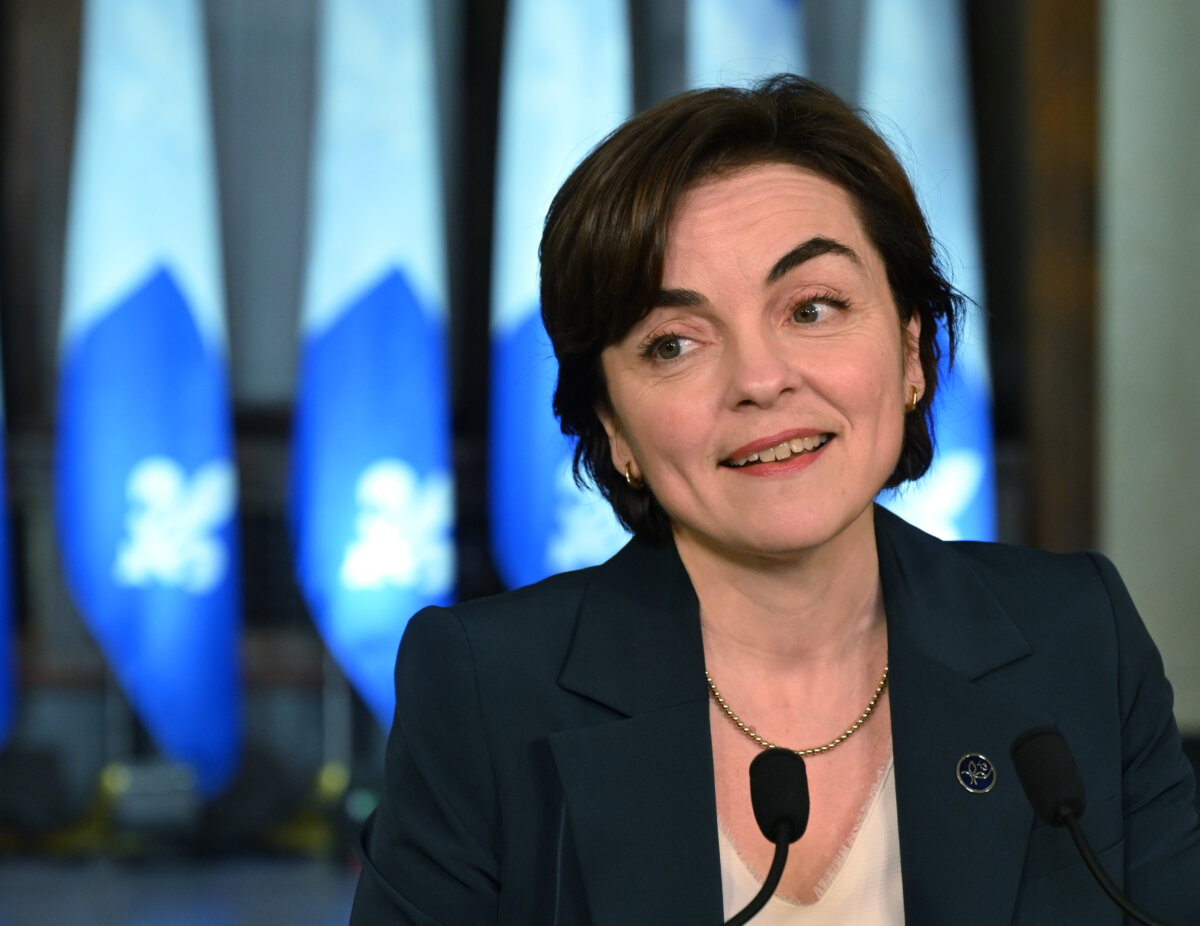

Christine Fréchette has officially been sworn in as Quebec’s premier, the second woman to hold the job in the province’s history.
In a speech at the legislature Wednesday, Fréchette promised to focus on growing Quebec’s economy and to govern as a nationalist.
“Becoming premier is much more than just a job; in fact, it is an immense responsibility. The responsibility to serve our nation to the best of my knowledge and ability, and above all to look after the interests of the people of Quebec every single day,” she said.
The 55-year-old follows in the footsteps of the Parti Québécois’s Pauline Marois, who was Quebec’s first female premier from 2012 to 2014.
Fréchette, who positioned herself as a centrist economic candidate, defeated Bernard Drainville in the race to replace François Legault, who created the Coalition Avenir Québec in 2011 and had been premier since 2018.
First elected in 2022 in the Sanguinet riding south of Montreal, Fréchette held the economy and immigration portfolios in Legault’s cabinet. Prior to joining the Coalition Avenir Québec, she headed the Chambre de commerce de l’Est de Montréal, a business association that promotes economic development in the city’s east end.
Speaking to party members, Fréchette reflected on growing up in Trois-Rivières, about halfway between Montreal and Quebec City, in the 1970s. As a member of Gen X, she said, she “never again wants a generation to feel like they were sacrificed.”
She added that she sees several parallels between the issues she faced growing up—global conflict, slow economic growth and high youth unemployment—and those of today.
She said she understands what it’s like to live in the regions where access to services, health care, employment and housing isn’t always easy. She said having spent time in Quebec City and Montreal, two economic drivers, has shown her that both the cities and the regions must thrive for Quebec to advance.
She also spoke about her father, who spent his career working at Hydro-Québec. She said the government-owned public utility company is proof that “a strong public institution can change the fate of a nation” through strong jobs and internationally recognized expertise.
“Above all, it is an example of what Quebec is capable of achieving when it builds on its strengths and talents. It is this vision that guides my economic commitment,” she said.
She said Quebec-made products and services will be required in government tenders, from timber and aluminum to food labour forces.
“This choice is not ideological. It is economic and it is nationalist,” she said.
Fréchette also pledged to defend Quebec’s culture and the French language, saying it unites and defines Quebecers.
Among other promises, she said she would fund an additional one million hours in at-home care, expand telemedicine and cut red tape for small and medium-sized businesses.
On immigration, Fréchette said she has always believed in a “humane and responsible” approach. She said it was crucial to respect Quebec’s capacity to welcome and integrate newcomers while meeting labour needs, particularly outside city centres.
“I think of the girl who grew up watching Janette Bertrand, Diane Dufresne, Madeleine Poulin and Pauline Marois … this young woman had no idea that one day she would be standing here,” Fréchette said, referring to prominent Quebec women in their fields.
“Today, I pledge to govern with ambition and determination. And I pledge to build a Quebec that lives up to your efforts.”
The new premier said she will name a cabinet next week and intends to make at least one announcement in the coming days related to the cost of living.
She now faces the task of boosting the fortunes of the Coalition Avenir Québec, which is polling behind the Liberals, the Parti Québecois and the Conservatives ahead of the Oct. 5 election.
 Friends Read Free
Copy
Facebook
Tweet
Friends Read Free
Copy
Facebook
Tweet