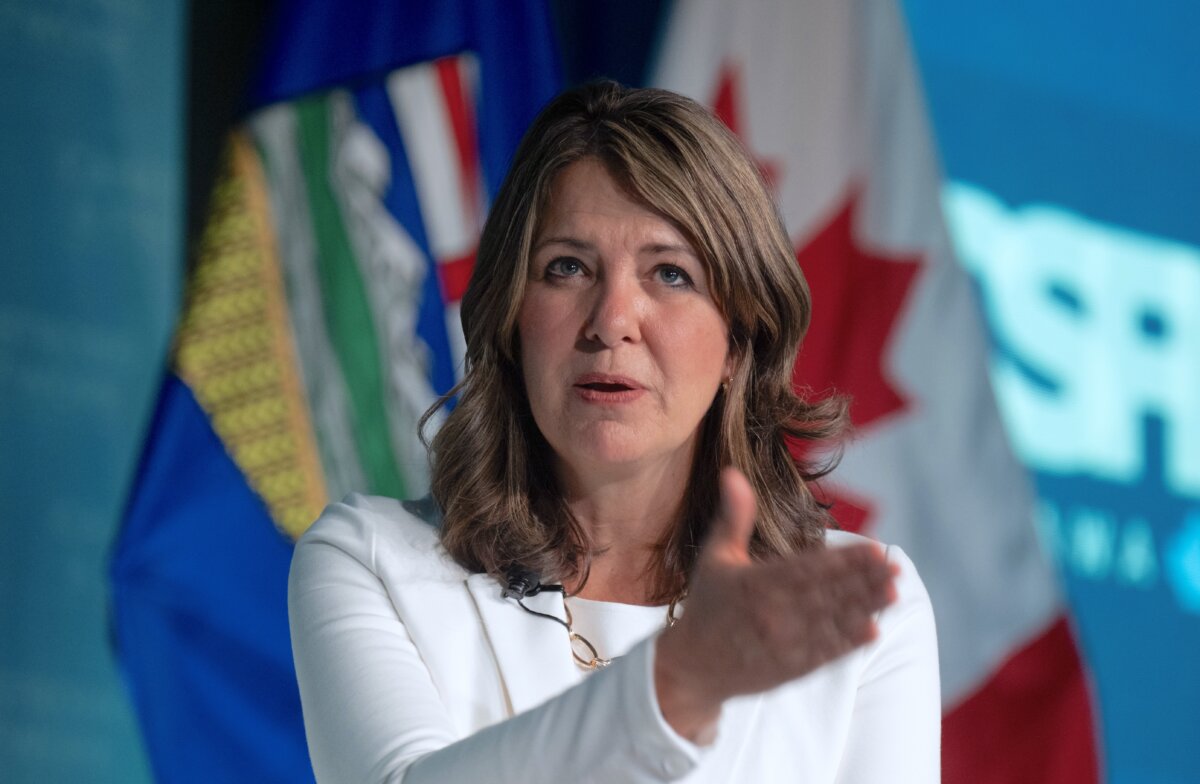

Alberta Premier Danielle Smith told MPs at a parliamentary committee that nearly all ambassadors she meets in her capacity as her government’s international affairs minister show a “very high level of interest” in Canadian energy exports.
“I meet regularly with ambassadors, and virtually every person I have met with has said, ‘How can we get more reliable energy from Canada?’” Smith told the House of Commons Environment Committee on Oct. 23.
The Alberta premier said the Trans Mountain Pipeline now exports the majority of Alberta’s oil westward to Asian markets, despite initial expectations that the bulk of the oil would go south to the United States.
Smith said Canada currently does not send oil directly to Europe, as the oil is sent to the Gulf Coast of the United States and is then exported to the continent. “So we think that we should probably be trying to do more of our sales directly if we want to open new markets,” she said.
Smith said there is the capacity for another million barrels of oil per day to be shipped to the West Coast, as well as another pipeline to Churchill, Man., on the Hudson Bay, or to James Bay in Northern Ontario. Smith said Alberta would also like to see the province of Quebec “develop its substantial natural gas resources to be able to wean itself off American supply.”
Smith also said that if the three pipelines of Northern Gateway, Keystone XL, and Energy East had not been cancelled, Alberta could be producing an additional 2.5 million barrels of oil a day. She said this would have amounted to $55 billion worth of GDP, leading to an extra $10 billion to $15 billion in tax revenue for the federal government.
Prime Minister Mark Carney said in July that it was “highly likely” the federal government would approve a new oil pipeline to the West Coast, as well as a massive carbon capture network proposed by a consortium of Canada’s largest oilsands producers.
While Ottawa did not announce a new pipeline in September as part of its first set of projects recommended for approval under the new Major Projects Office, the government approved a liquefied natural gas plant expansion in B.C. Ottawa also said it was examining a Pathways Plus carbons storage plant to be built in Alberta, as well as a pipeline that would “substantially reduce emissions with additional energy infrastructure.”
However, B.C. Premier David Eby has repeatedly expressed skepticism about the prospects of a pipeline to the West Coast. On Oct. 7, Eby said instead of a new oil pipeline, which he said currently is not a real proposed initiative with private investment and which would require Ottawa to scrap its ban on oil tankers operating in the region, Ottawa should be examining a “real project” that has secured a proponent and environmental assessment approval.
Smith has pitched an Alberta-B.C. project proposal to the Major Projects Office, saying she wants to help get such a project through initial permit requirements to attract private investments, which she says has been driven away by federal policies impeding oil and gas development.
Smith told the environment committee that the premiers should be supporting each province’s energy and resource projects, and said she has expressed support for Quebec’s aluminum sector and Ontario’s auto and steel sectors.
“There is not a single project that has been proposed that I have expressed an opposition to, and I would hope that politicians of all stripes and all premiers would take the same view,” Smith said.
 Friends Read Free
Copy
Facebook
Tweet
Friends Read Free
Copy
Facebook
Tweet