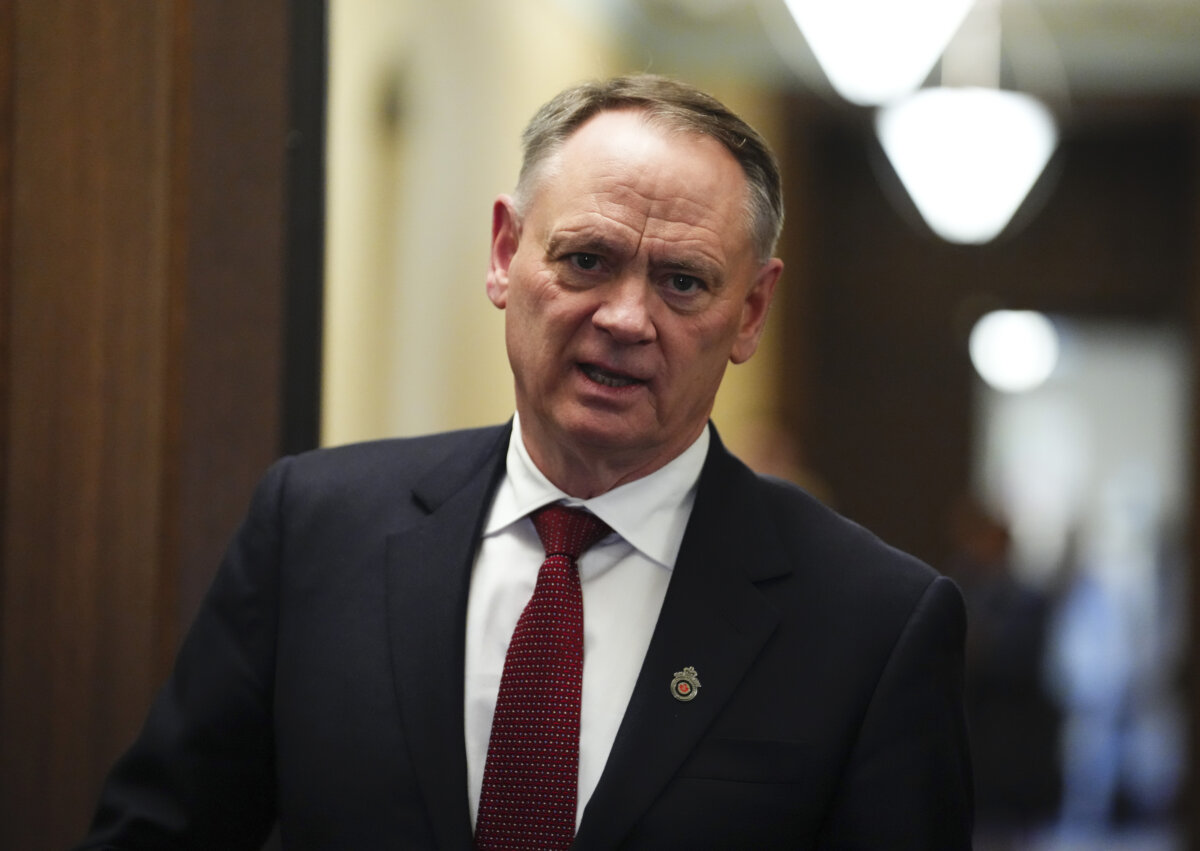

Defence Minister David McGuinty says he’s not aware of any major spending cuts planned for social programs following a news article claiming the finance minister is asking his colleagues to tighten the belt.
A July 7 article in The Globe and Mail said Finance Minister François-Philippe Champagne has sent letters to cabinet ministers, asking them to cut department program spending by 7.5 percent by the next fiscal year starting April 1, 2026. Additional cuts of 10 percent and 15 percent would follow for the next two fiscal years, according to the report.
At a July 7 funding announcement at Canadian Forces Base Trenton, McGuinty said he had “just received that letter” and hadn’t spoken to Champagne. “I have been part of no discussions with respect to, for example, significant social services cuts at a federal level,” he said.
Prime Minister Mark Carney’s government recently made major spending announcements, including a commitment to boost Canada’s defence spending to 2 percent of GDP by the 2025–26 fiscal year—amounting to an estimated $62 billion over the next five years. Carney also said Canada would boost defence spending to 5 percent of GDP by 2035.
At the same time, the government is implementing tax cuts, dropping the rate for the lowest tax bracket by 1 percent, and cancelling a planned expansion of the capital gains tax inclusion rate, effectively lowering government tax revenues.
The Liberal government hasn’t yet tabled a budget, saying it will table one in the fall. Parliamentary Budget Officer Yves Giroux said last month he expects the deficit to balloon this year primarily due to ramped-up defence spending.
The C.D. Howe Institute said in a study last week that Canada is projected to have an average yearly deficit of $78 billion over the next four years, adding approximately $350 billion to the nation’s debt.
During and prior to the recent election campaign, Carney said his plan to balance the budget involved separating the government’s operating and capital budgets, reviewing program spending to prioritize outcomes, and using artificial intelligence to create “efficiencies within programs and across government.”
The Liberals’ costed election platform called for $129 billion in new spending over four years, which included $18 billion for increased defence spending and $11.8 billion for housing.
Speaking June 25 on how Canada’s government will fund higher defence spending, Carney said, “we will have to make considerations about what less the federal government can do in certain cases, and how we’re going to pay for it.” He added, “those trade-offs happen towards the end of the decade, into the next decade, and we will be much, much better informed.”
Matthew Horwood contributed to this report.
 Friends Read Free
Copy
Facebook
Tweet
Friends Read Free
Copy
Facebook
Tweet