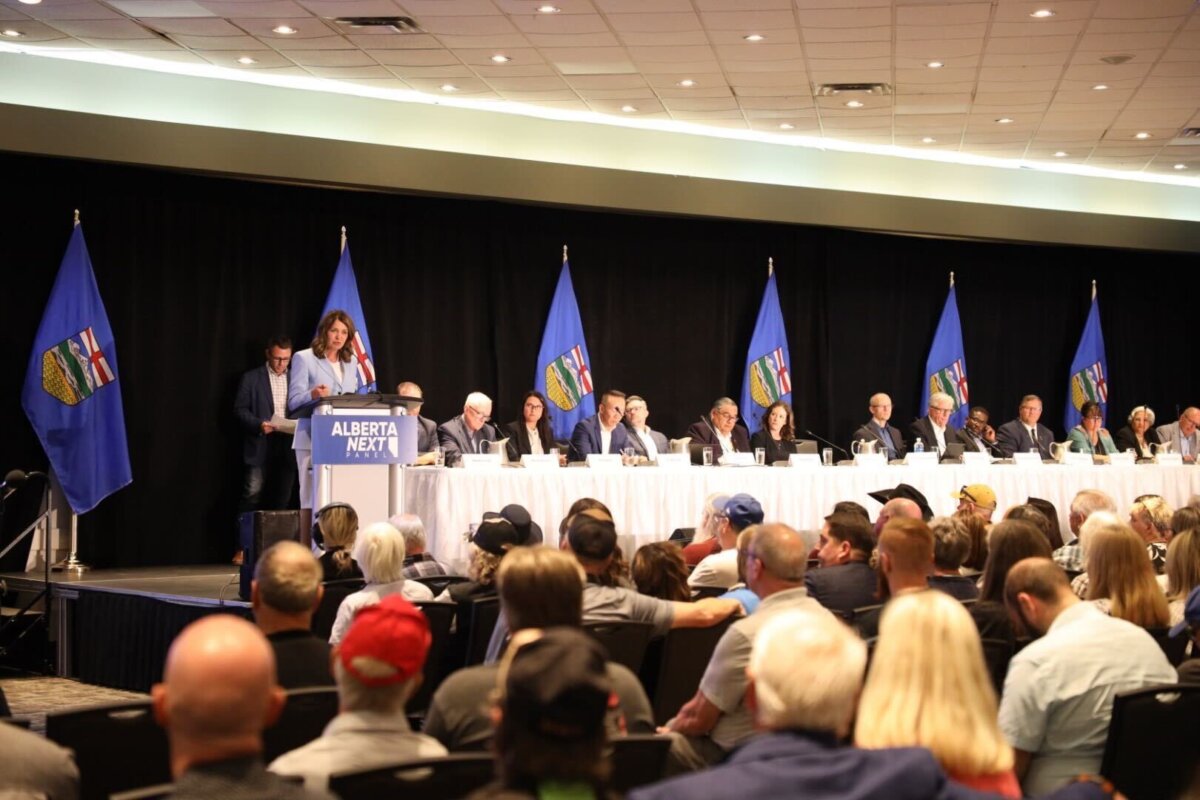

The first two sessions of the Alberta UCP government’s Alberta Next Panel saw packed venues and drew tens of thousands of remote viewers as the government sought public input on ideas such as a provincial pension plan and increased provincial control over immigration.
The inaugural session was held in Red Deer on July 15, followed by another in Edmonton the next day. Eight more sessions are scheduled across the province for August and September.
The panel is tasked with gathering public input and developing proposals to “assert” provincial sovereignty within Canada. It is one of the measures Premier Danielle Smith announced following the re-election of the federal Liberals earlier this year, aimed at finding ways to “protect” the province against current or future “hostile policies” from Ottawa.
The panel will also recommend potential referendum questions for a province-wide vote in 2026.
The Red Deer town hall drew more than 450 attendees and over 30,000 livestream views, according to data from the premier’s office. The Edmonton event saw higher engagement, with more than 500 in-person attendees and 80,000 livestream views.
Smith said the engagement is necessary to help guide the province’s next steps. At the Red Deer town hall, she pointed to the outcomes of the Fair Deal Panel, launched under former Premier Jason Kenney, saying its recommendations—including challenging a number of federal laws, establishing a chief firearms officer, and advocating for greater market access—have guided the provincial government’s work over the past five years.
Each topic at the town halls is introduced by a video produced by the provincial government, followed by attendees lining up to share their views at the microphone within a 45-second time limit.

Equalization
The first topic discussed at both town halls was federal transfers and the equalization program, a policy the UCP government opposes, calling it unfair. The goal of equalization program is to address fiscal disparities among provinces. Smith argues it has resulted in Alberta “subsidizing” larger economies like Ontario and Quebec.
One attendee from Calgary who participated at the Red Deer town hall expressed opposition to the program, comparing it to parents taking money away from their children to give it “indefinitely” to their siblings.
“If my brother needs help, he can come with a business plan and ask for it,” he said. “And Alberta should treat the other provinces the same.”
Meanwhile, an attendee from Strathcona County at the Edmonton town hall spoke in support of the program, describing it as a way to help other Canadians.
“As a Canadian, I am quite happy to use my tax, my contributions to help other provinces that are less well off,” he said.
Alberta held an equalization referendum in 2021, asking residents whether a section of the Constitution Act on “Parliament and the government of Canada’s commitment to the principle of making equalization payments” should be removed from the Constitution.
Nearly 62 percent of Albertans responded “yes,” and while the province could not unilaterally end participation in the program, then-Premier Kenney said the results gave the provincial government a “renewed mandate” to seek fair treatment for Albertans.
Smith said at the Red Deer town hall that the 2021 referendum was successful at getting other provinces to start questioning the fairness of the program, noting that a few of them launched a legal challenge on the issue.
“We are still going on with the political process, but now we have got more allies than we did before,” she said.
Alberta Pension Plan
Another topic discussed at the town halls was the possibility of establishing a provincial pension plan, a proposal also discussed by this panel’s predecessor, the Fair Deal Panel.
The provincial government says Albertans pay more than their fair share into the Canadian Pension Plan (CPP), contributing roughly $3 billion more each year than Alberta seniors receive in benefits.
The federal government is strongly opposed to the idea, with former Prime Minister Justin Trudeau saying in an Oct. 18, 2023, letter to Smith that Alberta’s withdrawal would “weaken the pensions of millions of seniors and hardworking people in Alberta and right across the country.”
The province says a provincial pension plan could help grow Alberta’s financial sector and protect it from what it calls Canada’s “economic and demographic decline.” It also notes potential drawbacks, including unclear rules for exiting the federal plan, the risk of mismanagement, and the possibility of Alberta’s economy or demographics falling behind.
An attendee from Fort Saskatchewan at the Edmonton town hall questioned why the provincial government is still considering an Alberta Pension Plan, given that results from a 2023 survey released last month showed 63 percent of Albertans opposed leaving the federal plan while 10 percent were in favour.
“Why is this question even a question when we have already done this survey and there’s only 10 percent of the Alberta population that was for the Alberta Pension Plan?” she said.
The premier said consultations are continuing because public sentiment has “somewhat” shifted since the survey was conducted, adding that, according to more recent polling by the province, more people are showing interest in the proposal, while many remain undecided.
Meanwhile, an attendee from Backfalds, Alta., at the Red Deer town hall spoke in support of keeping the idea on the table.
“I think the Alberta Pension Plan, personally, is the biggest leverage tool we have in any kind of negotiations with Ottawa, whether it’s on the independence front or whether it’s on getting us a better deal in Confederation,” he said.
Immigration
Immigration was another key topic at the town halls. The issue has also been widely debated at the federal level, especially in connection to Canada’s housing crisis.
The province says the federal immigration policy over the past years has resulted in millions of newcomers, some without job prospects or needed employment skills, putting a strain on social programs. It says the numbers of newcomers needs to be “sustainable.”
“We don’t control temporary foreign workers, asylum seekers, international students, and we only have a very small role that we play on economic migrants, so what we are asking is, should we be taking a greater role in that?” Smith said at the Red Deer town hall.
Smith was responding to a question from a Red Deer resident who expressed concern that high immigration levels were leading to increased youth unemployment
“Can we not put a stop to allowing some of these immigrants into our province and actually allowing our citizens to succeed?” said the attendee.
Meanwhile, an attendee at the Edmonton town hall, who introduced herself as a migration researcher, challenged the province’s approach to immigration and suggested it prioritize policies that reduce pressure on social services.
“If we are worried about having affordable housing, why aren’t we putting more policies to make landlords who own empty houses to make them come on the market?” she said.
One measure the province is considering to limit the number of newcomers admitted by Ottawa, where Alberta does not have decision-making authority, is to withhold access to provincial social programs from non-citizens or non-permanent residents who do not have Alberta-approved immigration status.
The Carney government has said it will impose caps on immigration to ensure there is enough capacity built before more newcomers are allowed into the country.
 Friends Read Free
Copy
Facebook
Tweet
Friends Read Free
Copy
Facebook
Tweet