
Ontario Premier Doug Ford said he would have liked Prime Minister Mark Carney to inform him of Ottawa’s deal on Chinese electric vehicles set to impact his province’s auto industry.
While visiting Beijing last week, Carney announced he was slashing the 100 percent tariff rate on up to 49,000 Chinese electric vehicles (EVs), which would instead receive the “most-favoured nation” rate of 6.1 percent.
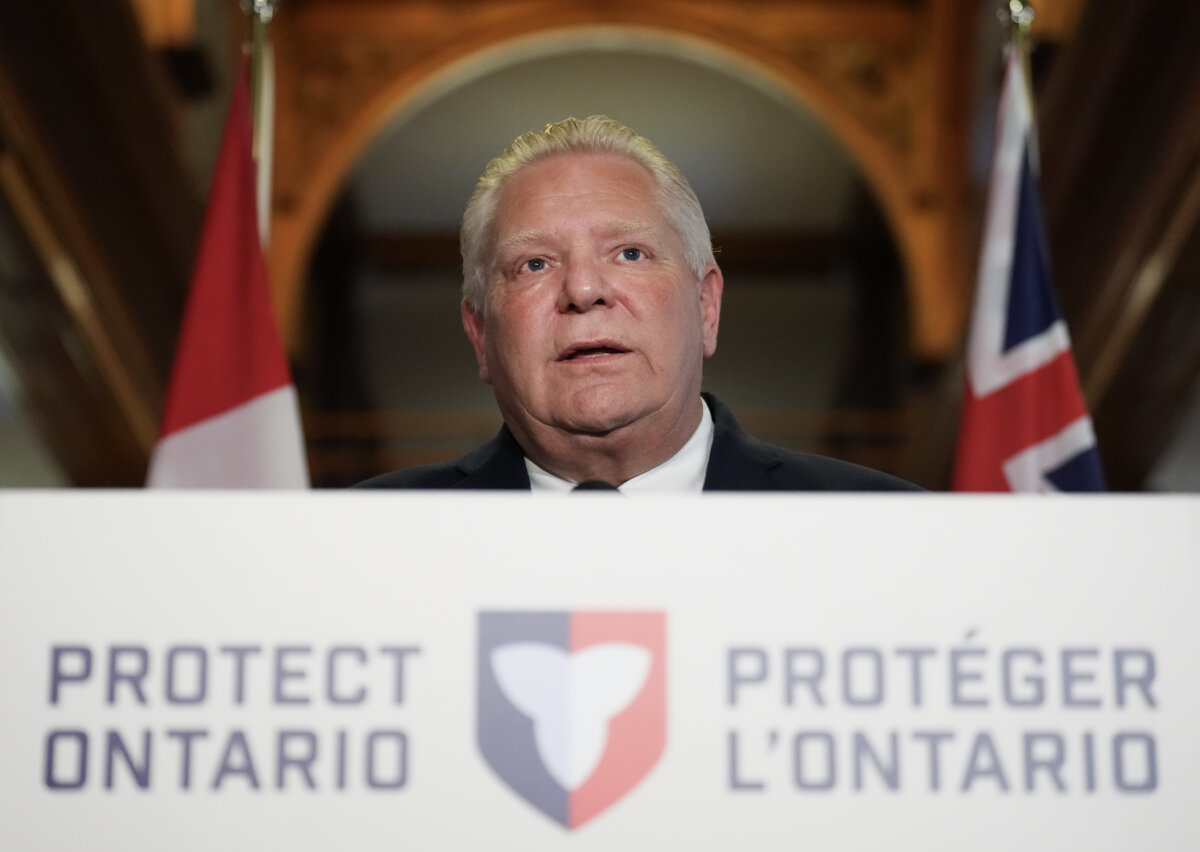
“I thought we had a good enough relationship that you give me a quick text or a little bit of communication. That never happened,” Ford said while speaking to reporters at Queen’s Park on Jan. 19.
“I’m disappointed because we had such a great relationship, and I look forward to continuing a great relationship, but it’s all about communication and collaboration and partnership,” he added. The Prime Minister’s Office was contacted for comment but didn’t respond.
Ford said it was Internal Trade Minister Dominic LeBlanc who advised him of the deal with China on EVs. In exchange, Ottawa said China will be dropping some of its tariffs on Canadian agricultural and seafood products.
Speaking at an event hosted by the Rural Ontario Municipal Association earlier on Jan. 19, Ford also commented on the EV deal, saying he and car manufacturers had only heard about it a “few hours” before it was announced.
“So much for the partnership,” Ford said, who has worked with Ottawa to mitigate the impacts of U.S. tariffs on the Canadian car industry.
The impacts of U.S. tariffs have already been felt in the province, with different Ontario plants laying off workers and moving production down south.
Global Carmakers of Canada, an industry association representing non-U.S. auto brands in Canada, said Ottawa’s China deal “risks creating significant market distortions.” The group said though the deal could bring “short term price relief” for consumers wanting to purchase EVs, it could “ultimately limit consumer choice and undermine the viability of the companies currently investing in and supporting Canadian jobs.”
Ottawa is trying to bring lower-priced EV options to the market as it intends to ban the sale of new gas cars by 2035. The Carney government in September announced a pause of its EV mandate targets for 2026 and a 60-day review of the policy amid U.S. tariffs and pressure from the automotive industry.
Ottawa said shortly after it has no intention of dropping the mandate altogether, as it pursues a net-zero emissions agenda, and is instead seeking to increase domestic production and importation. Details of the EV mandate review have yet to be released.
China Trip
Carney has sought to deepen ties with Beijing in a bid to boost non-U.S. exports and attract new investments in Canada. After years of frosty ties over Ottawa’s concerns that Beijing was becoming an increasingly “disruptive” power, the prime minister last week declared a “new strategic partnership” with China.
Carney called China’s strengths in the EV sector “undeniable,” saying it produces the “most affordable and energy efficient” vehicles.
“In order for Canada to build our own competitive EV sector, we need to learn from innovative partners, access their supply chains, and increase local demand,” Carney said in announcing he will allow up to 49,000 Chinese EVs in Canada at 6.1 percent tariff rate. The quota will increase to 70,000 within five years, he added.
Carney also said he expects Chinese car companies will make investments in Canada and the plan is for them to open plants, but no specific details were announced.
This aspect was part of Ford’s initial criticism of the deal on Jan. 16. He said Ottawa is inviting a “flood” of “cheap made-in-China” cars into Canada without obtaining any real guarantee there will be good returns for the domestic economy.
Carney reacted to that criticism during a press conference in Qatar on Jan. 18. He said a key focus of the deal is to bring more affordability to the Canadian EV market and that 49,000 vehicles represents less than 3 percent of total annual vehicle sales in Canada.
Ford touched on these aspects on Jan. 19, noting that 49,000 vehicles is equivalent to a third of all EV sales annually.
Statistics Canada reported there were 45,366 new zero-emission vehicles registered in the third quarter of 2025 (Q3-2025), or 9.4 percent of all new motor vehicle registrations in the country.
If the Chinese EVs eventually shipped to Canada are mostly battery-electric (BEV), they could end up taking an even larger chunk of that specific market. StatCan noted 26,792 new BEV registrations in Q3-2025.
Ford also cast doubts on purported Chinese intentions to set up factories in Canada, saying that car manufacturers have to produce 220,000 vehicles a year to break even. He added he doesn’t see how the United States would allow these China-linked vehicles to be imported from Canada given security concerns.
“Guess what folks, 80 to 90 percent of those vehicles [produced] go south of the border, so I’m not too sure if [U.S. President Donald] Trump wants Chinese spy vehicles coming across the border, but I’m betting the answer is no,” Ford said.
The issue has been bipartisan in the United States, with the Biden administration initially slapping Chinese EVs with a 100 percent tariff in 2024. In the last days of the administration in early 2025, it announced new rules for the content of vehicles to prevent countries like China and Russia from leveraging integrated cameras, microphones, GPS and other technologies.
“Connected vehicles yield many benefits, but software and hardware sources from the [People’s Republic of China] and other countries of concern pose grave national security risks,” said then-National Security Advisor Jake Sullivan.
Trump last week, while visiting a Ford plant in Michigan, said the high tariffs on Chinese EVs are necessary to protect the local industry. He pointed to the car market in Europe, which has lower tariffs, seeing increased encroachment by Chinese carmakers.
 Friends Read Free
Copy
Facebook
Tweet
Friends Read Free
Copy
Facebook
Tweet