
The federal government has reduced the pool of candidates for constructing the navy’s new submarines to a German company and a South Korean firm, as part of its plan to bolster Canada’s defence capabilities in the Arctic.
German company Thyssen Krupp Marine Systems and Hanwha Ocean Co. in South Korea were identified in an Aug. 26 announcement by Ottawa as qualified suppliers for its Canadian Patrol Submarine Project (CPSP), an initiative that aims to procure up to 12 new submarines that will be deployable in the Arctic.
“The Canadian Patrol Submarine Project, in collaboration with TKMS and Hanwha as the 2 qualified suppliers, is an opportunity to work with allies and strengthen our defence industrial capacity,” Procurement Minister Joël Lightbound said in an Aug. 26 press release. “This is a critical step toward equipping the Royal Canadian Navy with next-generation capabilities our Navy needs to protect our sovereignty and support our allies.”
The department says the decision to identify the two companies as qualified suppliers was based on an evaluation of construction and delivery schedules for Canada’s new submarine fleet, which will feature enhanced range and endurance to ensure “stealth, persistence and lethality,” according to the press release.
While the government has said Canada’s current submarine fleet will remain operational into the mid-to-late 2030s, it added it is “prepared to move quickly” to have the first Canadian patrol submarine no later than 2035.
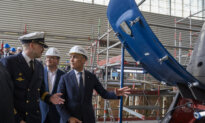
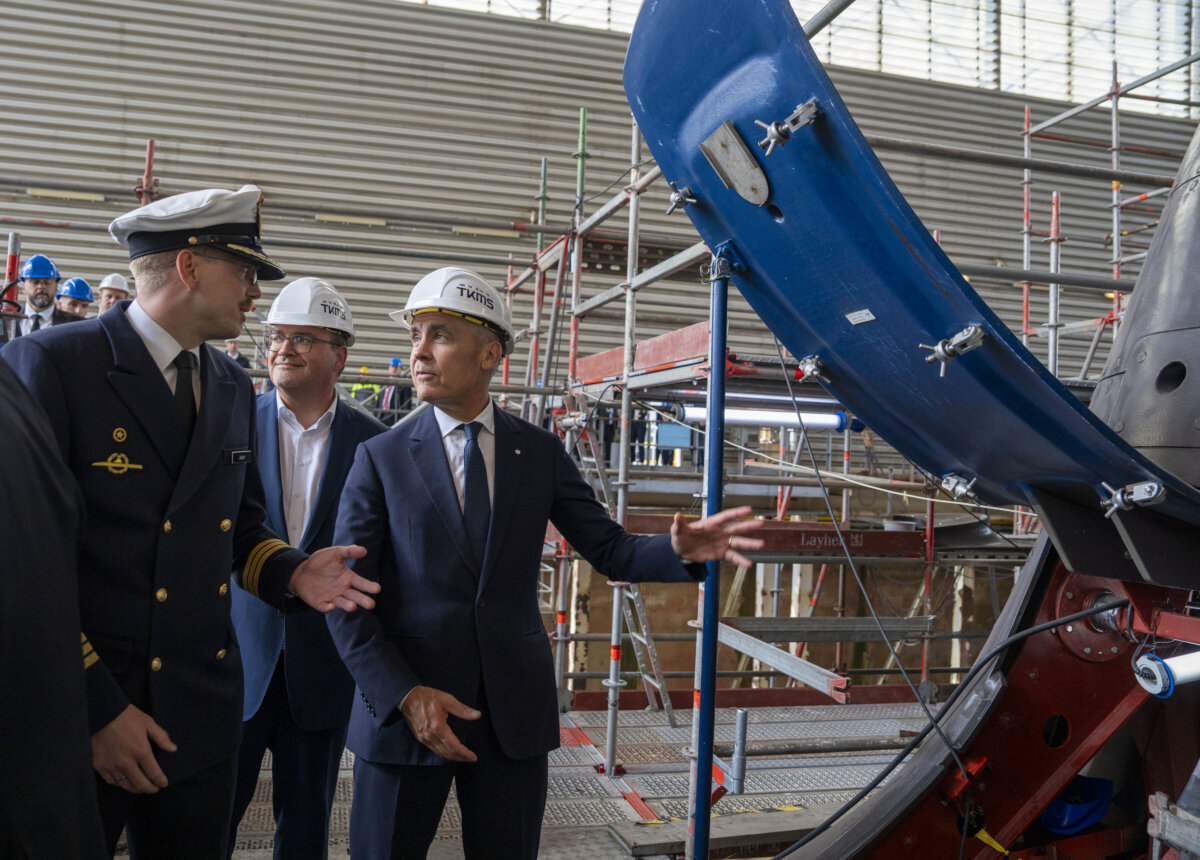
Prime Minister Mark Carney visited the TKMS shipyard in Germany on Aug. 26, and said he was set to visit the Hanwha shipyard in South Korea in October.
Carney told reporters both of the companies meet Canada’s technical requirements for its new fleet of submarines that will travel under ice in the Arctic waters as well as in the Pacific Ocean.
“We need to be able to have year-round fleets in all three coasts under quite demanding conditions,” Carney said. “Our government will be spending, rightly, a great deal of money to make our citizens more secure, to make the world more secure.”
Canada initiated its submarine project in 2021 to procure as many as 12 underwater vessels for the Royal Canadian Navy. The initiative seeks to bridge gaps in Canada’s submarine capabilities, allowing the nation to effectively patrol its three oceans and contribute to international security.
Canada’s existing submarine fleet consists of four Victoria-class submarines acquired from the United Kingdom’s Royal Navy in 1998 and are no longer deemed sufficient for Arctic missions.
Ottawa issued a request for information (RFI) to industry stakeholders in September 2024 which remained open until February 2025. The purpose of the RFI was to gather information about the availability of submarines that are either currently in service or in production, as well as to assess the industry’s capacity to construct and deliver up to 12 submarines to Canada. A total of 25 responses to the RFI were received by the federal government.
Thyssen Krupp Marine Systems produces HDW Class 209, Class 212A, Class 214, and Class Dolphin submarines, which feature diesel, electric propulsion. Hanwha Ocean Co. produces KSS-III Dosan Ahn Changho-class non-nuclear submarines that are similarly powered by diesel and a Korean fuel cell system.
Under-Ice Operations
Former Prime Minister Justin Trudeau last year released the “Our North, Strong and Free,” a renewed defence policy update that placed focus on protecting Canadian sovereignty in the North and included billions of dollars in NATO spending. The plan included the replacement of Canada’s current fleet of submarines with new conventionally powered vessels.
Other Canadian allies, such as Australia, have been in the process of renewing their submarine fleets, but have chosen the nuclear option. AUKUS, a U.S.-led security partnership with the United Kingdom and Australia was established in 2021 and focused on developing nuclear-powered submarines for Australia. Canada was excluded from the partnership.
Trudeau explained Canada’s exclusion at the time by saying the country was not in the market for nuclear submarines. Nuclear submarines are considered to be more suitable for patrolling beneath the Arctic ice due to their extended range.
Meanwhile, last year Trudeau said Canada was considering joining the second phase of AUKUS, the non-nuclear element of the security partnership, which includes technology sharing and increasing interoperability between the countries’ armed forces.
Trudeau said it was important for allies across the Indo-Pacific to work together and noted that Ottawa was looking into what type of submarines, including nuclear, were “most appropriate” for Canada’s defence in the Arctic.
Jennifer Cowan contributed to this report.
 Friends Read Free
Copy
Facebook
Tweet
Friends Read Free
Copy
Facebook
Tweet